
Rowan County teens make astronomical discovery
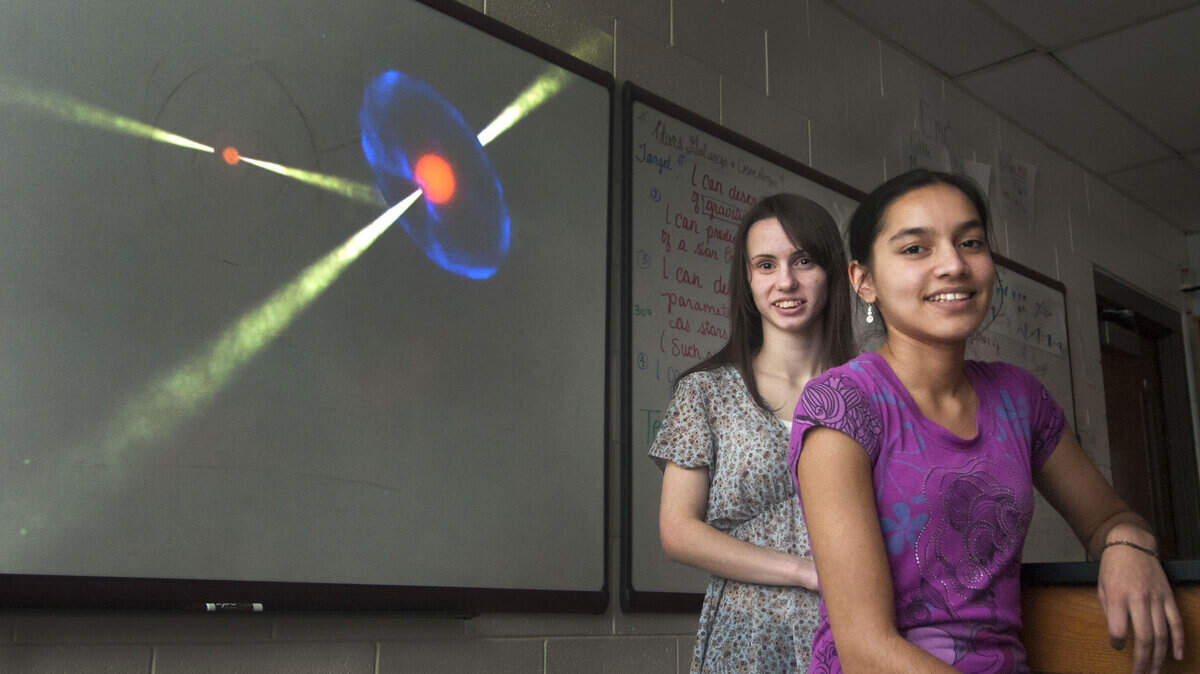
Two Rowan County Senior High School students participating in a national science research project have discovered two tiny but powerful astronomical objects called pulsars hundreds of light-years from Earth.
Astronomers say the girls' discoveries, rare for students still in high school, eventually could aid scientists in probing one of the most profound secrets of the universe.
Jessica Pal, 15, a sophomore at Rowan County High, was at home Jan. 13 — it was a snow day — spending her time poring over radio telescope data from deep space. She noticed in all the clutter what appeared to be the signature of a pulsar. Soon afterward, observations by the National Radio Astronomy Observatory at Green Bank, W.Va., confirmed that Pal indeed had identified a previously unknown pulsar.
Pal's big moment came almost exactly a year after her friend and classmate, Hannah Mabry, then a junior at Rowan County, also spotted a suspected pulsar signature in similar radio telescope data. The West Virginia observatory confirmed that Mabry had identified a pulsar.
Both girls were able to visit Green Bank and participate in the radio telescope observations that ultimately confirmed their respective pulsar discoveries.
"It was awesome," Pal said last week.
Pal and Mabry were participating in the Pulsar Search Collaboratory, a national project that gives high school students a taste of basic science research by allowing them to help comb the cosmos for signs of pulsars. With luck and diligence, young participants can do real research and, possibly, locate objects trillions of miles away.
About 600 students, mostly in the eastern United States, are participating in the collaboratory, sponsored by West Virginia University and the Green Bank observatory, and supported by the National Science Foundation.
Mabry and Pal became involved through the pulsar astronomy class at Rowan County High taught by Jennifer Carter. It's one of several science classes Carter teaches to help prepare Rowan County students for admission into Morehead State University's Space Science Center.
Carter notes that of the five pulsars identified by the Pulsar Search Collaboratory, two were spotted by her students.
Officially, Pal and Mabry are listed as co-discoverers with some collaboratory student participants in other states who identified the same pulsars at essentially the same time. But they're the only Kentucky students to make such discoveries.
"What's really cool is that we have two students who discovered millisecond pulsars almost a year apart," Carter said.
Millisecond pulsars spin at incredible speeds. Pal's pulsar, for example, spins more than 300 times a second.
Because of their spin and other bizarre properties, millisecond pulsars are good tools to help scientists search for so-called gravity waves, which are ripples through space-time predicted by Albert Einstein's general theory of relativity. Tiny fluctuations in the pulses of pulsars could indicate they've been affected by passing gravity waves.
No waves have been directly seen. But identifying more millisecond pulsars gives researchers more opportunities to spot them.
Trouble is, professional astronomers don't have time for the arduous work of going through mountains of archived radio telescope data to look for pulsar signatures. So, a few years ago, officials at the Green Bank observatory decided to recruit high school students to help. The result is the Pulsar Search Collaboratory.
Participating students may go online and sift through huge collections of raw data from the Green Bank radio telescope, looking for signatures that might indicate the presence of millisecond pulsars. Students are trained by their teachers in what to look for.
"When we started, we didn't know whether high school kids could do it or whether it would even be interesting for high school students," said Sue Ann Heatherly, chief investigator for the pulsar collaboratory. "But they take the data very seriously. They've done a great job, and that's why these discoveries have happened."
Students who spot likely pulsar signatures report their "plots" to Green Bank. If a plot looks right, astronomers train the Green Bank radio telescope on that point in the sky to determine whether it's really a pulsar or just man-made radio interference.
The plots Mabry and Pal sent were right on the money.
"I started jumping up and down and screaming where everybody could hear me," Mabry recalled. "When I told them what had happened they were like, 'That's cool.' "
Mabry was invited to Green Bank a few days later to help conduct the observation that confirmed her discovery.
"When it showed up on the screen, seeing it right there in front of me, that was the cool part," she said. Mabry said the screen showed only "numbers and graphs ... but it was the most beautiful picture I'd ever seen."
Pal recently told Universe Today, an online science publication, that "when you discover a pulsar, you feel like you're walking on air. ... It's wonderful to know that there is something out there in space that you discovered."
Mabry and Pal plan to study science after high school. Mabry, a senior this year, has received an undergraduate research fellowship from Morehead State University, the first MSU has awarded. Both girls credit Carter for sparking their interest in science.
Meanwhile, Carter herself has been selected to participate in a NASA science project later this year. She and other educators will help perform infrared astronomical observations from a flying laboratory.
Meanwhile, the pulsar search goes on. Carter says that another of her students has identified a plot that might turn out to be a pulsar.
This story was originally published February 5, 2012 at 6:13 PM with the headline "Rowan County teens make astronomical discovery."