
Review: 'The Hot l Baltimore' by Project See Theatre
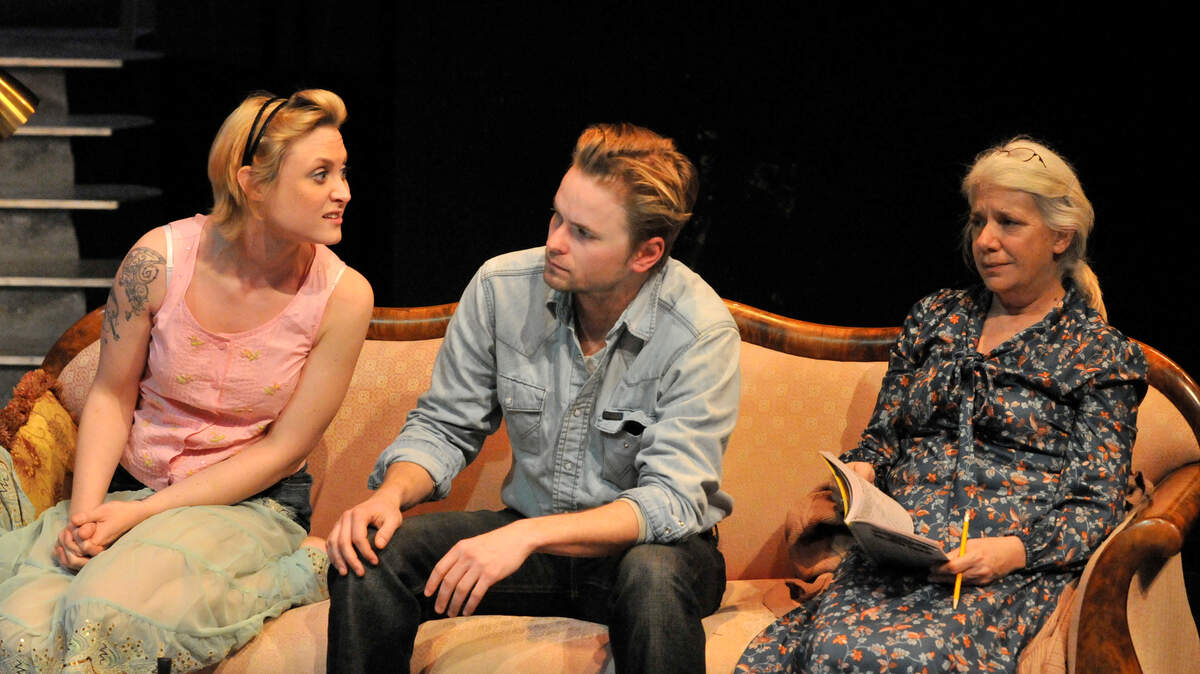
When Landford Wilson's The Hot l Baltimore opened in 1973, it was not a period piece. It was a contemporary slice of life — albeit a seedy, derelict, fading life, like the hotel itself and the characters who inhabit it.
When the play debuted, it spoke to the decay of a golden age of America and the rubble of the modern life replacing it.
Forty years later, Project See Theatre's production of Wilson's acclaimed script has the benefit of an audience looking backward in time, viewing the hotel and its motley inhabitants with twenty first century eyes, and the effect is haunting, poignant, and a little heartbreaking.
Project See's set designs are often on the minimal side, but since the ailing hotel is practically a character itself, lighting and set designer Mike Sanders went all out in creating a multi-tiered set complete with marble floors and antique fixtures, both reminders of the hotel's glamorous past.
But the building's former glory is just a ghost. With 70s tunes cranking out of a hulking radio, rotary dial phones, and ash trays in the lobby, the hotel is now a dilapidated flophouse. Slated for demolition, it is a pay-by-the-week refuge for society's outcasts, full of the marginalized, the very young or very old, drifters and prostitutes. The water is cold, the elevators broken, the "e" is missing from the marquee and its front lobby has become the stage for an ongoing dysfunctional living room drama, with characters entering and exiting with a kind of predictable randomness.
While the play literally begins with a wake up call, there is little conventional structure to the plot, and this might be unnerving to folks who expect a beginning, middle and end. But Wilson's script is atypical on purpose. There is no resolution to most of the conflicts within and among the show's dozen or so characters because that is how they experience life. They simply must go on, each day, making what meaning they can for themselves as they go along.
Director Evan Bergman skillfully cultivates the biographical and emotional intricacies of Wilson's complex characters, who collectively represent a cross section of modern maladies. The character's interactions are particularly well choreographed, and at times overlap, with different shouting matches erupting at the same time. It's okay that you can't hear everything everyone is saying all the time. The point is not necessarily what they are saying but how they are colliding, attacking each other before making small truces and later coming together as a group before breaking apart again.
Perhaps the play is best appreciated as a character study. Bergman's casting is spot on, and it is really enjoyable to see such variety in his choices. From Heather Porter as the wistful idealistic young prostitute who can't decide what her name should be to Lauralyn Hungerford as the retiree who never quite belonged in the world, the performers have created compelling, memorable characters. Even though their interactions never steer the audience toward the kind of resolution we are used to, their interrelationships are fascinating nonetheless, and reveal the social architecture behind the family room of vagabonds that the hotel lobby has become.
Take Nick Swarts as Jaimie, a kind of simpleton bossed around by his domineering sister Jackie, played by Lillie Ruschell. The pair have a dream to run an organic farm but learn that land they purchased out west is an infertile desert. When Jackie goes for gas and never comes back, the abandoned Jaime takes refuge in the hotel lobby and is comforted by April, a hardened prostitute played by Leah Marie McDivitt. What will become of Jaime tomorrow? Will the hotel really be torn down? Wilson doesn't tell us. For now, they just drink champagne, dance in the lobby, and wait for tomorrow's wake up call.
This story was originally published March 5, 2012 at 2:52 PM with the headline "Review: 'The Hot l Baltimore' by Project See Theatre."