
Review: 'Bengal Tiger at the Baghdad Zoo' by Balagula Theatre
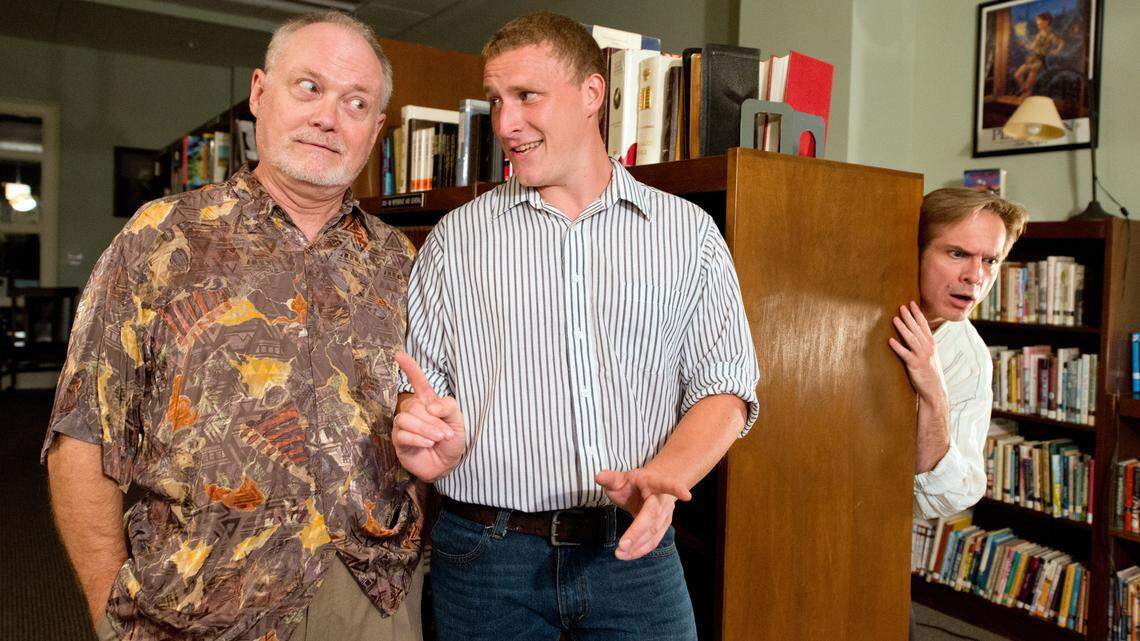
Rajiv Joseph makes one thing clear in his Pulitzer-nominated play Bengal Tiger at the Baghdad Zoo: war creates ghosts, at least, metaphorically speaking. And literally speaking, the lives of those affected by war (soldiers and civilians alike) are haunted forever.
The play centers on a real-life incident Joseph read in the back of a newspaper in 2007. A soldier in Iraq shot and killed a tiger in the Baghdad Zoo that had bitten off another soldier's hand. The incident inspired Joseph to develop the play, which became a Broadway hit in 2011 with Robin Williams starring as the tiger.
Directed by Joe Ferrell, Balagula Theatre's production of one of the most important American plays of the 21st century so far is a gripping exploration of the brutal effects of war on not only the human psyche, but all of creation's. For the tiger, too, suffers unwittingly, first as a prisoner in a cage at the zoo, and later as the ghost who paces the afterlife searching for meaning, for God, for forgiveness, for something, anything, that makes sense.
Adam Luckey and Zach Dearing, playing soldiers Tom and Kevin, set the darkly jarring (and sometimes darkly funny) tone for the show in its opening scenes while standing guard at the Baghdad Zoo, trading profanity-laden barbs. Luckey masterfully portrays the veteran who has seen action, including the capture and execution of Saddam Hussein's sons. He is focused and capable, and whatever parts of him that are rattled are sublimated to the one good thing he's salvaged from war: gold. Tom looted Uday Hussein's house, scoring a gold handgun and gold toilet seat, and that gold is presumably his ticket to a better life.
Dearing's portrayal of Kevin, who is new to the war, jittery, and overly eager to prove himself, is, among other things, a complex study in the extreme coping mechanisms of soldiers. From continually spewing slang and profanity to hyper masculine posturing to eventually losing his mind, Dearing's Kevin is not a violence-hungry meathead, even if he poses as one; he's frightened, confused, haunted, and later, haunting, and it turns out that almost everybody else is too. It's how those feelings are handled that differentiate the characters' plights.
Take Beau McGhee's character Musa, an Iraqi interpreter working for the Americans. Continually called the wrong name by American soldiers who simply see him as a "terp," Musa is actually an accomplished gardener, an artist even, who carved elaborate topiaries of animals for the sprawling garden of Uday Hussein (played with relish by William Harmon), who also appears as a bullet-riddled ghost haunting Musa. Musa is trading a hellish life working for Hussein, who raped and killed Musa's sister, for a hellish life working for the Americans, where he cannot stop, only attempt to lessen, the damage to his own people.
A significant portion of his lines, as well as supporting Iraqi characters played by Suraya Shalash and Stephanie Pistello, are in Iraqi Arabic, which serves to underscore how the bewildering and easily mistaken attempts to communicate can quickly deteriorate into deadly misunderstandings.
Laced throughout all of these characters' interactions is the Tiger's intermittent, anguished pacing through the afterlife as the conscience of the show. Wearing shabby striped clothes, Joe Gatton's Tiger juxtaposes the majesty and musculature of the creature's nature with the pitiful yearning for answers in the afterlife in multiple, exquisitely wrought monologues (or in some cases dialogues between himself and God). A tiger begging forgiveness for being a tiger, for killing and eating flesh, including human flesh, is somehow pitifully striking.
Scenic projections by Andrew Connerly provide visual reference to 2003 Baghdad, Uday Hussein's garden and a haunting image of the fierce stare of a tiger. Musical composition by Rob Thomas underscores the bleak yet other worldly atmosphere punctuated by understated scenic and lighting design by Russell Mendez.
A deeply thought-provoking, haunting production, Bengal Tiger at the Baghdad Zoo provides fresh insight into a 21st-century version of an age-old horror: war and all that dies and won't die in its wake.
This story was originally published April 16, 2015 at 9:00 AM with the headline "Review: 'Bengal Tiger at the Baghdad Zoo' by Balagula Theatre."