
Maggots help ex-soccer player get leg up on life
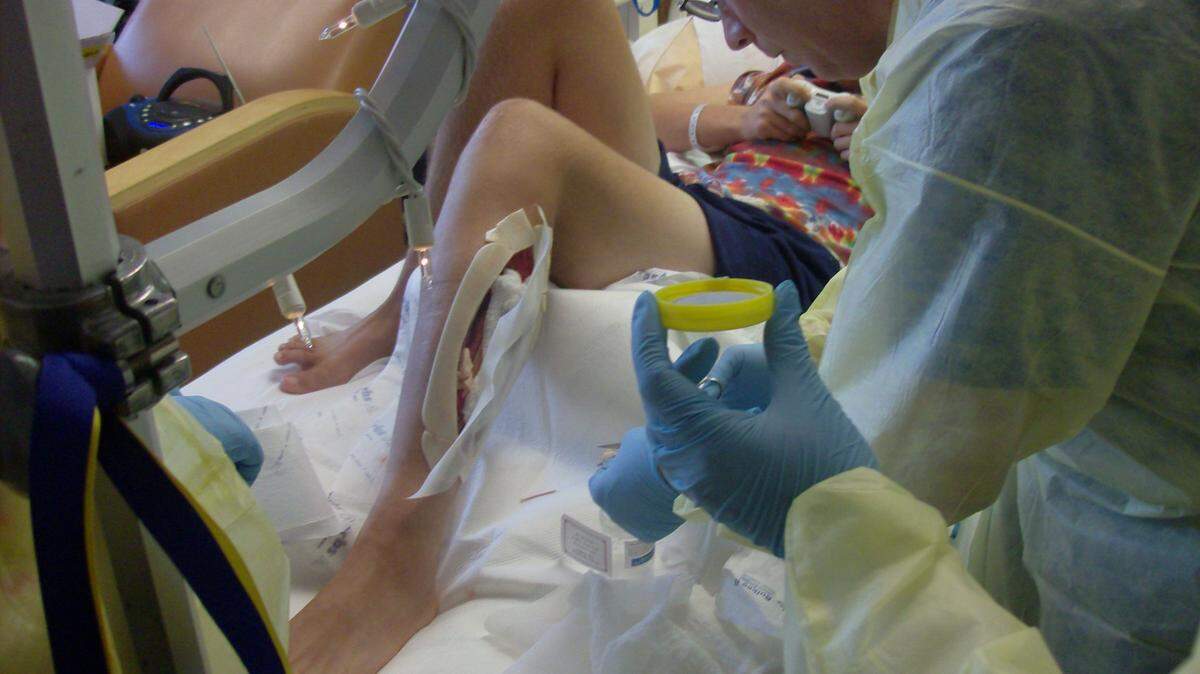
When the maggots started to escape, Dylan Newton knew he'd had enough.
The Sayre High School soccer star had stoically tolerated many things in the previous three weeks: two broken bones in his leg, multiple surgeries and skin grafts, a wound vacuum attached to him constantly.
He'd lost track of what day it was because he'd been in a hospital bed for so long.
But the rogue medical maggots, rarely used on humans but helpful in his particular case, were the breaking point for Newton.
More than 800 of them were placed in an open incision in his leg to feast on his dead muscle tissue.
The doctor had built them a custom cage with a mesh cover. But after several days, the maggots ran out of food and started to depart the cage, irritating his healthy skin.
That's when he came undone from the terrible tickling, creepy, crawly sensation.
"I couldn't deal with it anymore," he said. "I'd been up all day long and all night long flipping out."
His parents, including his father, Chris, who uses maggots in his equine veterinary practice, sprang to action.
In the middle of the night, pajama-clad Chris and Carrie Newton aided by two nurses at Saint Joseph East, cleaned out hundreds of maggots from Dylan's leg.
"It's not exactly what you want to be doing in the middle of the night," Carrie Newton said.
"They were coming off the bed. You had to drown them in alcohol to kill them."
Being the middle of the night, any of the participants might have mistaken this for a bizarre nightmare.
But it was real.
They were all there as a result of a soccer field collision on Sept. 29, 2009, that would not only alter the rest of their year, but Dylan's life — in both good ways and bad.
Unimaginable injury
Before the nightmare, it had been a near-perfect senior season for Dylan at Sayre.
In 12 games, he had team bests of 12 goals and 14 assists. The Spartans, not always a soccer power in this soccer-rich city, were 7-2-5 and had advanced to the All "A" Cup in Frankfort.
Exactly a year ago Wednesday, the weather was a lot like it is now, starting to get cool, and the Spartans were at Tates Creek to play an important district game.
Dylan, who had spent the previous weeks visiting colleges where he planned to play soccer, raced toward a ball. He could see both the ball and the goal in front of him.
He took one step too far, one touch too long.
The Tates Creek goalkeeper was charging for the same ball at the same time, and his body crashed into Dylan's extended left leg.
Sayre Coach Joe Porter said it wasn't a dirty hit, just two players going after a 50-50 ball as hard and fast as they could.
But that hit left all 6-foot-3, 195 pounds of Dylan Newton on the Tates Creek turf.
He tried to pick his leg up, and it "just hung there," he remembered.
Newton, a laid-back, dry sort by nature, turned to his teammates around him and said: "Hey, guys, I think I broke my leg."
He wasn't sure because he couldn't feel it anymore.
His parents, who had attended Dylan's soccer games since he was barely older than a toddler, knew immediately something was wrong.
"It was surreal," Carrie said. "I've been watching him play soccer his whole life and never imagined anything like this could happen."
The ambulance arrived and took him to Saint Joseph East.
'Horrific' pain
A family friend, Dr. Gregory D'Angelo, met the Newtons at the hospital.
The sports medicine specialist told the family Dylan had a broken tibia and fibula. The next morning he placed a rod and four screws in the player's leg.
Carrie Newton wasn't worried. She told herself: "We're going to stick the rod in his leg, put some screws in there, then we'll take him home for some rehab for a few weeks and he'll be back up being Dylan."
Her time frame was a little off.
Dylan took a turn for the worse and was struck by blinding pain.
"He was comfortable, and we were thinking we'd send him home the next day, and when I came in to see him on Friday morning, he didn't look good," D'Angelo recalled. "The pain was evident. There was more swelling. I said this isn't right at this late stage."
Dylan had a complication called compartment syndrome. If it hadn't been caught when it was, he might have lost part of his leg.
"The statistics are not good for a late compartment syndrome decompression," D'Angelo said, noting there's close to a 50 percent amputation rate in those cases.
It's a complication most common in high-velocity fractures like from automobile accidents. The compartments that contain the muscle — described by one doctor as protective Saran Wrap — can handle no more swelling and the blood flow to that area gets cut off, killing the muscle and healthy tissue around it.
If too much muscle dies, so does use of the leg.
"It's just one of those dreaded complications," D'Angelo said. "It's something that can happen, but not frequently, thank goodness."
The only way to relieve the pressure is a fasciotomy, cutting open the muscle covering, which they did on both sides of Dylan's lower leg.
Dylan winces even months later as he describes the pain of trying to stand up after the procedure.
"All the blood rushed down there, and it felt like my skin was on fire, like it was being ripped apart," he said.
It took him three hours to get out of bed.
"The pain, hours upon hours of it, that you'd never want to watch your child go through," Carrie said. "There were just horrific episodes of pain."
Still unable to run
To save Dylan from having to undergo even more surgeries (he's had eight in all and probably will have two more in the next year or so), which might have also meant the loss of more healthy tissue in the leg, his father suggested using the maggots.
Dr. William O'Neill, who worked on Dylan's case, had used leeches plenty of times, but never maggots. He researched the procedure, consulted with other doctors, but none had experience with them.
Some hospitals around the country had used them, but this is the first instance here, he believes.
Even though the crawling and the creeping of the medical maggots took Dylan to the edge, they did their job and helped him heal.
They weren't the only ones who aided in Dylan's healing.
By the end of October, his hospital room looked more like a dorm room, filled with young people constantly.
"At the hospital, there were always 15-20 people in there," Dylan said. "It was crazy how many people were there for me."
Carrie hung Christmas lights over his bed so he wouldn't be annoyed by overhead florescent bulbs. The family posted some 100-plus cards on the wall along with pictures and posters.
Sayre set up Skype video phone service for him at the hospital so some of his school friends even got to watch a live wound vacuum change via the Internet.
The doctors were impressed with Dylan's ability to persevere through it all.
"To go from being a high school senior athlete at the most exciting time of your life and all of a sudden you're relying on people to take you to the bathroom, things change quite a bit for you," O'Neill said. "Getting used to it is hard, but he's handled it well."
The player who had been traveling to colleges and talking to coaches about playing soccer a week before his injury is still dealing with the reality that he will never play competitively again.
At school now at Birmingham-Southern College in Alabama, Dylan goes and watches players who should have been teammates play. He misses soccer.
"I'd play again in a heartbeat if I could," he said. "They've tried to say it's possible, but it's slim."
He lost strength in much of the muscle that strengthens the ankle and allows Dylan to raise his foot, the doctors said. That muscle is important in flexing, running, going up stairs and kicking a soccer ball.
A year later, Dylan said he is not in much pain, but he's still unable to run.
New start
Dylan's leg will never look the same as it did that day on Sept. 29. Two long, vertical scars are a constant reminder to him of what happened. One scar hasn't fully closed and still drains.
At college, Dylan gets questions about the wounds, but he doesn't mind.
"I don't care at all," he said. "I get stares, but whatever."
He probably has more knowledge to explain them than most patients.
After his incident, he decided to do his Sayre senior internship at Bluegrass Orthopaedics and Hand Care, where D'Angelo and O'Neill practice.
For more than a month, Dylan got to see other people with scars like his. It has fueled his desire to go into sports medicine.
He got to follow the doctors as they met with patients. He's seen surgeries and is fascinated by them.
"It's cool to see the patients recovering," he said. "I've learned a ton just from watching."
He knows that if he does become a doctor he'll be better at it having gone through the past year.
"I'd definitely know how they feel," he said of his patients. "It sucks to be hurt, especially when you're an athlete, because you expect your body to be able to do things and then it can't anymore. ... Until you've been through it, you just don't know."
This story was originally published September 29, 2010 at 12:00 AM with the headline "Maggots help ex-soccer player get leg up on life."