
Visiting Harper Lee's Alabama hometown
MONROEVILLE, Ala. — Monroeville, on the edge of Alabama's Black Belt, is like other small towns in the Deep South with its central square and courthouse, ringed by a collection of buildings housing cafes, a book store and a post office. But unlike most, this sleepy burg can lay claim to a bevy of famous folks.
Crazy in Alabama author Mark Childress, nationally acclaimed educator Marva Collins and Pulitzer Prize-winning columnist Cynthia Tucker were born here; William Barrett Travis, Commander of the Alamo, practiced law here; Hank Williams regularly hopped midnight freight trains from Monroeville on his way to playing juke joints in Mobile, and author Truman Capote, though born in New Orleans, visited relatives here every summer.
No one, however, had more impact on Monroeville than native daughter and To Kill a Mockingbird author Harper Lee. Monroeville became her fictional Maycomb, a place she described as "an island in a patchwork sea of cotton fields and timber land."
The overwhelming success of her Pulitzer Prize-winning novel about principled lawyer Atticus Finch and his two precocious children, Jem and Scout, resulted in a cottage industry in Monroeville to the tune of 30,000 visitors annually — five times that of its permanent population of approximately 6,000 people.
The week after my visit, the release of Lee's highly anticipated second novel, Go Set a Watchman, would bring the world's media flocking here. But on this week, I had Monroeville all to myself.
On a late June afternoon, with the magnolias in bloom; the cicadas chirping in concert, and the sun "hot enough to wilt men's collars before nine," I made my way to the town square and the old courthouse.
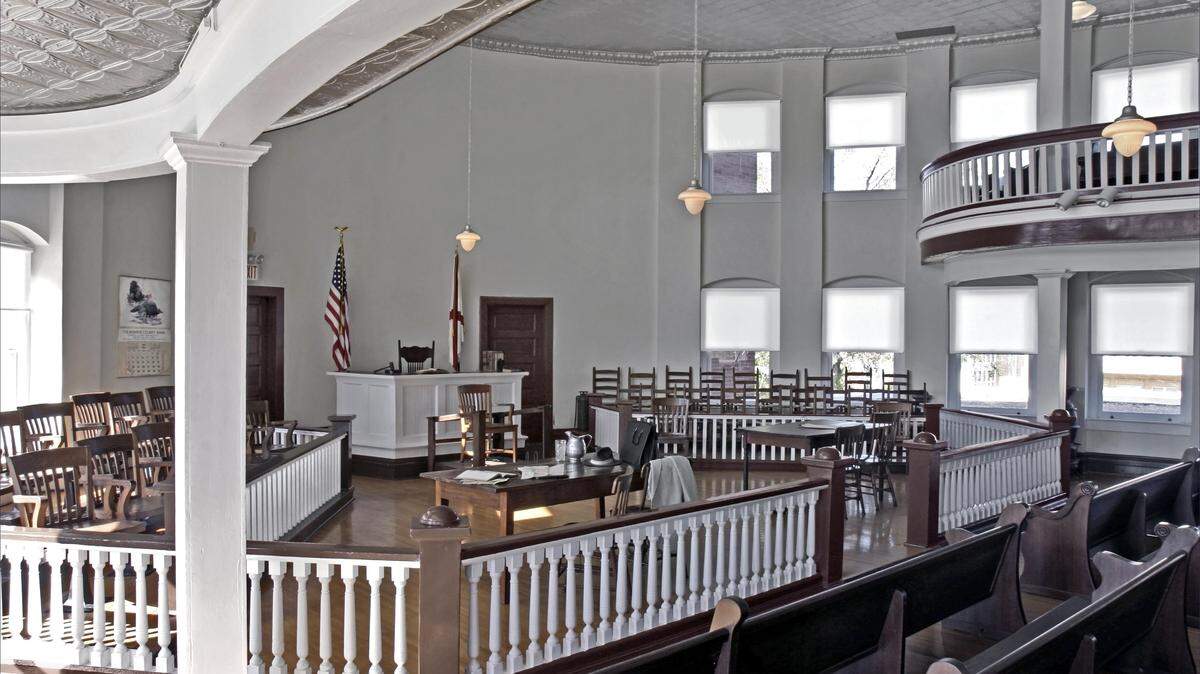
Scheduled to be torn down in the 1960s when a new courthouse was built, it got a last-minute reprieve and functions today as the Monroe County Heritage Museum. It's the first stop for literary pilgrims who make their way to the courtroom, with its gumwood floor and pot-bellied stove next to the jury box, where Atticus Finch defended Tom Robinson, a black man charged with raping a white woman.
As I was on my own pilgrimage, I made my way to the balcony, where during the trial Scout and Jem sat with the town's black community. Standing there, I could almost hear Reverend Sykes whisper to Scout as Atticus left the courtroom, "Miss Jean Louise, stand up. Your father is passin.'"
This courtroom was all too familiar to Nelle Harper Lee, as she is known to everyone in Monroeville. It was here that she snuck off to sit in the balcony and watch her own father, Amasa Coleman Lee, a respected lawyer who became the model for Atticus. Lee was also familiar with the 1933 case of a black man, Walter Lett, accused of raping a white woman, which she used as the centerpiece of her novel.
If you plan your visit to Monroeville from mid-April to mid-May, you can see the annual two-act production of To Kill a Mockingbird which begins in the amphitheater on the courthouse lawn and concludes in the courtroom. Locals play all the major parts, while jury members are selected from the audience.
The rest of the year you'll have to content yourself with taking a self-guided walking tour, showcasing the town as Lee would have known it in the 1930s. You can order a strawberry milkshake at Mel's Dairy Dream and know that you are on the spot which was once Lee's childhood home.
You can visit the cemetery where both Amassa Coleman Lee and Son Boulware (the real Boo Radley) are buried. You can stop for lunch at Radley's Fountain Grille, known for its potato soup, a favorite of both Nelle Harper and her late sister Alice.
It was at the restaurant that I met George Thomas Jones, who told me the story of Son Boulware. As a teenager, he was caught stealing a pack of cigarettes from a drug store on the square. His prominent father, to keep him from going to reform school, incarcerated him in his home. Lee was so intrigued by the story of Son that she made him a central character in her novel.
And, of course, there was Dill Harris, the "citified" child who became Scout and Jem's co-conspirator during that fateful summer. There is little doubt that Dill was modeled after Nelle Harper's friend-turned-nemesis Truman Capote.
Jones, a sprightly 90-year-old, was an elementary school classmate of both Lee and Capote.
"Truman arrived in Monroeville to live with relatives when he was four, after his mother Lily May took off for New York," he says. "When she remarried and took Truman there to live, he would still come back to Monroeville to spend his summers."
The Lee house was next door to the Faulk House where Capote stayed with his relatives. Nothing remains of it today except a historical marker honoring the writer and a rock wall that separated the two houses.
Lee and Capote met as kindergartners and kindled a friendship that lasted well into adulthood. They shared a passion for writing and even shared the tools of the trade: a beat-up Underwood typewriter Lee's father had given her and a water-damaged Webster's dictionary that Capote took everywhere.
In the late 1950s, Lee, as yet unpublished, accompanied Capote to Kansas to help with research for his book In Cold Blood — a journey recounted in the Oscar-winning 2005 film, Capote. It was here that the relationship began to unravel. Some say it was because of Capote's resentment that his work never earned him the coveted Pulitzer that Lee later won for Mockingbird.
Others believe it was the different paths they took after finding fame — Lee seeking privacy and solitude and Capote craving the spotlight. Whatever the reason, at the time of Capote's death in 1984, Lee publicly stated she hadn't spoken to him in years.
A town divided
About a mile from Courthouse Square is The Meadows, an assisted living facility, now home to 89-year-old Nelle Harper Lee, who is nearly deaf and almost blind, and if you are to believe many in Monroeville, not in control of her own affairs.
Always notoriously prickly with the press, she has not granted an interview since 1964, and frequently responded to requests for such, not just with a "no," but a "Hell, no," as if to punctuate her disdain. She has relentlessly pursued privacy, and has always had a love/hate relationship with her hometown, exiting Monroeville as soon as she could for New York, just as Jean Louise did in Go Set a Watchman.
Here lies the dilemma: Even in exile, Nelle Harper Lee was Monroeville's claim to fame, placed on a pedestal by a town that reveled in — and benefitted from — her success. Today, that pedestal has become slightly tarnished and Lee has become a polarizing figure.
Some, such as Dr. Wayne Flynt, a professor emeritus of history at Auburn University and one of the few people Lee sees on a regular basis, insists that she is "sharp as a tack" and makes her own decisions.
"No one tells Nelle what to do," says Flynt.
Others feel she puts her trust in the wrong people and is being manipulated, questioning whether she ever intended for a second novel to be published. For years, Lee put that trust (and her literary legacy) in the capable hands of her older sister Alice, an accomplished lawyer who was still practicing at the age of 100.
When Alice died last year at 103, Lee's affairs were taken over by another lawyer, Tonja Carter, a protege of Alice. It was Carter who found the manuscript of Go Set a Watchman in a safe-deposit box where it had gone undiscovered for more than 40 years.
Fairly or unfairly, Carter is seen by many in Monroeville as a sort of Svengali to Harper Lee's Trilby, and where Alice's management style was light-handed, Carter's is litigious; she has filed lawsuits against both Lee's former agent and the museum, which were settled out of court.
The museum, which exists "only to honor Harper Lee and her work," according to its former director, is in a state of flux. Having already taken control of the annual play, Lee (or her representative) has formed a non-profit to take control of the museum as well.
Harper Lee, the woman who once said she wanted to be the "Jane Austen of South Alabama," remains an enigma. To some, she is the best thing that ever happened to Monroeville. To others, she is a woman who turned her back on the town that made her a legend.
This story was originally published August 9, 2015 at 12:10 AM.