
The charm of the retro style of California's Pismo Beach is reason enough to visit
PISMO BEACH, Calif. — My first sight of this small beach community on California's Central Coast resulted in déjà vu — weird, considering that I had never been here.
Then it dawned on me — of course, I had ... countless times, during my pre-pubescent years, watching Frankie Avalon woo Annette Funicello over roasted marshmallows and crashing waves in a string of beach party movies.
It may not have been Pismo Beach specifically where those crazy kids surfed all day — and never changing out of their swim trunks and bikinis, danced all night — but it could have been. This is a place where it's easy to imagine endless summers orchestrated to a Beach Boys soundtrack.
Pismo Beach is unapologetically retro, with tiny 1940s and 50s motor courts instead of chain hotels, and family-run diners right out of American Graffiti rather than homogenized chain restaurants. And herein lies its charm.
Located halfway between Los Angeles and San Francisco, Pismo Beach is light years away in style and lifestyle. Here, along a seven-mile stretch of beach, the California Dream is alive and well.
Easy living is the town motto. Visitors who stroll along its boardwalk or 1,200-foot pier in the early morning hours or at sunset get used to seeing the same locals walking their dogs, and the same surfers carrying their boards.
Price Street, the town's main drag, is lined with restaurants such as Penny's All-American Café (the place to go for breakfast) and Cracked Crab (where the seafood platters are bountiful and the crab bisque is the house specialty.)
Also on Price Street is Tastes of the Valleys, a full-service wine bar serving hundreds of wines by the glass, reminding you just how close you are to Central Coast wineries. On the afternoon my friend and I moseyed in, we felt like we were in a 21st century version of the Old West saloon.
Even in the early afternoon, those looking for liquid refreshment were gathered. Instead of suspicious stares and silenced chatter, however, we were greeted with enthusiastic welcomes and a server bearing a wine flight. There were to be no duels at high noon on this day, just a pleasant afternoon spent with new acquaintances and old wines.
Fun fact: Pismo Beach was once known as the "Clam Capital of the World," and during the Depression, clamshells — signed, dated and endorsed by the Chamber of Commerce — were an acceptable form of currency. Today, due to overharvesting by humans and snacking by sea otters, the clam population is in decline.
Morro Bay
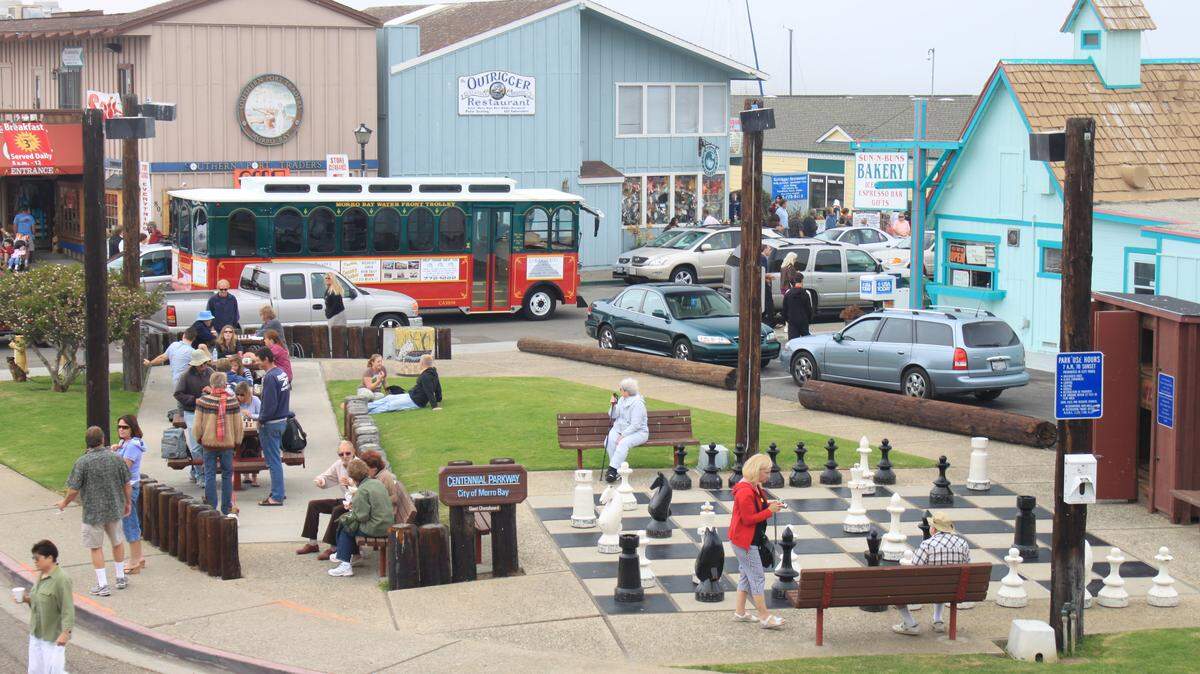
From Pismo Beach to Morro Bay is only a half-hour drive along the spectacular coast, but the two towns are far from being mirror images of one another. While Pismo is folksy, Morro Bay is chic, with designer shops and restaurants that slide a notch up the scale to appeal to a well-heeled crowd (think Nantucket with a California vibe.)
Still, there's nothing pretentious about Morro Bay. It has, as its name suggests, a tranquil bay providing easy access to the Pacific Ocean and a bustling Embarcadero, with a host of boutiques, galleries, antique shops, wine bars and seafood restaurants (the Galley Seafood Grill & Bar is perfect for sunset watching) most with an obligatory view of Morro Bay's most outstanding physical feature.
"The Rock," as it's known to everyone, is a 576-foot volcanic rock that juts up from the ocean and towers over the harbor, visible from nearly every part of the town. It's especially beautiful at sunrise when its craggy outline is burnished with gold, and at sunset when streaks of blue and lavender drape it gently.
One thing you probably won't need in Morro Bay is an alarm clock. If the sun doesn't wake you up, the colony of seals that congregate on a tiny sand spit near the Rock will. They spend most of the day and part of the evening happily chattering away to one another.
Morro Bay is the perfect base for visiting Hearst Castle in San Simeon, about a 35-minute drive up the coast. If you've been to the 250-room Biltmore Estate in Asheville, N. C., then Hearst Castle may seem like little more than a guest house, with its "mere" 165 rooms.
But when you began the long, winding drive up through the rugged Santa Lucia Mountains, and see the mansion perched atop its lofty peak, "castle" seems an appropriate word to describe it. Newspaper tycoon William Randolph Hearst and his San Francisco-based architect, Julia Morgan, started building the castle in 1919, and it took 28 years to complete.
It's a dramatic blend of Spanish and Italian architecture from the 14th through the 16th centuries. The Grand Drawing Room, with its 16th century Italian ceiling, Roman mosaics and medieval Belgian tapestries, was where Hearst and his mistress, Hollywood actress Marion Davies, entertained fellow Tinsel Town elite, Charlie Chaplin, Buster Keaton, Greta Garbo and MGM studio head Louis B. Mayer.
Dinner in the Gothic-inspired refectory with its colorful ceiling flags from Siena, Italy, found Hearst and Davies hosting the likes of George Bernard Shaw and Winston Churchill. After dinner, guests adjourned to the Billiards Room with its Spanish ceiling dating from the time of Christopher Columbus and Persian tiles from Isfahan; or to the 50-seat movie theater.
In addition to his newspaper empire, Hearst was involved in the film industry and was thought to have been the inspiration for Charles Foster Kane in Citizen Kane.
Upon release of what has been called the "greatest film of all time," Hearst was so incensed with the depiction that he forbade reviews of the film in any of his newspapers.
After finishing your tour of Hearst Castle, head a few miles down Highway 1 to the Piedras Blancas Rookery, the largest on the Pacific Coast. Corpulent elephant seals — depending on their energy level — frolic or slumber in the water and on the beach. If you're there on a Saturday, you can tour the nearby Piedras Blancas Lighthouse.
Paso Robles
Heading inland about 35 miles, I arrived in the charming town of Paso Robles, gateway to the Central Coast's wine country. The town itself is well worth a wander, but it's the wineries that are the big draw. If Napa is known for its cabernets and Sonoma for zinfandel, the area around Paso Robles is called the Rhone Zone, with 25 wineries along a 5-mile stretch of Highway 46.
The best way to sample the wineries' offerings is to book a tour with the Wine Wrangler, where your knowledgeable guide/driver will do the driving and you can do the drinking.
Our first stop was Summerwood, which in addition to superlative wines, also has a charming restaurant and nine-bedroom inn. That was followed by tastings at J. Dusi, where winemaker Janell Dusi is the fourth generation in her family to specialize in zinfandels, and Villicana, a boutique winery which produces only 2,000 cases per year, allowing proprietors Alex and Monica Villicana to handcraft each vintage.
That night, my friend and I had a chance to experience some of these excellent wines over dinner at Artisan, whose cuisine is justly described as "elevated farm-to-fork American fare."
Indeed, it was, and just another reason to visit California's Central Coast, blessed by beaches, castles, vineyards and the good life.
This story was originally published November 7, 2015 at 10:00 PM with the headline "The charm of the retro style of California's Pismo Beach is reason enough to visit."