
Statewide broadband project taking shape, with work expected to begin in September
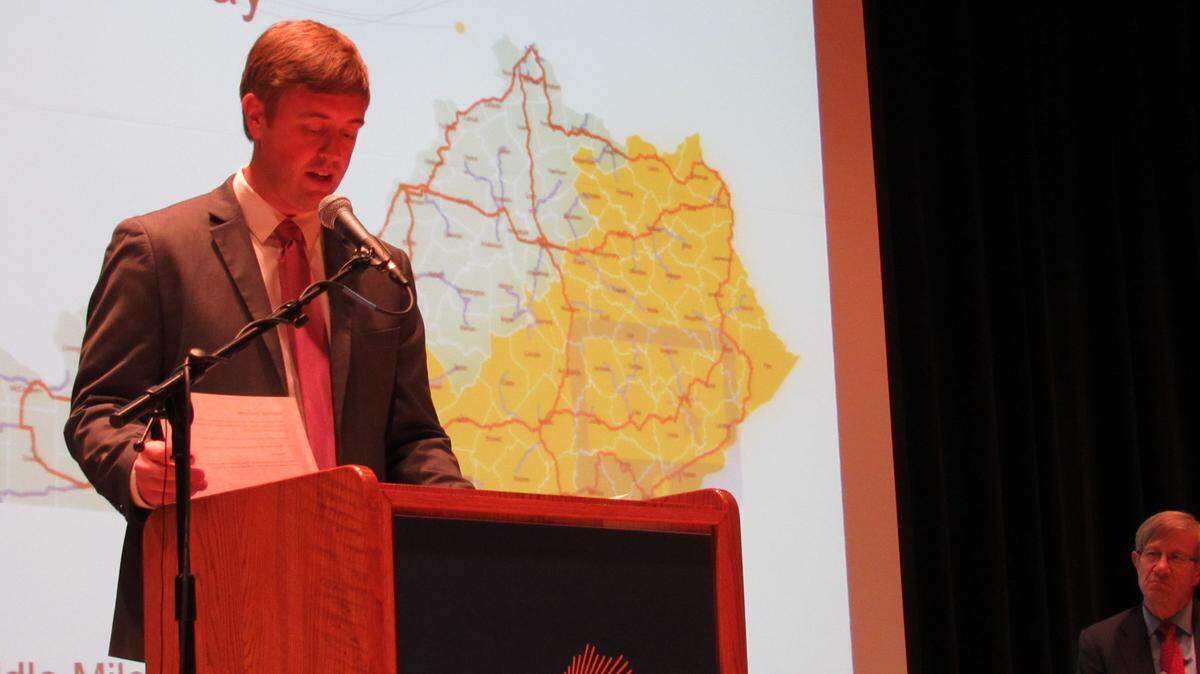
HAZARD — The details are coming together for construction to begin soon on a high-speed Internet network in Eastern Kentucky.
The contract is in place to build and operate the system, which will come first to Eastern Kentucky but ultimately stretch across the state. Financing should be finalized this week, and work to move old lines to make way for new fiber-optic cable in Eastern Kentucky is expected to start this month, state and federal officials said Monday at a kick-off event in Hazard.
The broadband system is scheduled to be done in the eastern part of the state in the spring and across Kentucky in 2018.
The network will bring great potential to make Kentuckians more competitive for jobs and to improve health care and education, officials said.
"Unconnected communities cannot compete in today's economy," said Jared Arnett, executive director of the Shaping Our Appalachian Region, or SOAR, initiative. "Entrepreneurs demand broadband, or jobs will go elsewhere."
The project, Kentucky Wired, will boost Internet speeds. Many places in the state are now far behind the rest of the nation and world.
Some places in Kentucky have good speeds, but the state as a whole ranks near the bottom of the nation in average Internet service speed. Nearly a quarter of the state's residents have no access to what the federal government defines as an appropriate broadband speed of 25 megabits per second.
Gov. Steve Beshear said the change that is coming will be like going from a two-lane road with a speed limit of 45 miles per hour to a 10-lane expressway with no speed limit.
The system will be designed, built and operated under a public-private partnership.
Macquarie Capital, an Australian company, will be the lead investor and will operate the network under a 30-year contract. The state will own and oversee the network.
Macquarie's revenue will come in part from providing Internet service to more than 1,000 government offices, including university buildings.
That's not a new cost to the state because it's already paying another vendor for the service and will just switch to Macquarie.
The public-private broadband partnership is the largest in the nation and the only one that provides full, open access to other providers such as local telecommunication companies, according to a news release from Beshear and U.S. Rep. Hal Rogers, who attended Monday's event.
Nick Butcher, an executive with Macquarie, predicted other states would look closely at the model.
"It's a game-changer for the industry, and it's a game-changer for Kentucky," Butcher said.
The latest estimated cost of the project statewide is $324 million.
Macquarie will put in the most, but the project includes $30 million in state funding and $23.5 million in federal money, most of it from the Appalachian Regional Commission.
Contractors will install 3,400 miles of cable as part of the system.
The work will begin in Eastern Kentucky in an effort to help diversify and boost an economy battered by deep jobs cuts in the coal industry.
Improved Internet service was one of the top priorities of the SOAR initiative, which Rogers and Beshear started in 2013.
It's no exaggeration to say the broadband project is one of the most important infrastructure developments ever in the state, officials said Monday.
Arnett called it a "literal economic lifeline."
More then 400 people attended the kick-off event, giving some hint of the hopes attached to the project.
The event included demonstrations of the potential for high-speed Internet service to boost jobs, education and health care, such as allowing a doctor in Louisville or Lexington to help diagnose and treat a stroke patient several hours away in a place where there are no neurologists specializing in strokes.
There still will be challenges after the system is in place.
The project involves building the so-called middle mile — a high-speed link between the global Internet and communities.
It will include an access point in each county but will not serve individual homes or businesses. Extending high-speed service throughout counties — called the last mile — will fall to other providers.
Those could include companies, local governments or public-private partnerships.
There will be a cost to extend that service, but it's necessary, Rogers said.
Beshear said that if the idea to extend broadband works as hoped, Eastern Kentucky would go from a place where people can't find work to a place where employers will have trouble finding workers because there are so many jobs.
The governor said he was convinced the project will work.
But getting there will be another part of the challenge.
To take full advantage of the system, schools must train students, entrepreneurs must figure out how to use it for their businesses, and communities will have to find ways to market their work force and attract jobs, officials said.
The system will not be a silver bullet for Eastern Kentucky's problems, but it will help put it on a competitive footing, Rogers said.
"It opens up opportunities," he said. "If you're a business leader or entrepreneur, this is your chance."
This story was originally published August 31, 2015 at 8:56 PM with the headline "Statewide broadband project taking shape, with work expected to begin in September."