
Georgetown Toyota plant gears up to produce luxury Lexus sedans
GEORGETOWN — The gray Lexus ES 350 luxury sedan runs so quietly you could hold a summit inside. The dashboard leather is hand stitched and the seats envelop riders in buttery comfort and support.
The Georgetown factory where this Lexus is cruising around, smooth as a hovercraft, is the home of Toyota Motor Manufacturing Kentucky.
The car is there now just for show. But TMMK is gearing up to begin producing 50,000 Lexus ES 350 gas-powered sedans a year, beginning in late 2015.
Toyota, for which Lexus is the luxury brand, is investing $531 million in the new 307,310-square-foot plant and other related plant improvements to accommodate this production. This marks the first time that Lexus will produce cars in the United States.
Toyota now builds the Lexus 350 ES at a plant on the Japanese island of Kyushu, which will continue to produce the gas-electric hybrid version of the car. Most of the gasoline Lexus ES 350 models will be produced in Georgetown.
Already much of the construction for the Lexus addition is either under way or completed. That is in addition to the 7.5 million-square-foot plant already at Toyota, the largest of the company's plants and Toyota's largest plant in North America.
"There's a pride that TMMK got selected for that," said Andrew McGuire, assistant manager of the quality department for the Lexus project. "The fit and finish and attention to detail — to get that kind of quality you have to be passionate about what you're doing."
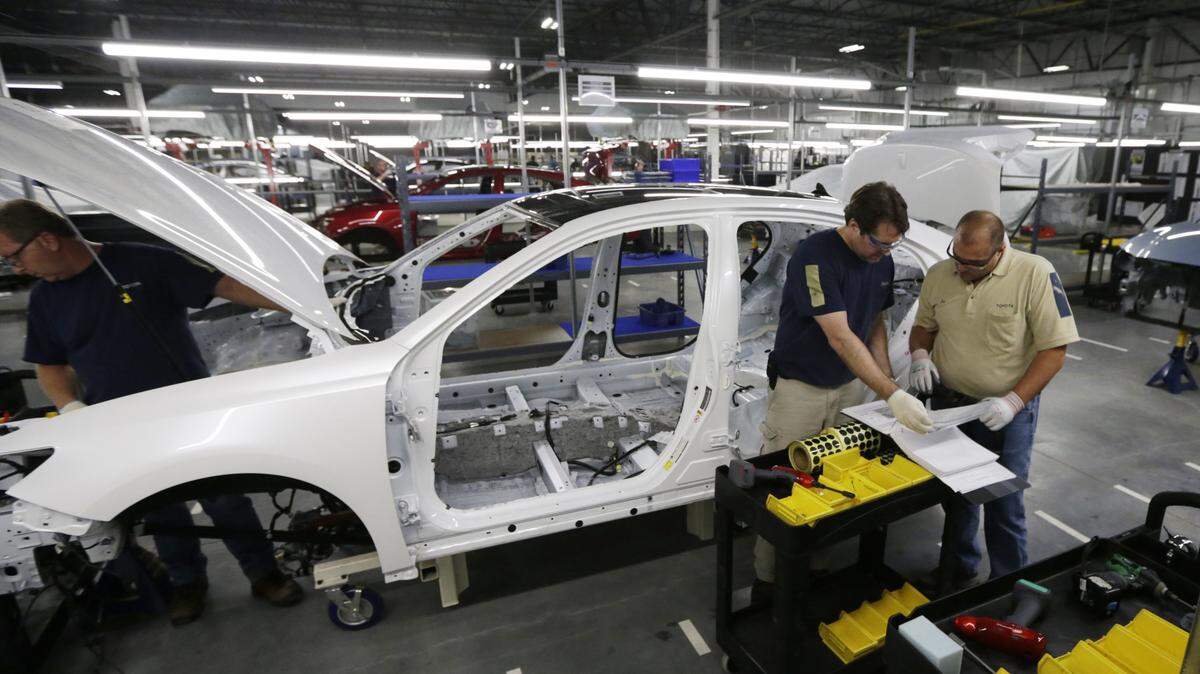
The equipment to build the cars is not yet delivered, but already a select group of employees — around 50 to 60 — are training for the exacting specifications of producing the Lexus using shells of unfinished cars. Production trials will start in March 2015.
"They bring 25 years of experience and the attention to detail that they have" to preparing for Lexus production, said Jeff Moore, chief project leader for Lexus ES manufacturing, watching a pair of workers prepare a Lexus for moonroof installation.
"After 25 years of building Camry, I think a lot of folks here are ready to take the next step and build the Lexus."
Group leader John Kidd holds up a manual roughly the size of an encyclopedia volume. That, he said, is a summary of the steps for one part of moon-roof installation.
First, the leaders study the set of instructions as thick as their fists. Then, Kidd and team leader Scott Peach will practice bolt installation in the roof again and again, initially for correct placement and solid installation, later for time. Then they will teach it to some of the employees who will be working in the new plant.
Another training area seeks to hone the sensory skills of employees who will be working to assemble the Lexus.
That aspect is important because Lexus production is going to be even more precise than that of the Camry, reflected in the different price points of the cars — a Camry LE has a manufacturer's suggested retail price of just under $23,000, whereas a 2014 Lexus ES 350 is closer to $37,000.
For example, it's important that those working with screws and bolts pick up exactly the right number needed for the task. If four bolts are needed, picking up more could lead to either waste or, worse, a bolt going astray within the car. Picking up too few could add precious seconds to the assembly time allotted and hold up the line.
Workers will also learn about electrical connections — there's a routine for how to catch a faulty one — and seals because all opportunities for wind noise to seep into the cabin must be covered up.
Tolerance for quality variances are tiny for Toyota models; for Lexus they are miniscule, part of what leads Kelley Blue Book to praise its "bulletproof reliability" among mid-size luxury cars.
Toyota took some of its employees for Lexus from those already working elsewhere in the plant, which also produces Toyota Camrys, Venzas and Avalons.
The plant is now gearing up to build the 2015 Camry, which will have 90 percent new sheet metal and 2,000 new parts.
David Hardesty is one of the Toyota employees who offered to work in the new Lexus plant. He was among the first Toyota employees in Georgetown — his "clock number" is #721 among plant employees — when he started work 261/2 years ago.
Since then, he and his wife have raised their two daughters, now 29 and 26, in Georgetown, and Hardesty said he still enjoys coming to work each day.
Hardesty, 51, said the chance to work on the new Lexus "was an opportunity I couldn't pass up. The challenge of setting up a new line, it's an accomplishment," he said.
The situation reminds him of helping get ready for the first Camry to be produced at the new Toyota plant in 1988. If you take a turn through the Toyota visitors' center, you'll see a little piece of Hardesty: the right hand quarter panel on the boxy 1988 white Camry, just above the right hand back tire.
Toyota employee Megan Williams of Paris used to work at Sonic. Now 22, Williams works on equipment maintenance for Toyota and will soon be going to Mississippi to study equipment similar to that coming to the Lexus plant.
She's eager to see the Lexus production equipment installed in the new plant.
"They say every time Toyota builds a new plant they build it smaller and better," she said, emphasizing the efficiencies of Toyota car assembly.
This story was originally published September 14, 2014 at 12:23 PM with the headline "Georgetown Toyota plant gears up to produce luxury Lexus sedans."