
Proposal would create mixed-use developments for Main and Vine, East Third and Midland
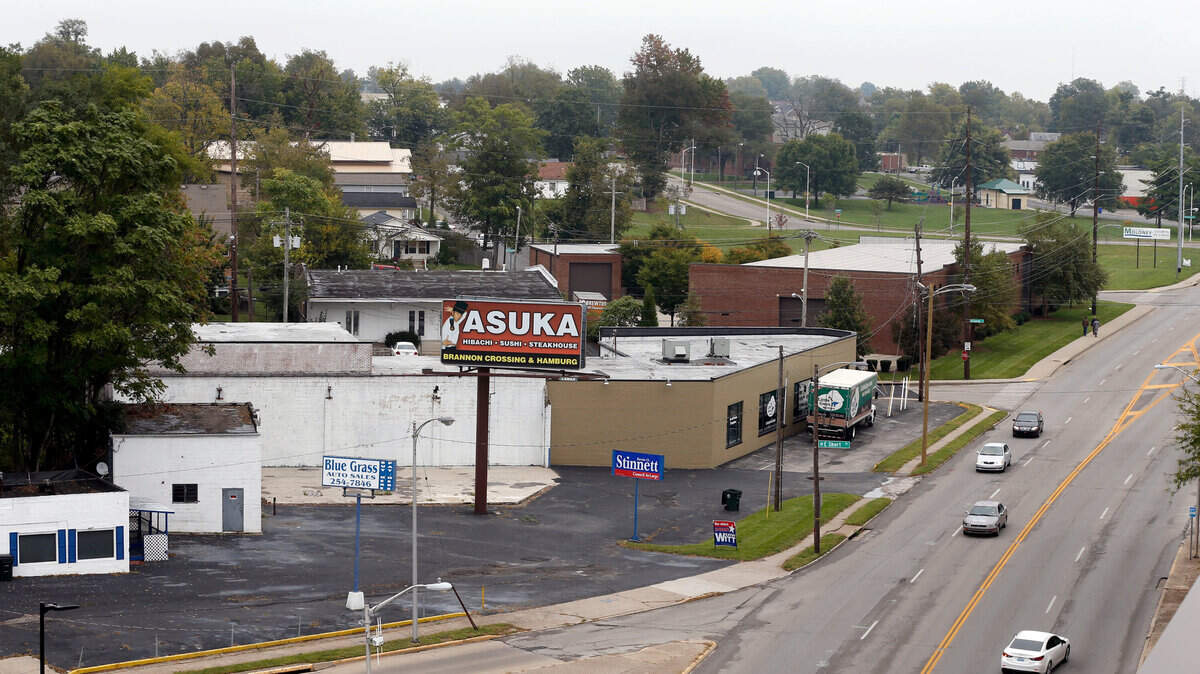
Lexington's East End could be home to the city's first tax increment taxing district north of Main Street.
A public hearing for the tax increment financing, or TIF, district — which uses taxes generated from new development to pay for infrastructure costs — will be Oct. 23.
The Urban County Council set the public hearing at Thursday night's council meeting. The new district will include the end of Main and Vine streets and then go up Midland Avenue to East Third Street. The proposed district will also include parts of East Third Street up to Race Street.
Phil Holoubek, a developer who is spearheading efforts to create the TIF district, said the district includes about $50 million in proposed development with $17 million in public infrastructure costs. A portion of the TIF district will include Holoubek's development on Main and Vine streets. Plans for the mixed-use development includes first-floor retail and three floors of apartments.
The LexPark board has agreed to build a 160-space, three-story, $2.8 million parking garage on that site.
The other end of the proposed TIF district includes land owned by the Community Ventures Corp., a nonprofit. Community Ventures has a building at East Third Street and Midland Avenue and other property in that area.
"This will be a mixed-use development, the specifics of which will be defined by the wishes of the neighborhood," Holoubek said. "We have hired a planning consultant, and there will be two community engagement sessions, the first of which will likely be held at the end of October at the Lyric Theatre."
An exact date has not been set for that meeting.
Holoubek said the property will become a mix of housing, retail and business space.
"The retail that is most needed is food-based, financial-based and health-based," Holoubek said. Senior housing and housing for people in lower-paying jobs is also needed in that area, he said.
"As far as retail, we not only want to create jobs for people in the neighborhood but ideally we would like those businesses to be owned by people from the neighborhood," Holoubek said.
The Urban County Planning Commission has already certified that the tax increment financing district complies with the comprehensive plan and the East End small area plan. The planning commission voted unanimously to certify the TIF district on Thursday afternoon.
Chris King, director of planning for the city, said the planning commission has not signed off on any project in that area. Thursday's vote only certifies that the TIF district complies with the comprehensive plan and the East End small area plan, which guides development in the East End.
Kevin Atkins, the city's chief development officer, said the Urban County Council will not take a vote at the Oct. 23 meeting; it will be a public hearing about the proposal. The council will likely give it a first reading Dec. 4. A final vote will take place Dec. 9.
"There are still a lot of steps that have to be worked through," Atkins said. "We all support something going into the East End, but it's got to be acceptable to the neighborhood."
Councilman Chris Ford, whose district includes the proposed TIF district, said the proposal will be discussed at 6 p.m. Wednesday at the Charles Young Community Center, which is included in the TIF district. Ford said the meeting was originally scheduled to discuss the five-year anniversary of the East End small area plan, but the TIF district proposal will likely be discussed.
The city has put nearly $500,000 into improvements at the Charles Young Community Center in addition to public money for the construction of the Isaac Murphy Memorial Art Garden. It's time for private investment to follow, Ford said.
"We don't want this development to turn its back on the East End," Ford said. But Ford said that the development could bring much-needed jobs and private investment. If the TIF district is approved, it will allow for long-needed infrastructure improvements in that area.
"There is such a demand for our traditional revenue sources, when we have the advantage of using the (tax dollars) to make those improvements, that's something that we should be open to exploring," Ford said.
Ford said that there will be plenty of opportunity for public comment. "There may still be some concerns," he said. "We, the government, and the development teams should go out of our way to address impacts — both positive and negative."
If the council ultimately approves the creation of the TIF district, it will go to the Kentucky Economic Development Finance Authority for final approval. The state economic development board will hire an independent consultant to estimate how much new tax money — from sales, property and occupational taxes — the proposed development will generate. Those new taxes can be used to reimburse developers for infrastructure costs. In this case, those costs could include burying utility lines; improving the streetscape, traffic signals and lights; and adding pedestrian-friendly crossings.
Most of the taxes that would be generated from the project and used to pay for infrastructure would be state taxes. By state law, school systems can not participate in TIF districts.
The amount of money that a developer can use for infrastructure improvements is capped by the state. For example, if the state approves $17 million in infrastructure improvements, and the TIF district generates more than $17 million, additional revenues can go to other projects in the district.
Holoubek said Friday that the district includes Charles Young, Thoroughbred Park and the Isaac Murphy Memorial Art Gardens for that reason.
"That money can be used for improvements in those parks," Holoubek said.
Lexington has five TIF districts: CentrePointe; the 21c Museum; The Red Mile; the Summit; and the former Turfland Mall site. Developers have to spend a minimum amount of money in order to "activate" a TIF and start receiving the taxes generated from the project. Lexington has never had an active TIF. Redevelopment of The Red Mile, Lexington's harness track, will likely be the first TIF district to go online. That could happen as early as January, Atkins said.
If the state approves the creation of the East End TIF district, developers and the city will also have to sign an agreement which will spell out what is expected of the developer, Atkins said. If the state approves the TIF district in January, it's possible construction could begin on the Main and Vine development as early as April, Holoubek said.
This story was originally published October 10, 2014 at 6:58 PM with the headline "Proposal would create mixed-use developments for Main and Vine, East Third and Midland."