
Review board recommends moving Confederate statues out of Lexington's historic courthouse square
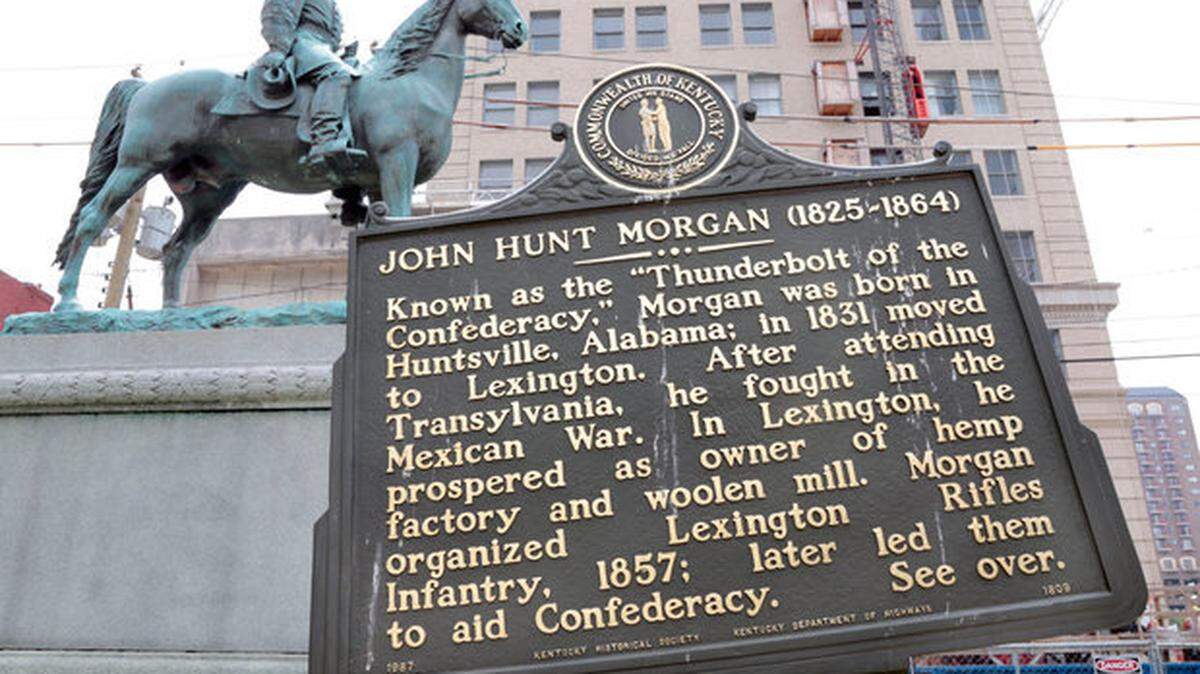
A Fayette County arts review board has recommended that statues of Confederate figures John Hunt Morgan and John C. Breckinridge be moved from the courthouse square and that the space around the former courthouse in downtown Lexington be reimagined.
But the recommendations of the Urban County Arts Review Board might be moot.
Restrictions connected to tax credits the city hopes to tap to help pay part of the expected $30 million cost to overhaul the former Fayette County Courthouse might prohibit moving the statues.
City officials did not tell the arts review board about the possible problems with moving the statues until the board was set to take a vote on its recommendations at its Nov. 4 meeting.
Morgan was a Confederate general. Breckinridge is a former U.S. vice president, congressman and senator who was expelled from the Senate after joining the Confederate Army.
During the Nov. 4 meeting, Lexington chief administrative officer Sally Hamilton told the board the city was planning to use federal and state historic tax credits for the courthouse overhaul. The credits are used to preserve historic structures. Making alterations to the historic structures — including moving the statues — might not be allowed, Hamilton said. The city is set to begin work on the exterior of the courthouse in the spring.
Some members of the board said they were disappointed the city did not share the information sooner. The board has been debating the issue for four months.
"We knew there was a courthouse renovation. We had absolutely no idea there was a connection to the tax incentives that would commit the city to not moving the statues," said Kurt Gohde, a board member. "I feel like they knew this before this meeting. That would have been good information for us to have."
But Gohde said if the board had known earlier, that might have influenced the group's decision.
Georgia Henkel, chairwoman of the board, said she was disappointed that the board was not informed sooner about the potential problem.
Finding out at the last minute "obviously did not change our recommendation," she said.
In addition to moving the statues, the group recommended that a historic marker about the Cheapside slave auction block, which once was on the courthouse lawn, should be restored and that the city's courthouse square be reimagined to include statues or art that is more inclusive of the city's history. The Cheapside marker was destroyed by vandals in July, but a replacement has been ordered.
Glenn Brown, deputy chief administrative officer, said Hamilton did not tell the board about the possible restrictions connected to the tax credit program until the Nov. 4 meeting because the city decided only recently that it was moving forward with the tax credit financing option. The city allocated $22 million in bond money for the courthouse project. State and federal tax credits were discussed as part of the financing as early as March.
"The city did not know with full certainty which direction — historic tax credit versus no tax credit — we would go until two weeks ago," Brown said. "We still don't know whether moving the statues would have an impact on qualifying for the credits. We have consulted two experts, who disagree. After discovering there was a potential issue, CAO Sally Hamilton talked to the board. She also encouraged the board to make its decision independent of the tax credit issue."
The board's recommendations came after hearing from more than 300 people and seeking input from historians, art historians and local activists. The board also did its own independent research. Henkel read a dozen books on the subject, and she said other board members read as many books and articles if not more.
The majority of emails, letters and calls the city received about the issue supported keeping the statues — 250 people asked that the statues remain in their current locations; 42 asked that Morgan be moved; 34 asked that Breckinridge be moved and 16 asked for the addition of a new monument.
Henkel said the vast majority of letters in favor of keeping the statues were form letters organized by groups that want them to remain. The city says that approximately 171 of the 250 were form letters, or about 69 percent.
Gohde said many people who have felt disenfranchised by the statues might not have felt comfortable speaking out or did not know the board was weighing the statues' fate.
The board's meetings were held at city hall, mostly during the day.
Mayor Jim Gray asked the board to review the placement of the statues after a vandal spray-painted "black lives matter" the Morgan's statue in June. The display of Confederate-era symbols — flags or statues of Confederate generals — on public property has been the subject of debate across the country since a white supremacist killed nine black worshipers in a Charleston, S.C. church on June 17.
The board has asked to meet with Gray soon to go over its recommendations. It probably will present its recommendations to the Urban County Council in January.
In a written statement, Gray said he looked forward to discussing the recommendations. But he cautioned that no decision could be made now because of the courthouse renovation.
"Even though these decisions concerning the statues have to be made as part of the courthouse renovation, the board's study will provide perspective as we move forward," Gray said. "And its recommendations for a comprehensive review is a good next step."
That in-depth review should be "inclusive of community input and seek to provide a complete and accurate portrayal of Lexington's history," the recommendations said.
Henkel said the group's intent was to develop a time-line for that redesign to take place. The group also wanted to engage more people — a grass-roots effort to get more public opinion — on what the space should look like.
If the state and federal historic tax credit programs won't allow the city to move the statues, Gohde said, the city should fight that decision. Other cities are reconsidering whether to display Confederate symbols on public property.
"Lexington cannot be the only city that has bumped up against this," Gohde said. "If we are willing to push against this regulation, there are other cities that also must be in a similar situation. This is a chance for Lexington to lead."
Henkel agreed.
"I think there are definitely ways that this could be changed," Henkel said. "I don't think it's a lost cause."
This story was originally published November 12, 2015 at 4:50 PM.