
University of Kentucky student's proposal for 'food tower' creates buzz in tornado-ravaged West Liberty
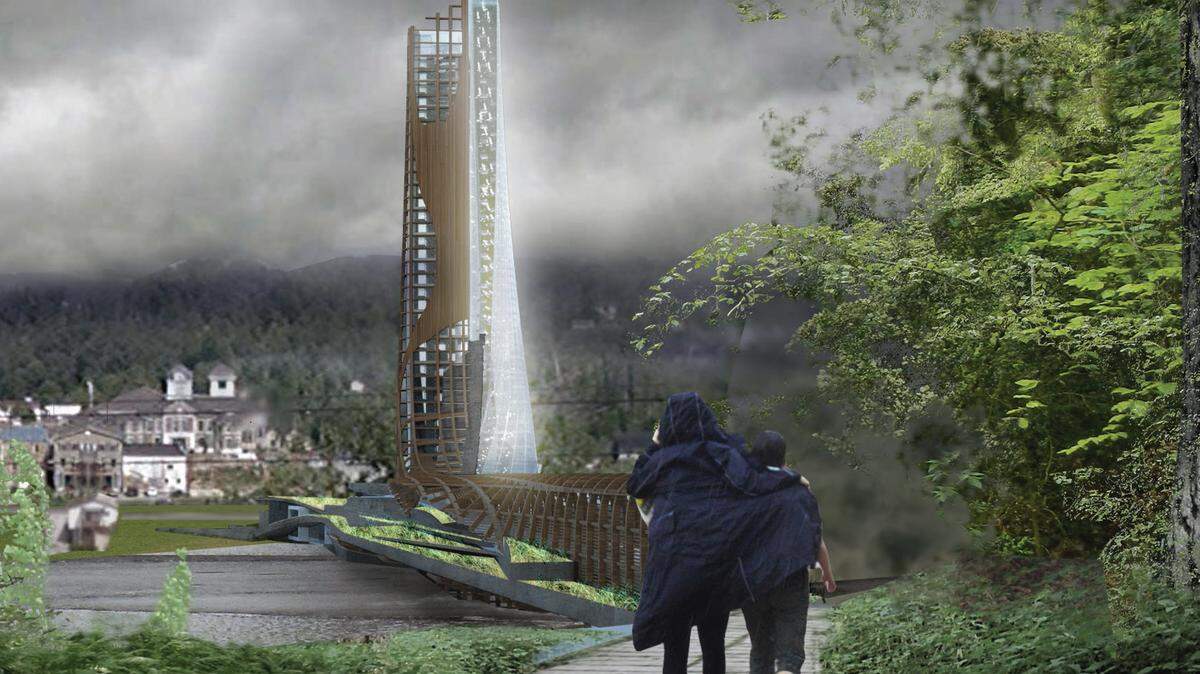
WEST LIBERTY — A 200-foot-tall "food tower" — a vertical greenhouse that would grow fruits and vegetables for sale — might be the signature structure that this tornado-ravaged community seeks as a symbol of its rebirth and as a draw for visitors.
Everyone admits it's a bold idea. But it captured local residents' imaginations when it was among the projects presented by University of Kentucky architecture students at a recent "town hall" meeting.
"It's the craziest thing, but by its essence, it's also the most interesting thing," said West Liberty retiree Brent Engle. "Maybe it's too outrageous for a lot of people to think of such a thing."
But Engle said he liked it because "it's an 'in your face' to a tornado." People in the audience applauded and whistled approval of Engle's assessment.
Ian Pangburn, a third-year student in UK's College of Design, was just relieved that people were intrigued by his idea for an urban farm.
"I'm excited to see what happens in the future," Pangburn said.
Other ideas presented by the UK students included a boutique hotel, a bike park and trail, a farm-to-table restaurant, a cultural heritage center, a recycling center, a theater and a fresh food market.
Whether any of these ideas actually come to fruition is not the point. The point is there's a lot of talk about West Liberty's future three years after the March 2012 tornado obliterated the downtown and left a mile-wide path of destruction.
That's a testimony to residents who, though grieved and saddened by the loss of six lives and familiar landmarks, see the rebuilding effort as an opportunity to set West Liberty apart from any other town in Kentucky.
"Where there is no vision the people perish," said small-business owner Dorcas Burton, quoting Proverbs 29:18. She said the ideas presented by the architecture students "may not all be attainable, but it gives you a starting point. It gives you a vision of what can be."
How that vision came to be can be traced to a little girl's empathy, and to the collaboration of local people with students of Gregory Luhan, associate dean for research in UK's College of Design and the John Russell Groves Endowed Professor of Architecture.
When the tornado hit West Liberty, Luhan was in Boston making a presentation at a conference of the Association of Collegiate Schools of Architecture. His then-9-year-old daughter, Miller, saw stories about the tornado in the newspaper, and when Luhan returned home, she told him, "Dad, we need to go to West Liberty."
She then went to her room and retrieved "two big bags of toys and stuffed animals that she wanted to give to the people of West Liberty," Luhan recalled.
So father and daughter went to Morgan County, and as they handed out toys to children, Luhan met various bankers and other leaders. From that visit Luhan got the idea to pair UK's expertise with the rebuilding effort.
Later, while on sabbatical in 2013-14 as a visiting associate professor of practice at Texas A&M University, Luhan and his students there held weekly meetings with West Liberty leaders via Skype. The students from College Station, Texas, also traveled to West Liberty to meet with residents.
Those discussions spoke of reinventing West Liberty as an ecotourism hub for the region's recreational attractions, such as Cave Run Lake.
When he returned to UK after the sabbatical, Luhan had students in Lexington develop prototypes for West Liberty that centered on how the community could take its strengths — agriculture, natural beauty, a keen sense of place and history — and turn them into something that would benefit local people and visitors.
"I think what everyone is looking for is a valuable concept that West Liberty can build back better and build back in a sustainable way," Luhan said. "This wasn't about us coming in with ideas. This was about working with the community, to get them to see things in different ways."
The students' ideas reflected global ideas — better food and health, energy efficiency — scaled to a hometown dimension.
Allyson Smith proposed a recycling center. Residents would drop off paper, plastic, cardboard, aluminum and glass at volunteer fire departments and other locations, and those materials then would go to a center to be made into secondary products for reuse.
Alexis Peneff noted that sorghum, a locally raised crop, could be used in making insulation.
"It could be used in all of your buildings and it is just as sustainable, if not more, than regular insulation that you can get," Peneff told the more than 120 people in the audience at the April 30 town hall meeting.
And then there was Pangburn's audacious idea for what he called an "urban farm."
His idea is to pump water from the Licking River, which meanders to the south and west of downtown, and use it to irrigate crops grown in a 200-foot-tall tower. The structure would be made of the same material used for the Bird's Nest stadium at the 2008 Olympics in Beijing.
The tower's height would allow it to "become a sort of beacon of sustainability," Pangburn said. Furthermore, it would be "a wayfinding device for the entire city. You know where it is at all times, and you can use that to position yourself in town."
What won the audience over was when Pangburn said the tower might be illuminated at night, "and it can become a sort of emblem of West Liberty. Or, I don't know, if you have a football game you can light it up whenever you guys are winning."
Overall, Pangburn said later, the tower is "meant to be something that's inspiring to people."
Burton, who owns a gift shop and country décor store called The Primitive Homestead, said she thinks the tower, like the Gateway Arch in St. Louis, "would be a wonderful thing to draw people into the community." Anyone interested in growing things would come to West Liberty to see it, she said.
"It's that one thing that will give Morgan County a signature," she added. "Nobody else has something like that around here."
Lisa Redding, human resources director for Morgan County ARH Hospital in West Liberty, acknowledged that "some of these ideas are a little bit too forward looking, because we are not the Jetsons."
But she reminded people that another crazy structure — the mirrored bean-shaped sculpture in Chicago's Millennium Park — draws thousands of tourists who then "go away and the town gets to be what it wants to be." Meanwhile, those tourists leave money behind at local businesses.
Later, when one resident asked where the money would come for these projects, Redding launched into an impassioned speech that could have come from Jimmy Stewart in a 1930s or '40s Frank Capra movie. She suggested money could be found from private sources like banks and from public sources such as the state Department for Local Government, whose commissioner, Tony Wilder, attended the town hall meeting.
"What it takes more than anything to make any of these ideas happen is the community will," Redding said. "Look at this room. Look to the left and right. You guys maintained hope for three years, even if it was just enough hope to come when I begged you. You came."
She concluded: "I know there are obstacles ... but I also know that when we work together as a group ... we can counter any obstacle. We can do it."
Perhaps no one knows that better than Billie "B.J." Conley, who owns the Giovanni's franchise in West Liberty.
The Italian restaurant that sold pizza, spaghetti and sandwiches was destroyed by the tornado, but thanks to Luhan's students, Conley plans to break ground for a new restaurant in July and reopen before the end of the year. The UK students helped design the space and made suggestions on details such as how the buffet bar should be positioned and how the building should be situated on the lot, she said.
"If it hadn't been for him and his group of students, I wouldn't be where I'm at today in trying to get Giovanni's back," Conley said. "They had the resources, they had the research and they came up with ideas you wouldn't think possible."
This story was originally published May 17, 2015 at 5:19 PM with the headline "University of Kentucky student's proposal for 'food tower' creates buzz in tornado-ravaged West Liberty."