
House panel approves borrowing billions for teachers' retirement fund, millions for UK project
The House budget committee voted Tuesday to crack open Kentucky's two-year budget and fund two major proposals: a $3.3 billion bond to shore up the Kentucky Teachers' Retirement System and a $132.5 million bond to pay for half of a medical research building at the University of Kentucky.
All but one member of the House Appropriations and Revenue Committee voted in favor of stabilizing the teachers' retirement system with the state's largest-ever bond issue, while a handful of legislators questioned the wisdom of approving UK's capital project in a non-budget year.
Rep. Addia Wuchner, R-Florence, was the only lawmaker to "pass" on voting for the retirement system bond, saying she wanted to further study a potential $3.3 billion bailout of the system for 141,000 current and former teachers and state education employees.
Other committee members appeared to agree with Rep. Mike Denham, D-Maysville, who said, "We owe these teachers a debt of gratitude" as he voted for the bill.
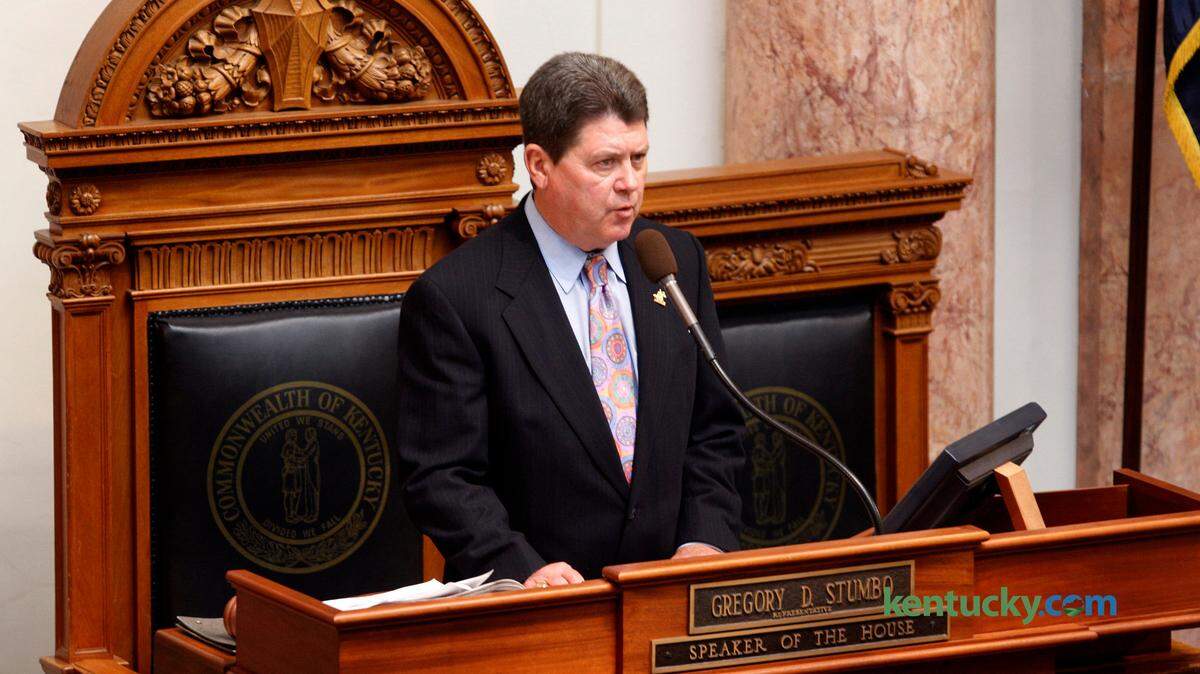
House Speaker Greg Stumbo, the sponsor of House Bill 4, told the committee that low interest rates provided "a window of opportunity" to stabilize the retirement system, which has only 53 percent of the money it is expected to need for future payments.
Stumbo said bonds could be sold at a 4.5 percent interest rate, then invested alongside the retirement system's $18 billion portfolio at an assumed rate of return of 7 percent.
"By doing this, you have guaranteed ... barring something catastrophic ... the solvency of the Kentucky Teachers' Retirement System well past 2035 and beyond," Stumbo said.
He said he was pleased by members' questions and interest, and he predicted the bill could hit the House floor by the end of this week. He also said he thought the Senate might add reforms of the retirement system's governance to the bill, which he would support.
Beau Barnes, deputy executive secretary of the Kentucky Teachers' Retirement System, or KTRS, said that without the bond issue, the projected shortfall would be $800 million a year by 2025-26. With the bond, the shortfall would be less than $400 million.
Barnes said the system's investment experts don't foresee another economic crisis like the one of 2007-08, which sent the stock market spiraling.
"The flip side of risk is 100 percent certainty that if we don't do something, this problem continues to get much, much worse very quickly," he said.
Barnes said debt service on the $3.3 billion bond would be paid out of existing revenue streams for debt service on previous bond issues that are now winding down.
The state made employer contributions of $722 million to KTRS in 2014, and teachers paid $440 million through paycheck withholdings. However, KTRS officials said the state stopped making its full recommended contributions in 2008, leading to annual shortfalls of several hundred million dollars.
Also, new accounting rules this year will require the system to nearly double its reported liabilities, from $12 billion to $23 billion, unless bonds are issued or another permanent funding mechanism is put in place. That would reduce the system's estimated funding level to 45 percent.
Lawmakers approved nearly $900 million in bonds for KTRS in 2010 but rejected the system's request for more bonds during the 2014 session.
The legislature also declined to fund UK's proposed medical research building as they crafted a two-year state budget last year, but it was a different story Tuesday.
UK President Eli Capilouto testified that the $265 million building would bring 1,623 jobs, $5.6 million in local and state taxes, and $116.2 million in total economic impact.
The building would allow UK to pursue a multidisciplinary approach to researching cancer, diabetes and other scourges of Kentucky, which could help lower the number of preventable deaths in the state, Capilouto said.
"Our goal is to make death a beggar in Kentucky," he said.
The state would finance half the construction cost, with UK raising the rest in philanthropy and research funding. House Bill 298 would authorize issuing the bonds and appropriate $5.4 million for debt payments in the upcoming fiscal year, but it's not clear where that money would be found in the current budget.
Rep. Larry Clark, D-Louisville, voted against the bill, saying he had a hard time supporting the project in an off-budget year. "This is without a doubt a great project, but the timing of this puts us all in a very awkward position," he said.
Clark also questioned why the project was being brought individually by UK, instead of going through the traditional budgeting process of the state Council on Postsecondary Education, or CPE, which coordinates Kentucky's system of higher education.
"If we're not going to use CPE, I think we should look at some legislation to do away with CPE," he said.
UK pitched the project last year, but legislators instead awarded funding for a law school renovation. The idea re-emerged at the Kentucky Chamber of Commerce dinner in January, when Senate President Robert Stivers suggested financing construction.
"We struggle mightily with our budget, but I think there are two things we can improve in Kentucky. That is education and the health of our population," said Rep. Rick Rand, D-Bedford, "and I believe this does both."
This story was originally published February 10, 2015 at 1:14 PM with the headline "House panel approves borrowing billions for teachers' retirement fund, millions for UK project."