
Republican gubernatorial candidates dispute global warming
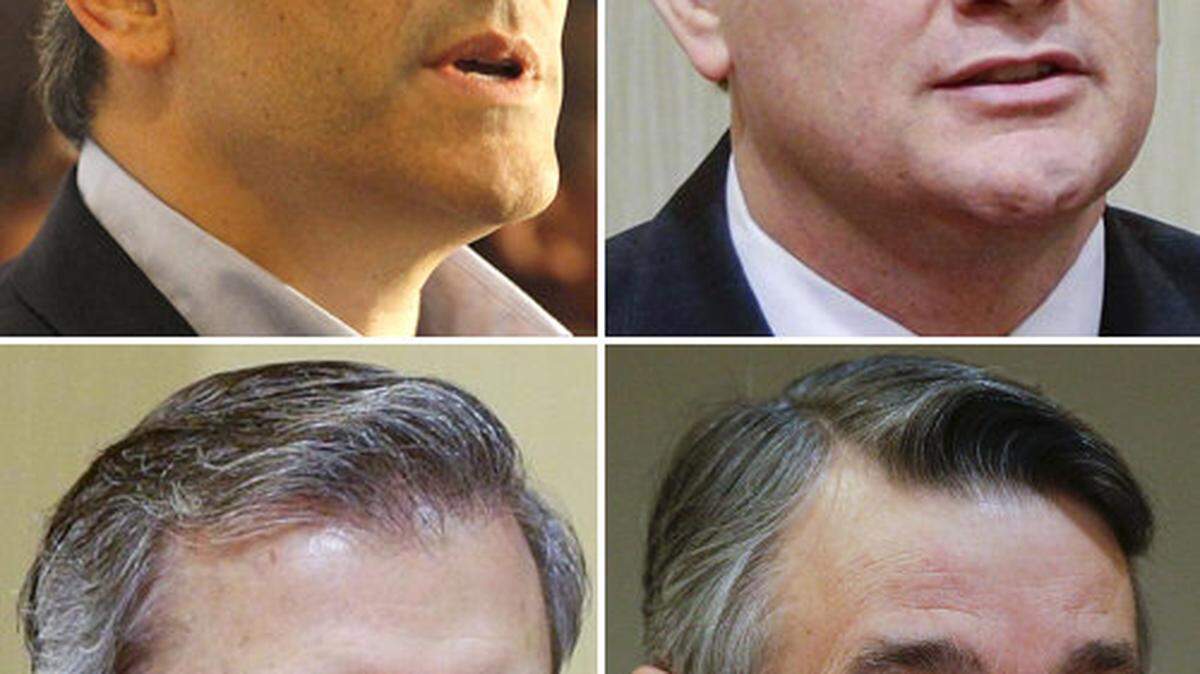
All four of Kentucky's Republican candidates for governor said Tuesday night that they don't agree that global warming is man-made, disputing the science that insists it is and declaring that protecting coal jobs is the higher priority.
In a debate that featured some of the campaign season's most heated exchanges, Nick Storm, the host and managing editor of CN2's Pure Politics, asked the candidates whether they believed in global warming and what role they thought government had in protecting the environment.
Leading off, Matt Bevin, a Louisville businessman and former U.S. Senate candidate, said there had been a lot of "fluff and theory that has been perpetrated as science to create the perception that somehow this global warming has been entirely man-made."
"I disagree with it," Bevin said. "I don't find scientific corroboration for it. I have found scientists that I believe to be as credible or more so than those that are calling for this who would say quite the opposite."
Bevin said he guessed that Storm and the television audience would agree that "at one point in time, the Earth was largely covered by ice."
"I think that most people that studied history and science would tell you that indeed it was," Bevin said. "And if in fact the world was once largely covered by ice and if in fact it is now largely not covered by ice, it would seem obvious to me that this didn't happen because it's been getting colder."
Former Louisville Metro Councilman Hal Heiner parroted U.S. Senate Majority Leader Mitch McConnell's response from last year's Senate race, responding first by saying he wasn't a scientist.
Heiner called for an energy policy that focuses on coal but includes clean-coal technology, arguing that it is crucial to the state and national economies.
"If you look at what's going on around the world from a competitive standpoint, they're turning to coal," Heiner said. "And I'm not willing to wreck the economy of Kentucky and the economy of the U.S. based on what President Barack Obama and our attorney general, it's his president, are willing to do to our natural resources here in Kentucky."
Former Supreme Court Justice Will T. Scott credited Bevin's answer, saying Bevin "hit the nail on the head."
"Scientists all agree — we've had five ice ages, complete ice ages, and five meltdowns, and we didn't even get here until the tail end of the last one, and we didn't even have fire then, so how'd we cause it?" Scott said. "We're sitting on a fireball 17 miles below us that has a core temperature of 3,500 degrees. The earth reacts and acts."
But Scott did say he wasn't "saying we're not influencing it now."
"I'm not saying that," Scott said. "But I'm saying give me a scientist that gives me a theory that ties in now and back through the five ice ages when we melted and when we froze up."
Scott suggested that viewers read Dark Winter, a book by former NASA consultant John L. Casey, in which, according to a synopsis on Amazon.com, Casey "argues that a decrease in the sun's activity led to an abrupt end to global warming in 2007, as the earth entered a new solar minimum — a 30-year period that will lead to record cold weather across the globe."
Scott, who later added a tale about how the cold winters of his youth allowed for skating across a frozen river in shoes, suggested that voters read the book and draw their own conclusions.
"I'm not a scientist," Scott said. "I can't decide. But read Dark Winter and make up your mind."
James Comer, the commissioner of agriculture, was less circumspect, stating flatly at the beginning of his answer: "I do not believe in global warming."
"Weather is cyclical. I think we would all agree with that."
Comer, a farmer by trade, said the government does have a role in environmental protections such as ensuring clean water, calling for "common-sense policy with regard to environmental regulations."
"I'm the one person whose business and livelihood depends on Mother Nature, so I understand weather patterns," Comer said. "We've had a very severe winter this year with 12-inch snows, so there is no global warming."
The debate featured a number of sharp-elbowed exchanges as arguments that had been made in the media — over super PAC ads and degrees of opposition to "Obamacare" — the Affordable Care Act — erupted on the debate stage.
This story was originally published April 21, 2015 at 10:08 PM with the headline "Republican gubernatorial candidates dispute global warming."