
Kentucky's day in court: Supreme Court hears historic arguments about state's same-sex marriage ban
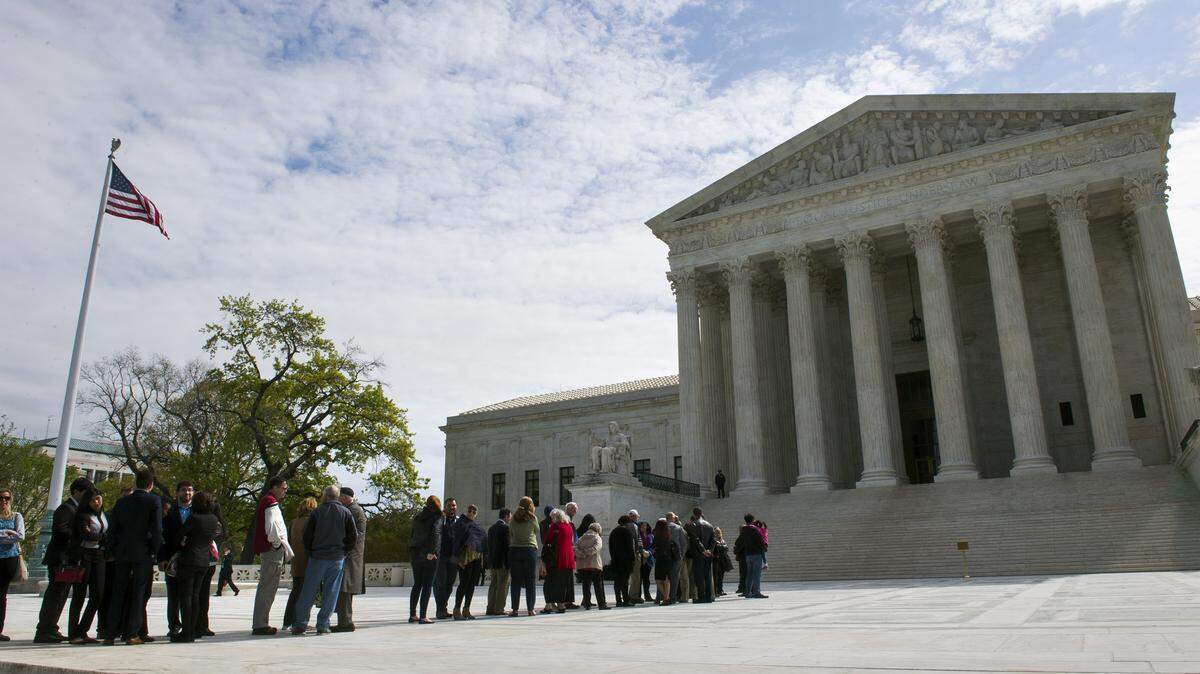
A few lawmakers expressed concern in 1998 when the Kentucky General Assembly overwhelmingly passed a law banning same-sex marriage.
"I'm not sure that we're not treading on people's constitutional rights," warned state Sen. Gary Johnson, D-Pikeville.
Here's where Kentucky finds out. On Tuesday, the U.S. Supreme Court will hear the states of Kentucky, Tennessee, Ohio and Michigan defend their prohibitions on men or women being married to each other. Same-sex couples from those states will argue that they have a constitutional right to "equal protection of the laws," so they should be allowed to marry whom they choose, just like any other Americans.
TIMELINE: Same-sex marriage and Kentucky's path to the Supreme Court
The high court's decision is expected to be historic when it's handed down this summer.
The justices could recognize an inalienable right to marriage for everyone, making this a victory for gays and lesbians akin to the 1954 desegregation of schools by the court's decision in Brown vs. Board of Education. Or they could uphold a state's right to define marriage as between one man and one woman, throwing into chaos the lives of thousands of same-sex couples who have been wed in the 37 states that now allow it, largely because of lower courts that overturned state bans.
Many legal scholars predict the former.
"It would be genuinely shocking to me if they upheld the state bans at this point," said Neil Siegel, a Duke University professor of law and political science who studies the Supreme Court. Siegel will attend Tuesday's oral arguments in Washington.
He bases his prediction on two of the court's previous actions.
In a 2013 case called United States vs. Windsor, the court struck down the Defense of Marriage Act — a federal same-sex marriage ban — saying it "writes inequality into the entire United States Code." In October, the court refused to intervene while lower courts, citing language from its Windsor decision, overturned state marriage bans, clearing the way for same-sex marriage across the country.
The Supreme Court stepped in — "granting cert," as it's formally called — only after Kentucky, Tennessee, Ohio and Michigan prevailed at the 6th Circuit U.S. Court of Appeals in Cincinnati. The 6th Circuit was the first federal appeals court to uphold state marriage bans. That is the case the high court will review Tuesday.
"The Supreme Court is composed of nine very intelligent lawyers, and they knew perfectly well what the consequences would be when they didn't grant cert last October. That was a very assertive denial of cert," Siegel said. "For the court to turn around now and tell all of these same-sex couples around the country, 'Just kidding! You can't really be getting married after all,' no, I don't see that happening."
Married or not?
The formal title of the six combined marriage lawsuits from Kentucky and the other states is Obergefell vs. Hodges.
Jim Obergefell of Cincinnati legally wed his longtime partner, John Arthur, during a quick visit in 2013 to Maryland, where same-sex marriage is legal. But the state of Ohio did not recognize their marriage after they flew home. When Arthur died shortly thereafter of Lou Gehrig's disease, Obergefell could not be named as surviving spouse on the state-issued death certificate.
Unwilling to accept this outcome, Obergefell sued Richard Hodges, director of the Ohio Department of Health. A federal district judge sided with Obergefell, declaring the state's actions unconstitutional.
"When a state effectively terminates the marriage of a same-sex couple married in another jurisdiction, it intrudes into the realm of private marital, family and intimate relations specifically protected by the Supreme Court," Judge Timothy Black wrote.
About the same time, same-sex couples in Kentucky sued Gov. Steve Beshear in federal court in Louisville for equal marriage rights. Their counterparts in Tennessee and Michigan likewise sued their state officials. All of the couples prevailed in the district courts. But in a 2-1 decision in November, the 6th Circuit tossed out the lower courts' rulings and sided with the states.
It would be wiser for gays and lesbians to wait until voters in their states endorse same-sex marriage through the legislative process, rather than force "a fundamental change" by suing, Judge Jeffrey Sutton wrote for the 6th Circuit's majority.
"When the courts do not let the people resolve new social issues like this one, they perpetuate the idea that the heroes in these change events are judges and lawyers," Sutton wrote. "Better in this instance, we think, to allow change through the customary political processes, in which the people, gay and straight alike, become the heroes of their own stories by meeting each other not as adversaries in a court system but as fellow citizens seeking to resolve a new social issue in a fair-minded way."
That's when the Supreme Court intervened.
States' rights
Lawyers for Beshear and for Kentucky's same-sex couples have submitted hefty written briefs for the justices to read, as have the other parties in the case and scores of "friends of the court" groups and individuals who wish to have their opinions considered.
U.S. Sen. Mitch McConnell, R-Ky., signed onto a brief with 56 other members of Congress to "counsel this court to exercise caution and to avoid imposing a judicially mandated redefinition of marriage on the states." One hundred and six members of the Kentucky General Assembly submitted a brief arguing that changes in "societal values" should be determined "by the people's elected representatives rather than by a judicial panel."
However, during the 21/2 hours of oral arguments Tuesday, nobody from Kentucky will stand before the justices.
Arguing for the same-sex couples will be Mary Bonauto, a civil-rights attorney with Massachusetts-based Gay and Lesbian Advocates and Defenders, and Douglas Hallward-Driemeier, an experienced Supreme Court advocate. Representing the states are John Bursch, former solicitor general of Michigan, and Joseph Whalen, an associate solicitor general from Tennessee.
The United States government, which sides with the same-sex couples, will be represented by Solicitor General Don Verrilli.
In their briefs, the states say many people are misreading the Supreme Court's Windsor decision. The high court did not establish a fundamental right to marriage in Windsor, they say. It rebuked Congress for ignoring the state of New York's legitimate authority to regulate marriage — in that case, by allowing two women to marry. This was a matter of the federal government overstepping its bounds, they say.
Given the court's expressed respect for states' rights, the opponents say, it can hardly turn around two years later and dismiss the definition of marriage agreed upon by Kentucky and other states through the democratic process. These states have legitimate interests in limiting marriage to one man and one woman, including preservation of their cultural traditions and promoting procreation, they say.
But supporters of same-sex couples say the Supreme Court long has treated marriage as a fundamental right.
Most famously, in a 1967 case called Loving vs. Virginia, the court struck down a state ban on interracial marriage. It said Virginia's authority to regulate marriage did not trump the Constitution's 14th Amendment, which prohibits states from denying basic civil rights to which all Americans are entitled.
Two questions
On Tuesday, both sides will closely watch Justice Anthony Kennedy, who sometimes is the swing vote in 5-4 decisions that split the court's conservative and liberal factions. Kennedy wrote the court's majority opinion in Windsor and in a 2003 decision, Lawrence vs. Texas, that eliminated states' criminal sodomy laws punishing homosexual acts.
"It is the promise of the Constitution that there is a realm of personal liberty which the government may not enter," Kennedy wrote in the Lawrence decision.
The Supreme Court says it will consider two constitutional questions Tuesday and in the weeks of private deliberation that follow: Should states be required to allow same-sex couples to marry, known as the "marriage question," and should states have to recognize valid same-sex marriages from other places, known as the "recognition question"?
Siegel, the Duke University professor, said it's possible the court could split the difference, ordering the states to recognize a valid same-sex marriage from elsewhere but not requiring them to issue their own marriage certificates to gay or lesbian couples. In that instance, a same-sex Kentucky couple could travel to New York, marry, then have that marriage recognized upon their return home.
"I suppose there's a chance they might try to answer one question but not the other. I don't think that's likely, though," Siegel said. "At some point, you've gotta just go ahead and decide the issue that's been teed up in front of you."
This story was originally published April 27, 2015 at 12:50 PM.