
Beshear raising pay of about 800 state workers to $10.10 an hour
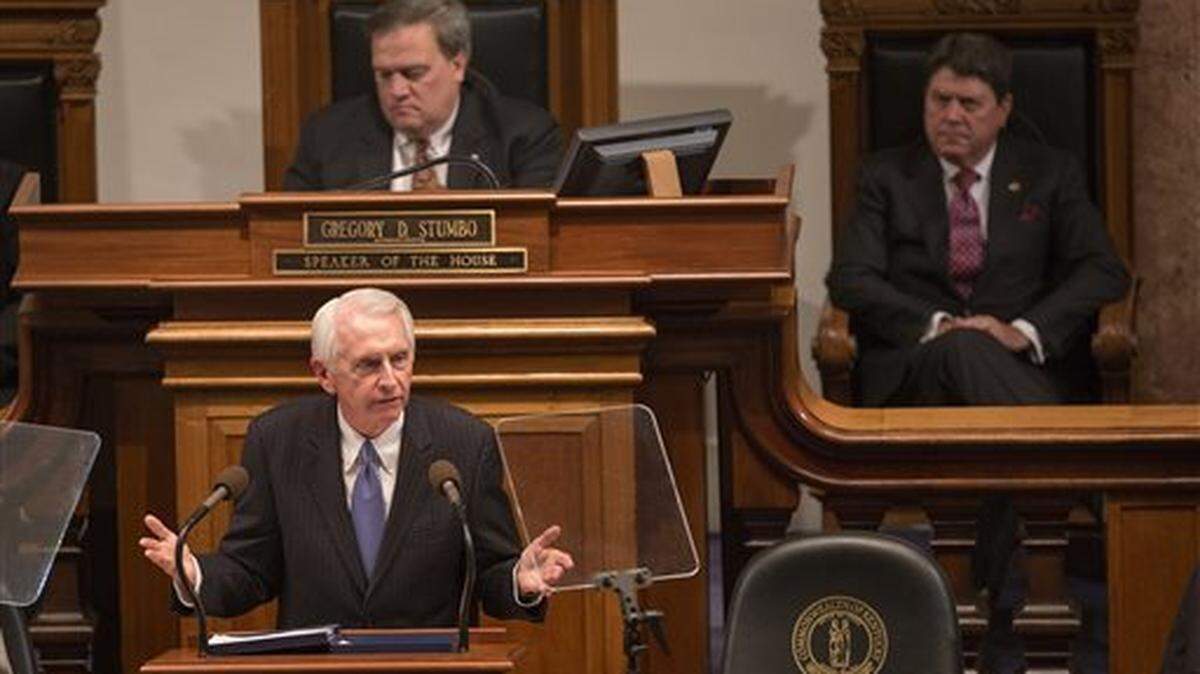
Gov. Steve Beshear is raising the minimum wage to $10.10 an hour for hundreds of the lowest-paid workers in Kentucky's executive branch.
Beshear, who will leave office in December, ceremonially signed an executive order Monday afternoon at the Kentucky Horse Park in Lexington to raise the pay of nearly 800 state workers starting July 1. The current minimum wage is $7.25 an hour.
Tipped employees — such as those who work in state park restaurants — will see their wages more than doubled to $4.90 per hour.
The wage increases will cost about $1.6 million, and less than $800,000 of that cost will come from the General Fund, Beshear said. He did not immediately identify the source of the other money.
Hundreds of state government workers care for veterans in nursing homes, maintain parks and help adults with mental disabilities for about $15,000 a year, Beshear said.
"That's a disgrace," Beshear said. "Raising their pay is a moral imperative."
The Democratic governor also challenged employers in the private and public sectors to follow the lead of the state's largest employer, and strongly argued that common arguments against raising the wage don't hold up to scrutiny.
"I call on every business leader and local government to take a hard look at the facts," Beshear said. "Paying our people a living wage isn't a fiscal backbreaker, and the impacts will be extraordinarily beneficial."
State lawmakers have argued in recent years about raising the minimum wage, with House Democrats pushing the idea and Senate Republicans blocking the measure. The General Assembly can review Beshear's order when they return to session in early January, but it would be difficult for them to lower state workers' wages.
"It's easy to parrot the same tired sound bites against raising the minimum wage, but any reasonable review of unbiased research shows that raising the wage is a smart business decision," said Beshear, who is concluding two four-year terms. "Plus, many of the long-held assumptions about who earns minimum wage are just flat wrong."
He said a raise of less than $3 per hour may be enough for some employees to move off government assistance programs.
It was not immediately clear how the policy change will affect employees in the state's legislative and judicial branches of government.
The change will affect 510 state workers who earn less than $10 per hour. An additional 269 who earn about $10 per hour will see a small raise. Tipped employees will see an increase in their base hourly income from $2.19 an hour to $4.90 an hour, which matches recent federal changes.
The new policy also requires private companies that have service contracts with state government to pay a minimum wage of at least $10.10 an hour to employees who perform work in connection with those government contracts. That requirement will be added to contracts as they come up for renewal.
Of the 510 employees who make less than $10 an hour, more than a third work for the Kentucky Department of Veterans' Affairs, many of them caring for Kentucky veterans in the state's veterans nursing homes. Another 90 people work in behavioral health agencies, taking care of vulnerable Kentuckians.
Other large groups of low-paid employees work at state parks and at the Department of Natural Resources
"The irony here — and it's an appalling irony — is that the people we have tasked with the difficult job of caring for our vulnerable populations are paid so little that they too are vulnerable, at least when it comes to financial security," Beshear said.
The governor noted that a single person with no dependents working full time at $10.10 per hour would no longer be eligible for food stamps or Medicaid.
The Cabinet for Health and Family Services estimates that a statewide increase in the minimum wage would move 13,000 Kentuckians off Medicaid.
Raising state government's minimum wage would also help reduce turnover in low-paying jobs, Beshear argued, cutting the costs of training, increasing productivity and reducing inefficiency.
"As the economy accelerates, the job market grows more competitive," Beshear said. "These critical state agencies need qualified workers to deliver services to our citizens."
Beshear offered several statistics to bolster his argument:
■ A 2009 analysis of 64 economic studies found that the minimum wage had no negative impacts on employment,
■ The 13 states that raised their minimum wages at the beginning of 2014 added jobs at a faster pace than those states that did not, he said.
■ Nearly 88 percent of the people who would benefit from raising the minimum wage are over age 20.
■ More than a third — 34.5 percent — of minimum wage earners are over the age of 40.
■ More than half of minimum wage earners (53 percent) work full-time, and more than 85 percent work at least 20 hours a week.
This story was originally published June 8, 2015 at 1:31 PM with the headline "Beshear raising pay of about 800 state workers to $10.10 an hour."