
Ky. hemlocks threatened by pest
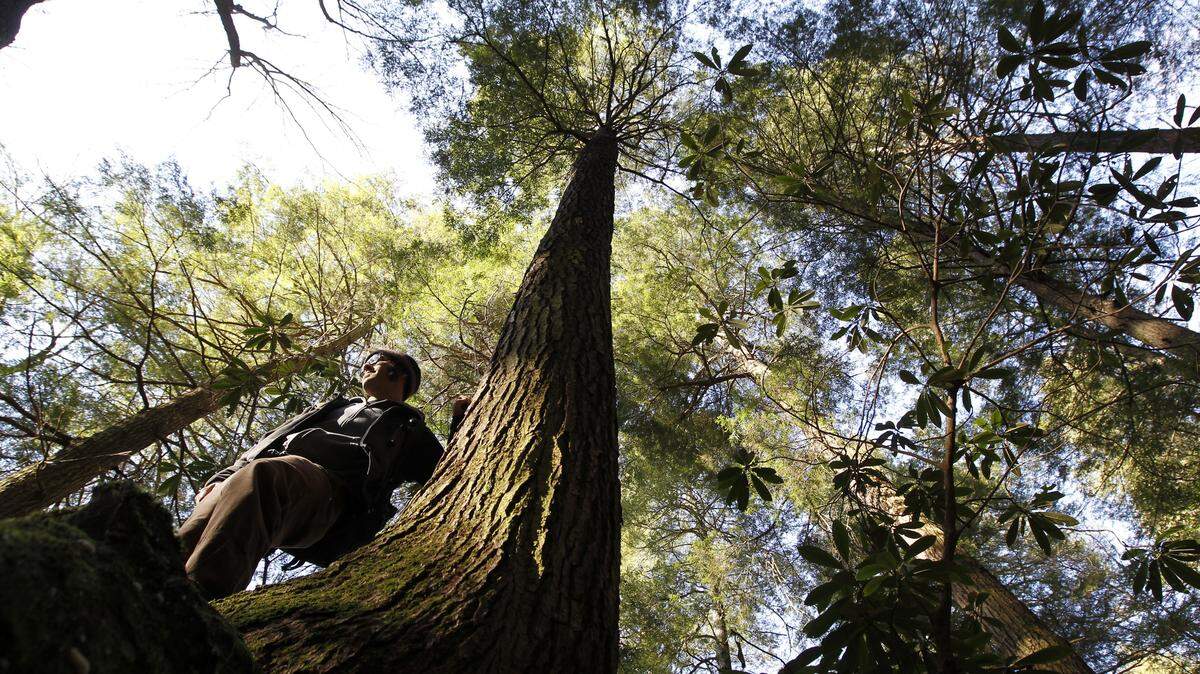
LONDON — Walking through a grove of towering hemlock trees in the Daniel Boone National Forest, Alice Mandt stopped to pick up a small branch that had fallen to the ground.
The hemlock needles on the branch were green and healthy. Mandt smiled.
"Hopefully we won't find it today; that would be good," she said.
The "it" she dreaded was a tiny insect called the hemlock woolly adelgid (pronounced a-DEL-gid) that threatens the stately hemlocks found in some of the most beautiful and environmentally sensitive places in Eastern Kentucky.
Mandt, who used to work at the Kentucky State Nature Preserves Commission, recently was hired by the Division of Forestry as the state hemlock woolly adelgid coordinator.
Her task: Working with other state agencies to protect trees in a few high-priority areas from an exotic pest that has proven to be unstoppable in other states, and reaching out to private landowners to explain how they can protect their trees.
The day before her visit to Angel Hollow west of London, Mandt had been part of a group that applied insecticide to the soil around 500 trees in Kentucky Ridge State Forest in Bell County.
She hopes to find private landowners through county extension agents to sell them on the notion that it would be cheaper to spend $10 to treat a tree with an insecticide that would last for a couple of years than it would be to remove a dead tree.
No one, including Mandt, has any illusions about saving all the state's estimated 71 million hemlocks. But she views her job with optimism.
"What I would like to see us do is save as many of these high-priority areas as we can, and kind of make them close together for later, when more options become available," she said.
The options are still being developed. Rusty Rhea, an entomologist who coordinates the hemlock battle in the southeast for the U.S. Forest Service, says the current goal is to have several kinds of predator beetles eating enough adelgids to keep them under control.
"We wouldn't assume we would ever eliminate all the adelgids," he said. "We're just trying to create a balance and re-establish a natural system that's not in place at this time."
Switching from insecticide to predator beetles could be tricky. The beetles will die if they eat adelgids that have been exposed to insecticide. And, because the beetles being used eat only adelgids, they can only be released in an area that already is infested.
Thousands of beetles have been released in Kentucky, but no one is yet ready to call those releases a success.
Several state agencies have treated thousands of trees, many of them with insecticide supplied by the Forest Service. The effort also has been helped by grants from corporations such as Toyota, Bayer and Columbia Gas.
The work has been done by University of Kentucky entomologists, employees of the state agencies and volunteers. In most cases, it has involved lugging water across steep terrain to mix with powdered insecticide.
Each agency chose places in southeastern Kentucky, where the adelgid was found first and is the most widespread.
Nearly 24,000 trees have been treated in Bad Branch State Nature Preserve in Letcher County and Blanton Forest State Nature Preserve in Harlan County, where some of the old-growth hemlocks are four feet in diameter and well over 100 feet tall.
The Division of Forestry chose Kentucky Ridge State Forest in Bell County and Kentenia State Forest in Harlan County. The Kentucky Department of Fish and Wildlife Services chose Cranks Creek Wildlife Management Area and Stone Mountain WMA and State Natural Area, both in Harlan County. The state Division of Water chose Martin's Fork State Natural Area, also in Harlan.
The state Parks Department trained people in how to treat trees, then didn't participate because of extreme budget and staffing shortages, spokesman Gil Lawson said.
That means that parks with significant hemlock stands, such as Pine Mountain, Cumberland Falls and Natural Bridge, have had little or no work done to protect trees.
The Daniel Boone National Forest, which contains many important hemlock stands, has applied insecticides only to a relatively few trees, mostly in areas where a dead tree could fall on someone.
The environmental group Kentucky Heartwood, which normally would object to using insecticides on public land, finds itself in the odd position of urging Daniel Boone officials to hurry up and do something.
Those officials are asking for public input on a plan to treat some trees in each of 92 "Hemlock Conservation Areas" spread through the 700,000-acre forest.
If a decision is made to go ahead with the plan, treatments could begin in the spring. Insecticide won't be used in the forest's two wilderness areas, but predator beetles could be released there.
Sixteen months passed between the time the agency first asked for public comments and the current round of comments. Nancy J. Ross, a natural resources staff officer, could not provide an explanation for the delay.
"It's just taken longer than we anticipated," she said.
The hemlock woolly adelgid is an oval, reddish-purple bug that hails from Asia.
It does little damage in Japan or China where natural predators apparently keep it in check. But, like the emerald ash borer and other pests, it has made its way across the ocean and is wreaking havoc without the normal checks and balances it had back home.
The adelgid was first noticed in this country near Richmond, Va., in the 1950s.
Adelgids have spread to at least 17 states, killing millions of trees.
In places such as Virginia's Shenandoah Valley, as many as 90 percent of the hemlocks are dead. Vast hemlock stands in the Great Smoky Mountains National Park are succumbing.
The sharp freezing and thawing cycle in northern forests appears to slow the insect's spread. And a few trees here and there appear to be able to withstand the insect. But, without treatment, scientists think that all the hemlocks on the southern end of the tree's range will die.
That means trouble for what is called the hemlock ecosystem. The trees are usually found in damp coves and along mountain streams, where their evergreen needles regulate temperatures and provide year-round shelter.
When the trees die, endangered species of fish such as the blackside dace could follow. And birds such as the black-throated green warbler would lose nesting sites.
Adelgids were first spotted in Kentucky on the side of Pine Mountain in Harlan County in March 2006. They apparently had already been here for a while.
The bug has since spread to 15 other counties, most of them in the east.
Later on the day that Mandt visited Angel Hollow, with Jim Scheff, the coordinator for Kentucky Heartwood, he showed her a hemlock branch he had collected in Tight Hollow in Wolfe County.
Mandt confirmed Scheff's suspicion that the branch was infested with adelgids, which meant the insect had established another beachhead.
Adult adelgids are only 1⁄32 of an inch long. Infestations usually are spotted by waxy white material females use to cover their eggs. It looks like wool.
Because the adelgid can start in the top of a tree, in some cases more than 100 feet above the ground, infestations often are advanced before anyone notices.
The female adelgids do all the damage. They feed by piercing the base of hemlock needles and drawing out sap. When enough bugs are on a tree, it grows weaker and dies, usually in 5 to 10 years.
This story was originally published December 12, 2010 at 12:00 AM.