
Mark Story: Howard Schnellenberger offers assessment of what has held back UK football program
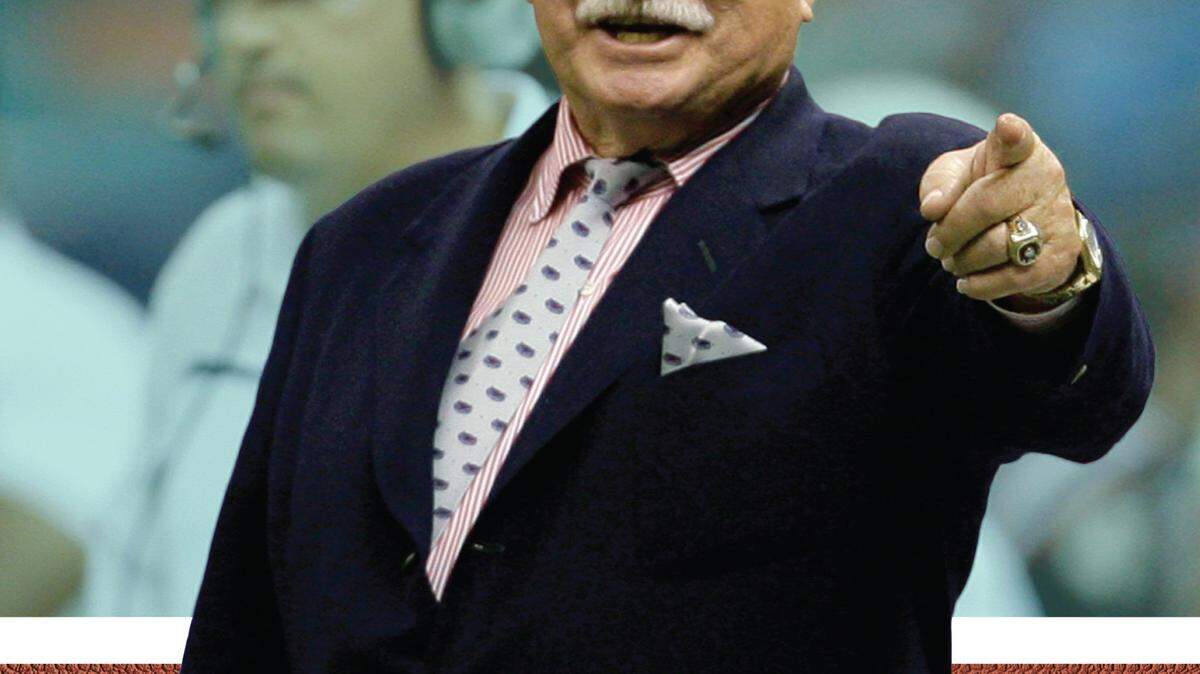
Over the phone, Howard Schnellenberger's deep, gravelly voice rumbled with indignation.
Schnellenberger, you will recall, is the coach who launched Miami's 1980s-90s college football dynasty by winning a surprise national championship after the 1983 season. He is also the coach who transformed Louisville football from an irrelevancy to a program that has won three major bowl games since 1990.
Yet, I had just asked him if he planned to attend Monday's U of L opener against Miami. "I can't imagine being anywhere else," Schnellenberger growled.
Schnellenberger, 80, will be in Kentucky this weekend promoting his new book, Passing The Torch: Building Winning Football Programs ... with a Dose of Swagger Along the Way.
The book's author is one of the most significant football figures in our state's history. As a player, Schnellenberger was a standout at the old Flaget High School in Louisville, playing alongside future Heisman Trophy winner Paul Hornung for iconic coach Paulie Miller.
Schnellenberger committed to play college football at Indiana, before Bear Bryant wooed him away from the Hoosiers for UK. In Lexington, Schnellenberger, an end, became a first-team AP All-American in 1955 while playing for Bryant's successor, Blanton Collier.
As a coach, Schnellenberger fully altered the conception of what was possible for Louisville Cardinals football. When he inherited the U of L program in 1985, Louisville played its games in a minor-league baseball stadium and was on a stretch of six straight losing seasons — not that anyone much cared.
Through bombast (which state sportswriters, a much younger me included, used to mock), force of will and some quality coaching, Schnellenberger launched the metamorphosis of Louisville football into a program that now plays in its own sleek stadium and has won the Fiesta, Orange and Sugar Bowls.
Since he played for Kentucky and coached Louisville, I asked Schnellenberger his opinion of why UK has had such difficulty building a consistently winning football program?
"Because they have not been willing to do what the University of Louisville has done," Schnellenberger said. "The only reason the University of Louisville has been able to make the turn, it had the introspection to be willing to really look at what it had done wrong and what had to be done to change that culture. That was my key (to take the job).
"The University of Kentucky has seemed satisfied with mediocre football as long as the basketball team wins a national championship every five years or so. It's a culture. Kentucky needs to go through that process (of change) that Louisville did."
Yet Schnellenberger says he has never bought the premise that UK football must inevitably be a "graveyard of coaches."
"I believe the right coach can win at Kentucky — and can do it without cheating," Schnellenberger said. "I believe that. I've always believed that."
At least twice, Schnellenberger says he came "reasonably close" to testing that belief by becoming UK's head coach. In 1981, after Fran Curci was fired, Schnellenberger talked to Kentucky but chose to stay at Miami. UK ultimately hired Jerry Claiborne.
After Schnellenberger made an ill-fated decision to leave Louisville after the 1994 season for what became an unhappy one-year stint as Oklahoma head coach, he again talked with Kentucky in 1996 after Bill Curry was fired. UK instead chose Hal Mumme.
"Once, it was not the right time for me," Schnellenberger said of his flirtations with the UK job. "The other time, it wasn't the right time for the university."
For UK fans, some of the best parts of Passing The Torch will be Schnellenberger's descriptions of how Bryant got him to flip on his recruiting commitment to IU (the governor of Kentucky and a Roman Catholic Archbishop were involved).
There is also an insider's depiction of the negotiations that eventually led to the resumption of the long-dormant Kentucky-Louisville football series in 1994.
"I've been working on it for two years," Schnellenberger said of the book, which was written with Florida attorney Ron Smith. "I finally got it together, and the timing of it worked out pretty good."
Actually, the timing of Howard Schnellenberger promoting his book the weekend before a Miami-Louisville football showdown is more like impeccable.
This story was originally published August 30, 2014 at 5:47 PM.