
Decline in Thoroughbred foal crop hurting racetracks while strengthening sales market
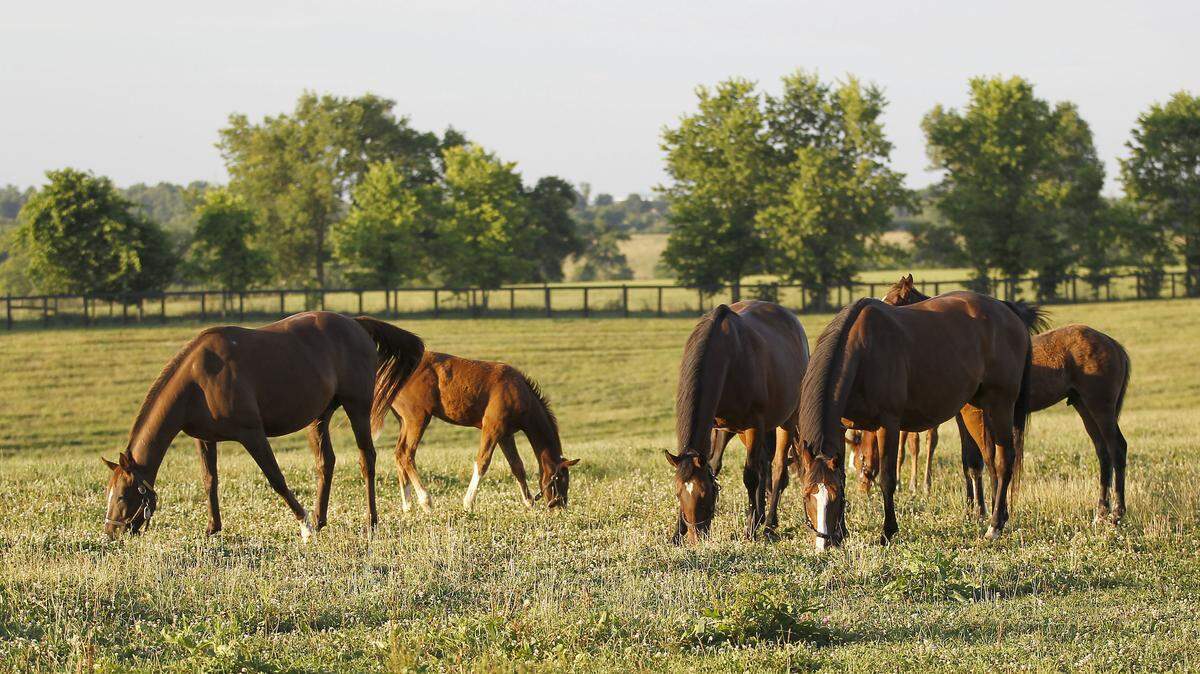
The future of the Thoroughbred industry stares out from just beyond the fence lines.
In the spring and summer, paddocks of mares with foals at their sides dot the Central Kentucky landscape. As the cooler air of late season sets in, the growing bellies of ambling broodmares tease of the impending generation.
Glimpses of the breeding cycle are ingrained in the Bluegrass, so much so that shifts in its makeup can be indiscernible to passing glances.
But what has transpired behind the fences the past several seasons is a drop in the number of foals to levels not seen in more than 40 years.
The North American foal crop has been shrinking for nearly a decade, with its sharpest cuts coming after the economic crash of 2008.
In August, The Jockey Club announced it was projecting the 2015 North American Thoroughbred foal population — which is based on reports of mares bred — to come in around 22,000. Should that figure hold, it would equal the estimate of the 2014 foal crop and represent the first time since 2005 that there was no decline.
Such potential stability is welcome, but the reality of the numbers remains. The foal crop hasn't been in the 22,000 range since 1968, a time when stallion books were a fraction of the size of the number of mares many sires now cover.
Whether this data is positive or negative for the industry depends on the viewpoint.
At racetracks across the country, the angst is palpable as racing secretaries struggle to fill cards in the face of a shortage of Thoroughbreds.
Thoroughbred racing economic indicators
The most recent indicators released by Equibase last week show year-to-date decreases in every category from 2013 to 2014.
| Indicator | 2014 | 2013 | Change |
| U.S. wagering | $7,541,616,766 | $7,673,962,797 | -1.72% |
| U.S. purses | $741,708,215 | $748,769,112 | -0.94% |
| U.S. race days | 3,469 | 3,533 | -1.81% |
| U.S. races | 28,656 | 29,777 | -3.76% |
| U.S. starts | 216,011 | 231,065 | -6.52% |
While many factors have contributed to declines in betting handle, short field sizes are known to make horse racing less attractive to fans.
"It's a huge problem, it's a national problem. It's not just Kentucky, it's everywhere," said Ben Huffman, racing secretary for both Churchill Downs and Keeneland. "We're all kind of fighting for the same horses and owners. The foal crop number, when you look at the actual number, it is scary."
While the racetracks attribute some of their struggles to the decline in Thoroughbred population, the sales arena hails the trend for putting the public auction market back on stable ground.
The supply of horses coming back in line with demand from buyers has contributed to widespread gains in the yearling, juvenile and breeding stock sales. The Keeneland September Yearling Sale — considered the bellwether auction of the industry — thundered that point home by posting its best numbers last year since 2008.
"Anytime you shrink a market, a lot of people come out better," said Eric Hamelback, general manager of Frank Stronach's Adena Springs Kentucky. "We had a tremendous reduction, and some people went out of business, but there was an influx of quality of horses that came out on the other side of that smaller crop. And (buyers) were more hungry to get that crop."
If there is one thing the Thoroughbred industry can agree upon, it's that the reduction in the foal crop has affected every major economic driver in the sport.
High number of foals 'unhealthy' for industry
The all-time peak for the foal crop came in 1986, when 51,296 youngsters were registered. While the numbers settled in around the 34,000 to 38,000 range from 1992 through 2005, talk of overproduction, particularly at the lower ends of the market, became common.
By the mid-2000s, prices within the public auction arena reached facepalm levels. In 2006, a Forestry colt later infamously named The Green Monkey sold for a world-record $16 million at the Fasig-Tipton Florida Select 2-Year-Olds in Training Sale. That September, a Kingmambo colt became the second-most-expensive yearling of all time when he topped the Keeneland sale with a bid of $11.7 million.
Desire to cash in on that unrealistic level of trade prompted the excessive procreation of some horses whose commercial value was negligible. Hence, when the bottom dropped out in 2008, the economics of the time weeded out horses of questionable breeding.
"Our Thoroughbred industry does run in cycles, and within that cycle is the foal crop," said Geoffrey Russell, Keeneland's director of sales. "And as the market tends to go up, people start tending to breed more horses.
"I think we talked about in January of 2008 that there was a concern we were overproducing. Did we expect what was going to happen in September 2008? No. But the correction was going to happen anyway. We were breeding too many foals for what we need. It was unhealthy — it wasn't doing the industry any good."
The downturn drove many smaller breeders and farms out of the market, and others who had jumped in to take advantage during the good times stopped investing.
Suddenly, money had to be spent carefully, and only on proven products. Support for stallions at the top end remained ample, but finding mares for sires with fees in the $15,000 range and lower became challenging.
Beneath the highest levels, stud farms have had to get creative with incentives to lure owners of mares to their stallions.
"A lot of our programs came about when the market was at its worst," said Ned Toffey, general manager of Spendthrift Farm, whose "Share the Upside" and "Breed Secure" incentive programs have drawn criticism from competitors but have been crucial in the development of stallions such as Warrior's Reward, currently the third-leading first-crop sire in North America.
"We had to come up with some ways to do a couple things: No. 1, to get breeders, but No. 2, to be able to do things to allow breeders to stay in business.
"Obviously it's nice if you've got a great stallion, but if you've got nobody around to breed to them, it doesn't do anybody much good. I think it's been a very good situation for the breeders in that everyone had to get as creative and aggressive as they could with price reductions and deals."
Competition for Thoroughbreds is stiff
The number of Thoroughbred races run in the United States and Canada has declined over the past decade — from 58,858 in 2004 to 46,814 last year. However, the speed of that decrease has not been as fast as the decline in the foal crop.
Factor in the competition brought on by multiple tracks running meets simultaneously — for example, both Churchill Downs beginning its 12-date September meet and Kentucky Downs commencing the first of its five dates this weekend — and racing secretaries have a difficult task.
Efforts to creatively fill cards have resulted in an upsurge of races with multiple conditions — factors that determine which horses are eligible for each race — that can be mind-numbing to bettors and trainers.
For instance, one recent race offered this condition for entrants: "For 3-year-olds and upward which have never won $10,000 three times other than maiden, claiming, starter, or state bred or which have never won four races."
More than ever, racing secretaries also are having to reach well beyond regional markets.
"With the inventory of races coming down slower than the rate of decline that we're seeing in the number of starters, which is coming from the foal crop, it creates concern for us, obviously, as to the levels of handle that will be possible going forward," said Matt Iuliano, executive vice president and executive director of The Jockey Club. "You get that type of reduction matriculating its way through racing, it puts pressure on how many races can be conducted and still maintain economic viability."
Pari-mutuel handle in the United States topped $15.1 billion in 2003, but it has been below $11 billion the past three years and is headed for another decrease this year. Purses, race days and the number of races run are also down this year from last.
Tracks are reducing the number of races and, in some cases, the number of race days, but those adjustments might go only so far toward keeping the overall product strong while the smaller foal crops work their way through.
Along with the loss of Hollywood Park, Beulah Park in Ohio closed in May after 91 years of racing. With fewer horses available, such a fate could threaten additional smaller operations.
"I know there are some tracks that are just kind of hanging on," Huffman said. "I personally don't want to see those small tracks go out of business. I think they serve a purpose and ... several big-time trainers started at tracks like Beulah Park and River Downs."
Added Toffey, "Especially for the tracks, the storm is not really over. It wouldn't surprise me to see some tracks go away. But the good thing is the market seems to be going in the right direction. So if they can weather things for a little bit more, I think it's clearly going the right way now."
Too many races?
If there is one segment of the industry that has not been affected by the reduction in the foal crop, it's Thoroughbred aftercare.
John Moore, CEO and president of the Thoroughbred Retirement Foundation, which has more than 20 farms across the country, said its current herd size is around 925 horses, down only about 150 compared to 2011.
"You're going to have more than enough horses coming off the track for adoption for many years to come. The retirement problem is still a serious problem," Moore said. "Even though we've had this decline, there are still around 43,000 races, and it's no secret the tracks themselves aren't doing very well. We probably have around 25,000 too many races a year in this country."
Should the sales market continue its uptick, the expectation is that the foal crop will begin inching its way back up. But no one is certain of the industry's ideal foal crop number.
What may linger as the most lasting effect is an altering of the industry's mindset. From the breeding shed to the racetrack, those involved have had to take an unfiltered look at their business and either adjust or fall back.
"What is the optimum level? That is a very good question," Russell said. "Because without racing we don't have sales. This idea that when we were having a bump these horses were just moving around, that didn't do anything for our industry.
"We have to have good racing. We have to have strong racing from coast to coast, and that helps the Thoroughbred industry breeding and sales."
This story was originally published September 6, 2014 at 7:51 PM with the headline "Decline in Thoroughbred foal crop hurting racetracks while strengthening sales market."