
100 years ago, Regret was the first filly to win the Kentucky Derby and put the race on the map
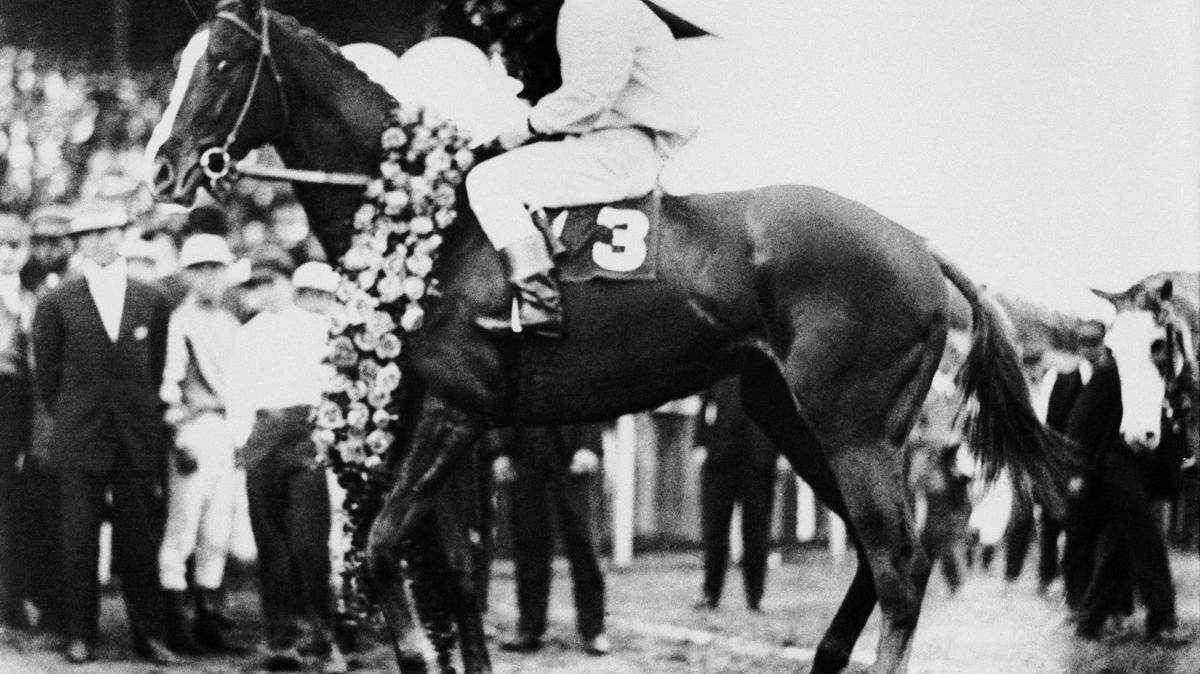
Before Billie Jean King beat Bobby Riggs in tennis, a female in another sport gave the boys a run for their money in 1915.
Her triumph wouldn't be matched by another female for 65 years.
But above all, her win secured in the minds of many sportswriters and others that the Kentucky Derby is the source of a good story, that it would endure, and that it is one of the nation's premier sporting events.
Her name was Regret, and 100 years ago she was the first filly to win the Derby. Only two other fillies have won the race since: Genuine Risk in 1980 and Winning Colors in 1988.
In 1915, at the same time that women were demonstrating for the right to vote, some horsemen thought a filly shouldn't be in the Derby, or worse, that a filly couldn't win.
"In general, there was the thought that a male animal is stronger and there's a lot of people that think it's not very smart to run fillies against colts in major races," said author and racing historian Ed Bowen. "That has been disproven in Europe a lot and in this country, too.
"I think the reason that people may have been against fillies running was that they looked upon this race as a proving ground for stallions," Bowen said.
Meanwhile, the Kentucky Derby at that time had to deal with another image defined by Eastern horsemen: That it was a regional race drawing mediocre horses.
These Easterners saw the Kentucky Derby as a provincial backwater race. Between 1896 and 1914, it had been won by a "succession of horses who were at best second-raters by the standards of the New York elite," wrote Avalyn Hunter in the 2004 book about fillies, Women of the Year.
Furthermore, from 1884 to 1903, "the real ‘Derby' of this country was the American Derby, which was then run at the old Washington Park in Chicago," wrote Thoroughbred Record writer Neil Newman in 1944. Prior to 1915, Newman wrote, the Kentucky Derby "seldom, if ever, attracted the more prominent 3-year-olds owned along the Atlantic seaboard."
Churchill Downs manager Matt Winn sought to change this image by fattening the 1915 purse to $10,000 — nearly $250,000 in today's dollars, according to the Daily Racing Form. This was more than what any other track in America offered at the time. Winn hoped a bigger purse might convince those guys from the East to bring their horses to the Bluegrass.
Enter Regret.
Born in 1912 in New Jersey, the chestnut filly was the daughter of Broomstick out of Jersey Lightning. (Regret's maternal grandfather was Hamburg, the stud for whom horse breeder John E. Madden named his Lexington farm Hamburg Place, some of which the Madden family developed into today's commercial development known as Hamburg.)
Regret was owned by Harry Payne Whitney, the oldest son of William Collins Whitney, who had been secretary of the Navy in President Grover Cleveland's first administration. An avid horseman, Harry Whitney had organized the U.S. polo team that defeated England in 1909. Whitney was 30 when Madden had introduced him to racing, selling him the 2-year-old champion Irish Lad for $27,500.
When his father died in 1909, the young Whitney was the principal buyer of the racing and brood stock held by the estate. Among the mares purchased was Daisy F., the mother of Jersey Lightning, Regret's dam. Legend has it that Whitney named the foal Regret because he had hoped for a colt.
Whitney was among the first Easterners who brought their horses to Kentucky. The April 18, 1915, edition of The New York Times carried a story with this headline: "Invasion of West by Eastern Horses: First Time in Racing History Eastern Thoroughbred Campaign Begins in Kentucky." Among the other Eastern horses entering the Derby were Pebbles and Sharpshooter.
Regret came into the Derby as the favorite. In 1914, she had won three races within 14 days against male competitors, all at Saratoga in New York.
But by Derby Day, May 8, 1915, Regret had not raced more than six furlongs, had not raced in nine months, and she was making her first start of the year at Churchill Downs, wrote Jim Bolus in his 1996 book, Derby Dreams.
"Trainers would be laughed off the grounds today if they came to Louisville with a filly who had done nothing more than sprint and who was being brought for her first start of the year in the Derby," Bolus wrote. "But in the old days, with fewer opportunities to run in prep races, it was not rare for horses to make their first start of the year in the Derby."
Regret was only the 15th filly to enter the Derby since it began in 1875. Lady Navarre came in second in 1906. Flamma, Gowell and Bronzewing all came in third in the 1912, 1913 and 1914 Derbies.While he was undoubtedly pleased to have a horse in the Derby, Whitney had other things on his mind.
The day before, May 7, 1915, the British ocean liner Lusitania sank off the coast of Ireland after it was torpedoed by a German submarine. Nearly 1,200 people died, including Whitney's brother-in-law, Alfred Gwynne Vanderbilt, but his death hadn't been confirmed by Derby Day. (It was later learned through surviving witnesses that, before he drowned, Vanderbilt gave his life jacket to a woman he didn't know.)
Despite rumors that he would pull Regret out of the Derby as a show of respect to his brother-in-law, Whitney decided to leave her in among the field of 16 starters. It was the largest number of horses in the Derby up to that time.
The Thoroughbred Record described the race succinctly: "Dashing to the front with the rise of the barrier, she made every post a winning post and came on to the laurels that were rightfully hers."
Regret won by two lengths. The other two Eastern horses, Pebbles and Sharpshooter, came in second and third.
"Isn't she the prettiest little filly you ever saw?" Whitney asked reporters and photographers after the win. Then he uttered the words that were music to Matt Winn's ears.
"You know, this is the greatest race in America at the present time, and I don't care if she never starts again," Whitney said. "The glory of winning this event is big enough, and Regret can retire to the New Jersey farm any time now. I told Rowe (trainer Jimmy Rowe) I didn't care if she never won another race if she could only land this one. I have seen much bigger crowds than this one in the East and abroad, but I never saw a more enthusiastic one. It's great."
"That quote really was the imprimatur of the fashionable Eastern stables to designate that this is a big target for us, not just the Midwestern section," Bowen said.
The next day's papers were filled with news of war and Regret's win was relegated to the inside pages. But the Daily Racing Form noted that "a new brand of cigars, with Regret's name on the box and her image engraved on the bands, made its appearance in Louisville the very next day."
Regret's win was the third consecutive compelling story to come from the Derby. In 1913, Donerail was a winner at odds of 91-1. The payoff on a $2 ticket to win was $184.90.
In 1914, Old Rosebud became the first of Madden's five Derby winners and set a track record that would not be broken for 16 years.
And now, a filly had won the Derby. Her win secured the race as a national event.
"The race needed only a victory by Regret to create some coast-to-coast publicity to really put it over," Winn said years later. "She did not fail us. The Derby thus was made an American institution."Regret "has always been regarded as the winner who broke through and allowed Matt Winn to promote it as a national, huge event," Bowen said.
As if her legacy isn't enough, Regret could have been the only horse to win the Kentucky Oaks and the Kentucky Derby.
Today's racing fans know the Oaks as the race for fillies that's run at Churchill the day before Derby Day. But in 1915, the Oaks ran on May 21, the last day of the Churchill meet. Regret had been feeling out of sorts even before the Derby, so trainer Rowe decided to keep her out of the Oaks.
Regret finished her career with nine victories in 11 starts. She never lost to another female.
On April 13, 1934, Regret died at age 22 of an internal hemorrhage at the farm of Harry Payne Whitney's son, C.V. Whitney, in Fayette County. The property is now part of Gainesway Farm. Regret is buried in the same horse cemetery with her sire, Broomstick, and other Thoroughbred greats.
No fillies have been in the Derby since 2010, when Devil May Care finished 10th. Under a qualifying points system announced in 2012, fillies must run against males in prep races to get enough points to enter the Derby.
In 1993, Daily Racing Form writer Joe Hirsch was asked if Regret was "really a good filly or was she simply a better-than-average filly who caught a moderate field at Churchill Downs?"
Hirsch answered: "She did beat an ordinary field in the Derby but was an exceptional individual herself."
This story was originally published May 1, 2015 at 8:32 AM.