How did this play get an ex-Kentucky Poet Laureate back into the visual arts?
By Kevin NanceContributing writer
In August Wilson’s play “The Piano Lesson,” set in a working-class black neighborhood in Pittsburgh in the 1930s, a young man named Boy Willie arrives from down South looking to sell a family heirloom.
It’s a piano into which the faces of his ancestors dating back several generations have been carved and he needs to sell it to buy a plot of land where those ancestors were slaves and, later, sharecroppers.
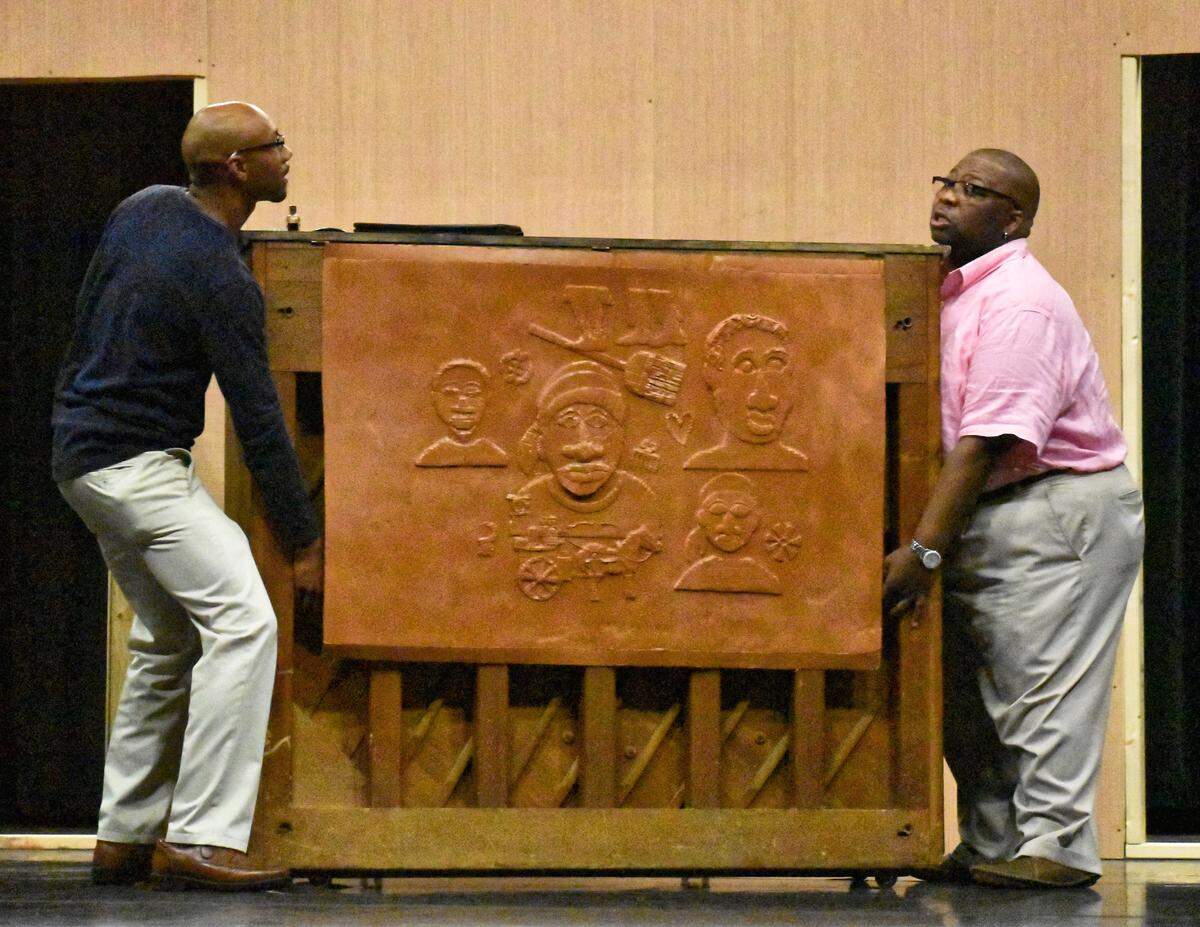
For the carvings, Griffith asked one of Message’s co-founders, Frank X. Walker, a Lexington poet and former Kentucky Poet Laureate who recently returned to making visual art after a long hiatus, to lend and artistic hand for the backside of the piano.
“I’m not an actor, so I was excited to be able to contribute at all,” said Walker, whose work has been exhibited at the Carnegie Center for Literacy & Learning. “I had the chance to pull up some images of the carved piano they created for the Broadway production (which starred Charles S. Dutton and S. Epatha Merkerson in 1990), and I knew we couldn’t have anything like that because of our budget.”
Walker adapted by creating a bas-relief piece, on painted cardboard, depicting the faces of characters referred to in the play. It turned out to be the first piece created in his new visual art studio.
“It’s liberating to be in a studio again,” he said. “Good to be back.”
Emanuel Thurman (left, as Lymon) and Damon Greene (as Boy Willie) rehearsing a scene from “The Piano Lesson,” about a brother and sister fighting over a family heirloom. The artwork for the carvings on the piano were done by of Message’s co-founders, Frank X. Walker, a Lexington poet and former Kentucky Poet Laureate. Kevin Nance
In the play, Boy Willie (played by Damon Greene) lays down his game plan this way: “Walk in there. Tip my hat. Lay my money down on the table. Get my deed and walk on out. This time I get to keep all the cotton. Hire me some men to work it for me. Gin my cotton. Get my seed. And I’ll see you again next year.”
The effect of the plan, as Toni Morrison put it in a 2007 foreword to the published play, is “changing generations of servitude into ownership and escape from a brutal past.”
But Boy Willie’s sister, Berniece (Desiree Denise Jackson), for whom the piano is an irreplaceable reliquary of her family’s tragic history, has other ideas. “I ain’t paying him no mind,” she tells their uncle Doaker (Patrick J. Mitchell). “If he come up here thinking he gonna sell that piano then he done come up here for nothing.”
“The play is about a family and its history,” says director Keith Griffith, one of the co-founders of Message Theater. Kevin Nance
Frank X. Walker recently returned to making visual art after a long hiatus. Pablo Alcala 2014 staff file photo
This conflict between brother and sister is the crux of “The Piano Lesson,” one of two Pulitzer Prize winners in “The Pittsburgh Cycle,” Wilson’s 10-play sequence about African-American life in each decade of the 20th century. (The other Pulitzer winner, “Fences,” will be produced in February by AthensWest Theatre Company at the Pam Miller Downtown Arts Center.)
“The play is about a family and its history,” says Griffith, who co-founded Message Theater with Mitchell and others in the early 1990s as a community organization producing plays by, for and about African-Americans. “There’s a piano that has the history of this family carved into it, from slavery times until when the play takes place. The story goes generation by generation, following the history of this piano and its significance to the family.”
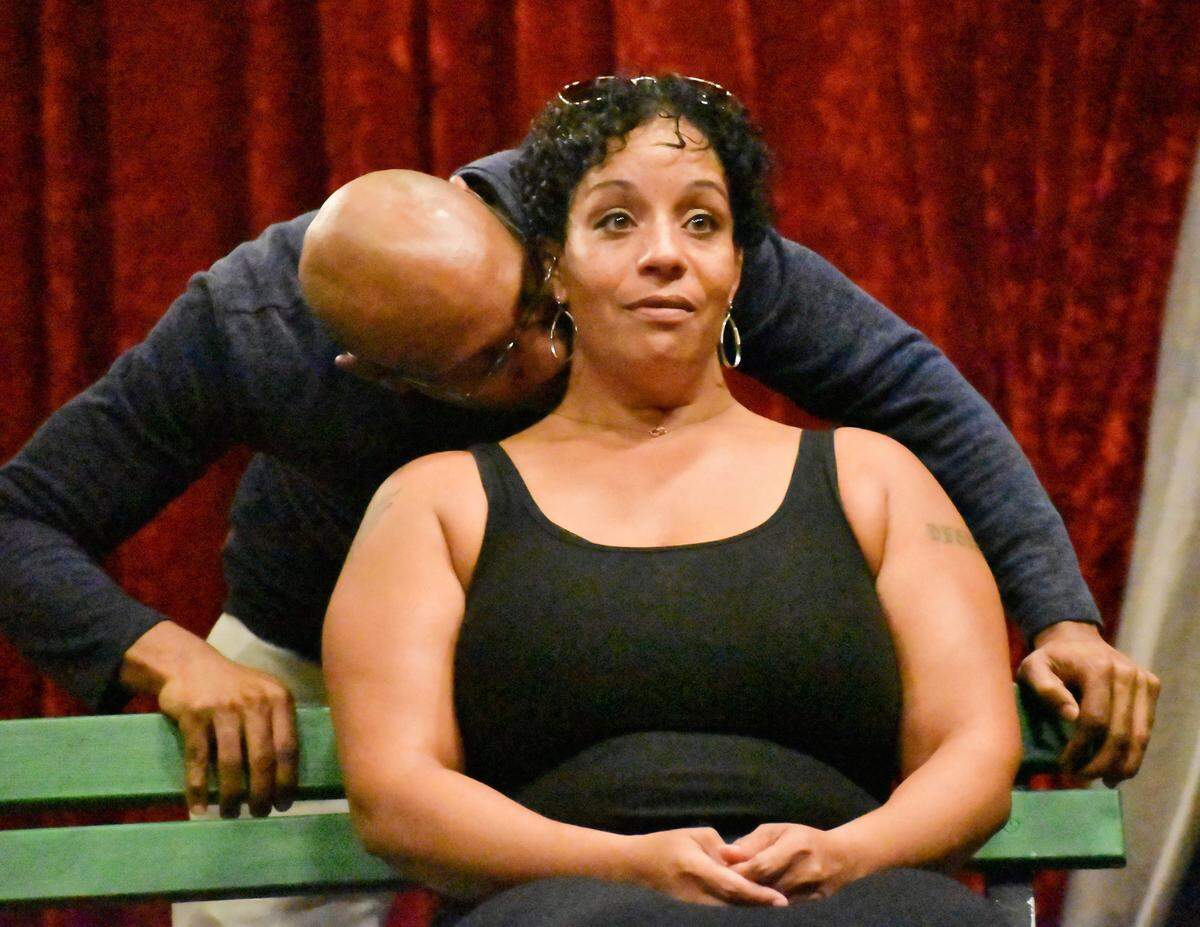
Emanuel Thurman (as Lymon) and Desiree Denise Jackson (as Berniece) rehearse a scene in Message Theater’s production of August Wilson’s “The Piano Lesson.” Kevin Nance
The Piano Lesson by Message Theater
Where: The Lyric Theatre & Cultural Arts Center, 300 E. Third St., Lexington