
‘Selma the Musical’ tells untold stories from front lines of the civil rights movement
All by itself, the word “Selma” conjures not just a place but an entire era, an entire chapter of American history.
It was in Selma where, on March 7, 1965, a group of civil rights activists led by the Rev. Martin Luther King Jr. tried to cross the Edmund Pettus Bridge to begin a 54-mile march to Montgomery, Alabama’s capitol, to protest state laws that kept many African-Americans from being able to vote. On that Bloody Sunday, as it came to be known, police and their white-supremacist supporters attacked the protesters with billy clubs and tear gas.
The marchers tried again two days later, only to turn back in compliance with a federal injunction, and finally made it across the bridge on March 21, this time protected by National Guard troops. The Selma-to-Montgomery march dominated front pages and news broadcasts around the world, highlighting the civil rights struggle and contributing to the passage of the landmark Voting Rights Act later that year.
That’s the big picture that many if not most Americans over 40 know at least parts of. But there are smaller pictures, too, just as important but less well-known. If the story of Selma is an epic narrative of major historical figures and colliding political forces, it’s also about how everyday African-Americans and their families — who were often divided in their views of the event as it unfolded — were caught up in the whirlwind of history.
It’s that less-publicized side of the narrative that comes to the forefront in “Selma the Musical: The Untold Stories,” a touring theater production making a stop at the Lyric Theatre & Cultural Arts Center on Feb. 7-9. Drawing on research that included interviews with Selma residents who experienced the events of 1965 firsthand, “Selma the Musical” explores the contrasting opinions of African-Americans who were there.
“I went and spent time in Selma, and walked across the bridge several times,” writer-composer-director-producer J.P. Haynes said at the Lyric last week during a visit to promote the show with the cast. “There’s tons of information online, but the best information is from those who lived it.”
A native of Mississippi, Haynes, 36, was inspired to create a stage production about Selma after visiting the city in 2016 to perform her spoken-word poetry. The musical opened three years ago and has been touring ever since, playing venues across the country, receiving exposure on network TV (including “Good Morning America” and “The Today Show”) and being performed on a Royal Caribbean Cruise to the Bahamas.
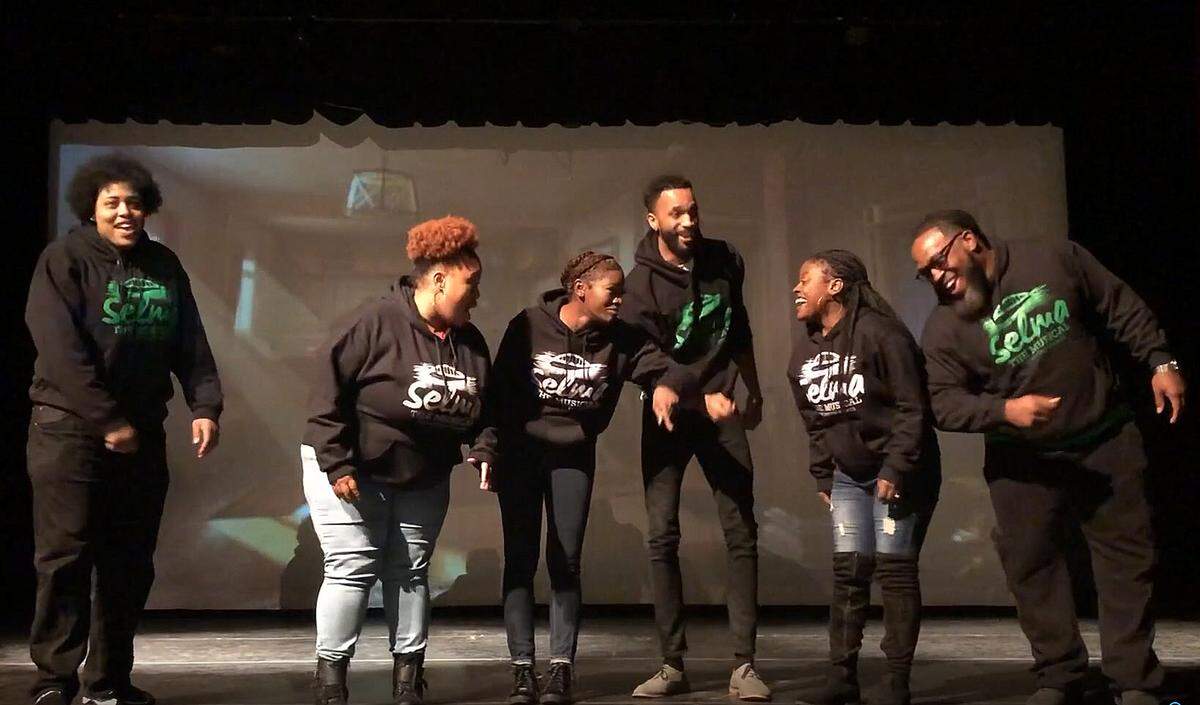
The show — which features a score that combines spirituals (including rousing renditions of “Amazing Grace” and “I Know I’ve Been Changed”) and gospel music along with original songs — centers on the Wilson family, whose members reflect the wide range of black opinion as the attention of the country bore down on Selma.
The Wilsons are led by two adult siblings, Connie and Joe, who are on opposites sides of a passionate debate about the direction of the civil rights movement.
Connie, a soon-to-be college student “who believes she can be the next Thurgood Marshall,” said Haynes, is a staunch supporter of King and his belief in nonviolent resistance to racist oppression. Joe is “vehemently against Dr. King,” Haynes says, preferring the more confrontational approach of Malcolm X, who was assassinated less than a month before Bloody Sunday.
Other characters in the musical represent other points of view, including the widely expressed desire for the Selma protest to simply go away.
“Some people — black, white, it didn’t matter — did not want Dr. King there in Selma,” Haynes says. “They didn’t want him coming to town, ruffling feathers. They didn’t want riots and shootings and killings. Dr. King’s approval rating around the country was very poor. He’s honored now, but during his time here, he was not well-liked or well-received by all black people. And some people just did not want to get involved.”
That last group is represented in the show by two characters “who offer comedic relief but really just don’t care,” Haynes says. “They’re just not connected to the issue. They don’t see what the big deal is. So the show is a look at a family that has these four or five different opinions, and how do they all come together?”
Cast member Chiara Pittman-Lewis says the show’s nuanced retelling of the Selma story is often a deeply emotional, even tearful experience for black and white audiences, including many people who may know little or nothing about events that occurred more than half a century ago.
“We go a little deep,” says Pittman-Lewis. “After the show, I see a lot of hope. I see that it gives a lot of people inspiration. And I also see that it educates a lot of them that may not have known anything about Selma. There’s a lot of people that we meet that didn’t know anything about the civil rights movement. So it’s a whole education class, coming to see this musical.”
Jeanne Mabson-Sweat, a member of Women in Worship of Lexington — a community group co-sponsoring “Selma the Musical” along with the Lyric — agreed.
“It’s powerful,” she said of the show. “The talent is amazing. The storyline is emotional and it actually connects with the audience. They’re not going to be prepared for what they feel.”
‘Selma the Musical: The Untold Stories’
Where: The Lyric Theatre & Cultural Arts Center, 300 E. Third St., Lexington
When: 7 p.m. Feb. 7; 2 p.m. and 7 p.m. Feb. 8; 3 p.m. Feb. 9
Tickets: $30-$45 at (859) 280-2218 or lexingtonlyric.tix.com
This story was originally published February 5, 2020 at 9:49 AM.