
Lexington Children's Theatre's adaptation of 'Goodnight Moon' explores the subtext of children's classic bedtime tale
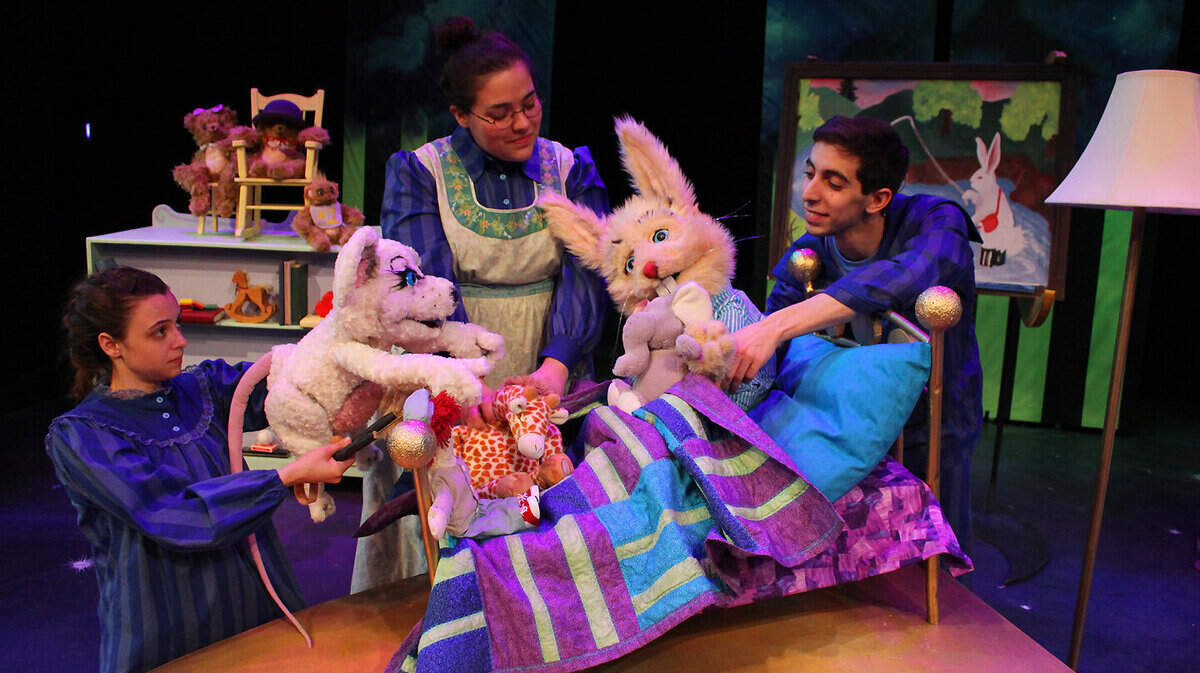
Vivian Snipes and Eric Abele are aware that if Lexington Children's Theatre presented a literal interpretation of Margaret Wise Brown and Clement Hurd's children's book Goodnight Moon, it would last about five minutes.
At 32 pages and just 130 words, the book, first published in 1947, is a masterpiece of spare prose and simple imagery. It even lacks a story, and giving it one is how the short, sweet bedtime book has been turned into an hourlong stage play.
"Why isn't Bunny going to sleep?" says Snipes, who is directing Chad Henry's musical adaptation of the classic at the Children's Theatre on Sunday and next weekend. "It's the subtext of the book, brought to the forefront of the musical."
Despite the source material's simplicity, designer Abele says the big, complicated musical is the show that the LCT crew has steeled itself for all season.
"It's about the imagination," Abele says.
And the imagination can run wild. It even did in the book.
Goodnight Moon is a simple read, describing a room where an old woman rabbit is trying to get a young rabbit to go to sleep, but it conjures images of, among others, a cow jumping over the moon, mice, kittens, and bears sitting on chairs.
The book also has a quiet allusion to writer Brown and illustrator Hurd's other classic, Runaway Bunny, an image of which is seen on the wall of the room. But in the stage show, the story of Runaway Bunny is fully told in the course of Moon's Bunny trying to get himself to sleep. The play also brings many characters to life and adds others, including the Tooth Fairy.
One of the first questions to be answered in staging Goodnight Moon was whether it would be done with just actors or actors with puppets.
"When I did the original sketches for this show, I did one complete set with actors and one with puppets," Abele says.
Puppets helped solve some of the problems that the show presented, such as how to get a cow to jump over a moon on stage.
"We needed a bunny who could fly," Abele says. "It's so much easier to do those sorts of things with puppets."
In the end, the show ended up with a mix of actors and puppets.
They are active, colorful puppets. Abele demonstrates how Bunny can go from being bright and attentive to droopy-eyed and sleepy. Representing the bears are two-person puppets, a first for LCT. The actors in the roles of bears have to coordinate tap dancing, among other moves.
The other major question facing the creative team was the overall look of the show.
"I was probably the biggest advocate that it needed to look like the book, because that's what the audience would come in expecting," Snipes says.
Like the puppets and humans, the solution was a bit of a mix. The props reflect the "great green room" of the 65-year-old book, with its comfy bed, bookcase, toys, pictures and, of course, the red balloon.
But the motif is more of lunar blues and yellows, with the phases of the moon represented as the story progresses.
Maybe easier than putting the show up is explaining why the book has endured for such a long time.
"It's a universal story about the relationship between a child and a guardian," Snipes says, because the old woman's relationship to the child is never defined in the book. "We all went through everything that's in the story, wanting to go to sleep, wanting a child to go to sleep and the intimacy of that time."
And although the stage show builds on the book, Snipes says, the essence of the original is there: the great green room, the moon, the comb, the brush, the bowl full of mush, "and a quiet old lady who was whispering hush."
This story was originally published April 29, 2012 at 12:00 AM with the headline "Lexington Children's Theatre's adaptation of 'Goodnight Moon' explores the subtext of children's classic bedtime tale."