
SummerFest's Shakespeare play, 'Comedy of Errors,' gets a Monty Python update
The program notes for last year's SummerFest production of William Shakespeare's comedy Twelfth Night included a cartoon of the many tropes used in Shakespeare's plays, tropes like mistaken identity, twins, and shipwrecks.
This year, they're dusting off the trope shelf with The Comedy of Errors, one of Shakespeare's earliest plays, possibly his very first.
Mistaken identities, twins, shipwrecks, and lowbrow puns woven with highbrow ideas are all ingredients in what SummerFest's parent organization, Kentucky Conservatory Theatre, touts as one of Shakespeare's "wackiest plays."
Not typically one of the go-to plays for outdoor Shakespeare, SummerFest's production of Comedy of Errors will give Central Kentucky audiences a chance to see how an early-career Shakespeare began planting the seeds of constructs and ideas that were more fully fleshed out in later works.
But making intellectual connections between Shakespeare's early works and later ones are not the main thing on director Bob Singleton's mind. He's playing for laughs — lots of them.
"Tragedy is me tripping and falling over a curb," Singleton says. "Comedy is when you do it."
Singleton says the show is a perfect pairing with the festival's other summer production, Monty Python's Spamalot, which is running in repertory with Comedy throughout the month.
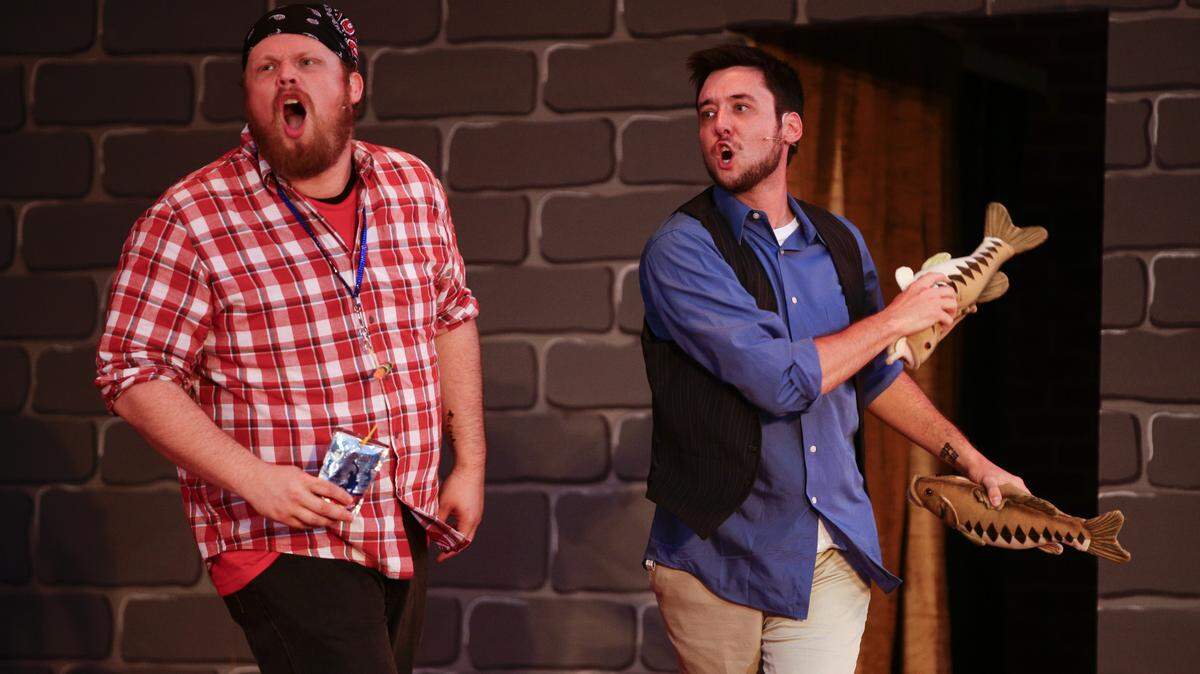
"I said to Wes (Nelson)," Singleton says, "there's going to be a fish-slap. I'm telling you right now, there will be a fish-slap, period.
"There might be a distant relative of the Black Knight in this production," Singleton says, and there are many comedic "Easter eggs" throughout the production that audiences will pick up on, and they aren't just limited to references to Monty Python, whose 1975 movie Monty Python and the Holy Grail was the basis for Spamalot.
Singleton was inspired by iconic comedians from the past century or so: Charlie Chaplin, Buster Keaton, Carol Burnett, Jackie Gleason, Abbott and Costello, and Lucille Ball, among others.
"You can hear a lot of these influences in the wordplay. In the back-and-forth between characters, there's almost a 'Who's on First?' feel to some of the scenes," Singleton says. "It's very physical comedy, very slapstick, and it's by far Shakespeare's most farcical work."
Singleton says he wanted to fully embrace the absurdity of farce while deepening the dramatic tension that might get glossed over in other productions.
The play opens with the prospect of a beheading, for instance.
Nelson, executive director of KCT, says he tapped Singleton, who has never directed a Shakespeare production (but has performed in them), because of his ability to connect and to translate a vision modern audiences.
"When seeking a director, I knew that we needed someone with a modern take on period comedies," Nelson says. "So many people think that Shakespeare has to be performed with this grand, slow pace. This belief does not always apply well to modern audiences. Having seen Bob's work on other comedic pieces, I knew he was the man for the job."
Singleton's Comedy of Errors clocks in at less than two hours, even with intermission, and is, in Singleton's words, "streamlined and very accessible."
"Ostensibly we're set in the present period," Singleton says, "but it could be wherever or whenever."
The show might also may be a bit easier for audiences to follow, plot-wise, than some of Shakespeare's later works.
One of only two of Shakespeare's plays (The Tempest is the other) that adhere to Aristotle's three classical unities — of action, time and place — all of the events take place in 24 hours, in the same location and with one plot driving the action. It has a smaller cast and fewer subplots than many Shakespeare shows, making it an un-intimidating introduction for those just cutting their teeth on the Bard's work.
This story was originally published July 16, 2015 at 11:11 AM.