
Lexington art project wins national grant, will bring iconic Black portraits to new sites
Perhaps you’ve seen them in the windows of buildings around downtown Lexington: Portraits of Black faces gazing out at you, their eyes soulful, solemn, bottomless, timeless.
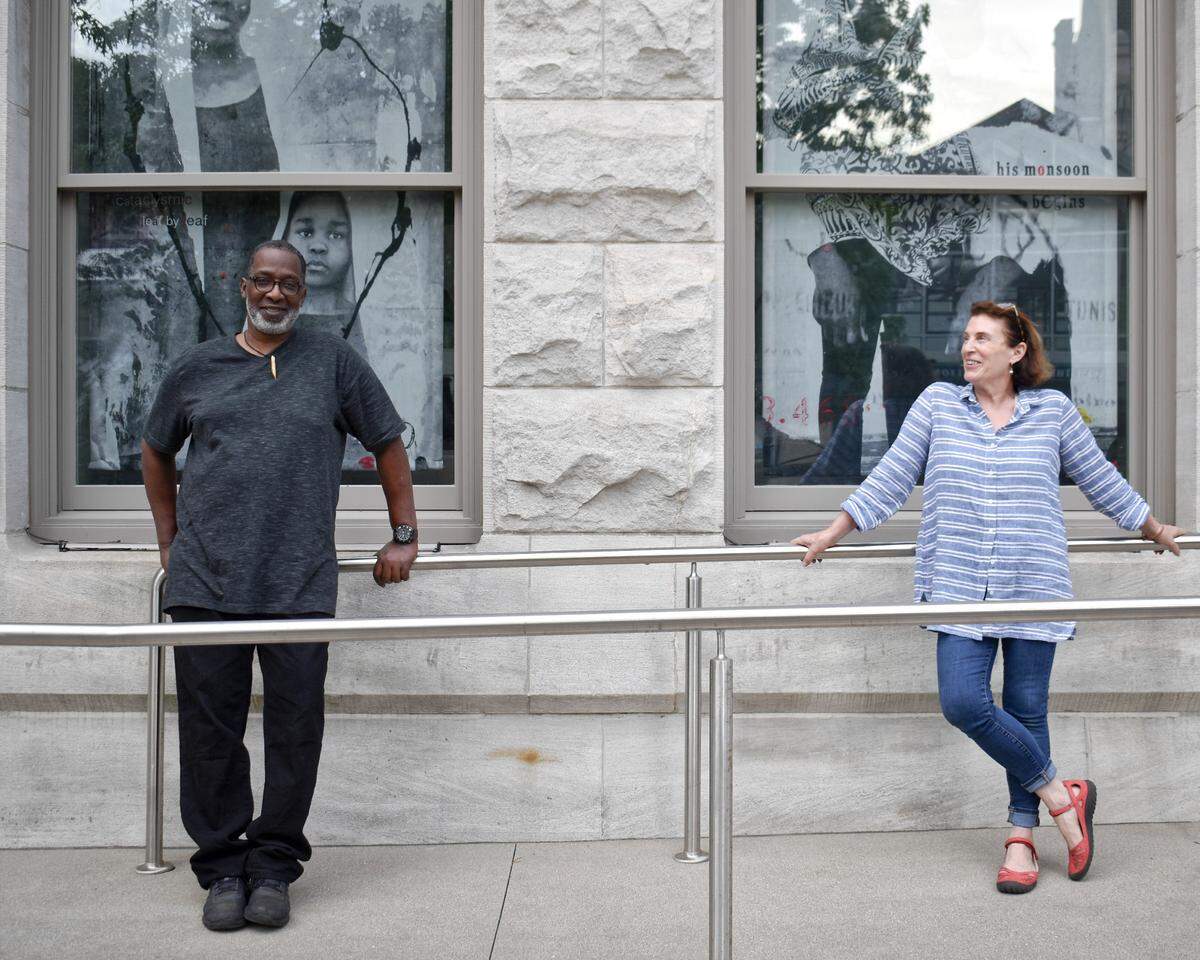
The tapestries overlook the streets surrounding Cheapside Park, where enslaved human beings were once bought and sold, seemingly embodying and transcending what happened there, then and since.
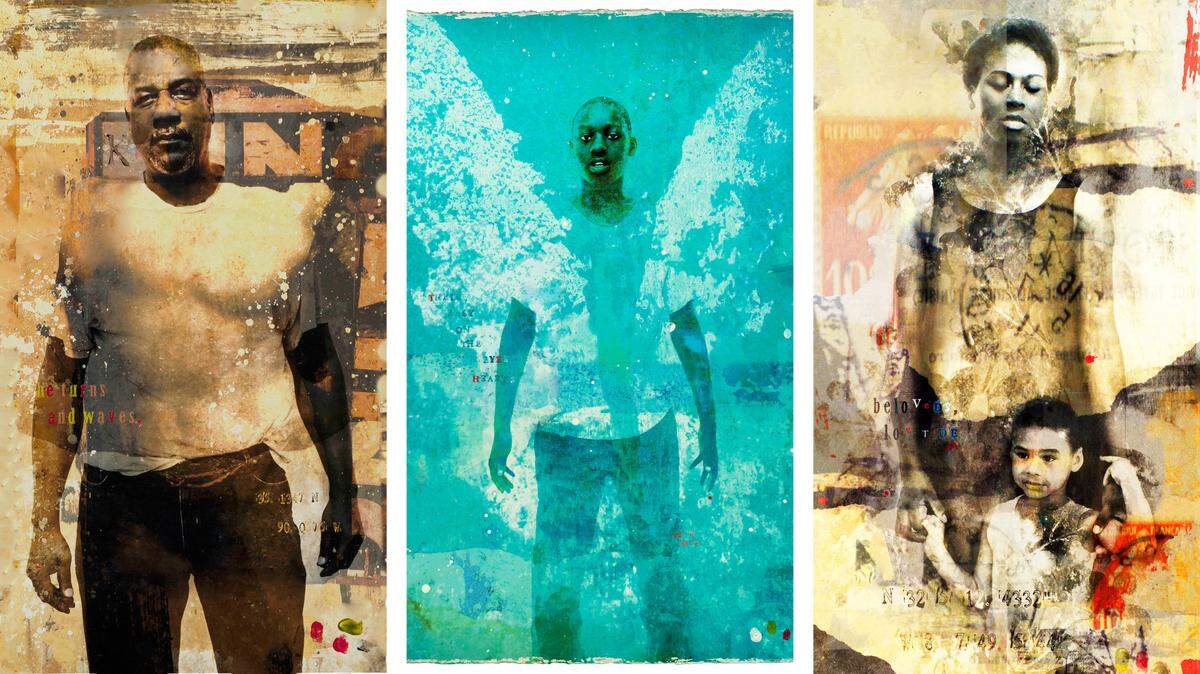
These are the 21 “ancestor spirit” portraits of “i was here,” a public art project by collage artist Marjorie Guyon, photographer Patrick J. Mitchell and National Book Award-winning poet Nikky Finney.
Featuring Mitchell’s somber photographs overlaid with Guyon’s abstract and/or historical elements referencing the transatlantic slave trade, as well as fragments of a poem by Finney and other texts, the series was installed in the fall of 2018 in various locations, including Lexington’s Central Library and its Northside Branch.
Now with the help of a recently announced $20,000 grant from the National Endowment for the Arts, the library plans to expand the “i was here” project, installing additional portraits for permanent display at its Eastside, Village, Beaumont and Tates Creek branches.
“We’re really excited about this,” said Doug Tattershall, the library’s community arts coordinator. “All along, we wanted to make it system-wide, and now this grant allows us to do that. The work itself is amazing. The customers love it and the employees love it, so we’re looking for places to install the portraits. We like them especially in windows because they’re translucent, facing both inside and outside.”
In a statement NEA Chairwoman Mary Anne Carter praised “i was here” as a project that “asks us to engage with history of place, creating a path for communities across America to share the truth of the past and the possibilities of the future. In honoring a piece of the human puzzle that makes us who we are, we are planting a vision of what the word US means in the heart of America.”
The “i was here” project has its roots in a moment that occurred in Guyon’s downtown studio on Upper Street in late 2016. Ashley Grigsby, a Black friend of the artist, was visiting her studio, whose west-facing, second-floor windows overlook Cheapside, the site of one of the South’s largest slave markets before the Civil War.
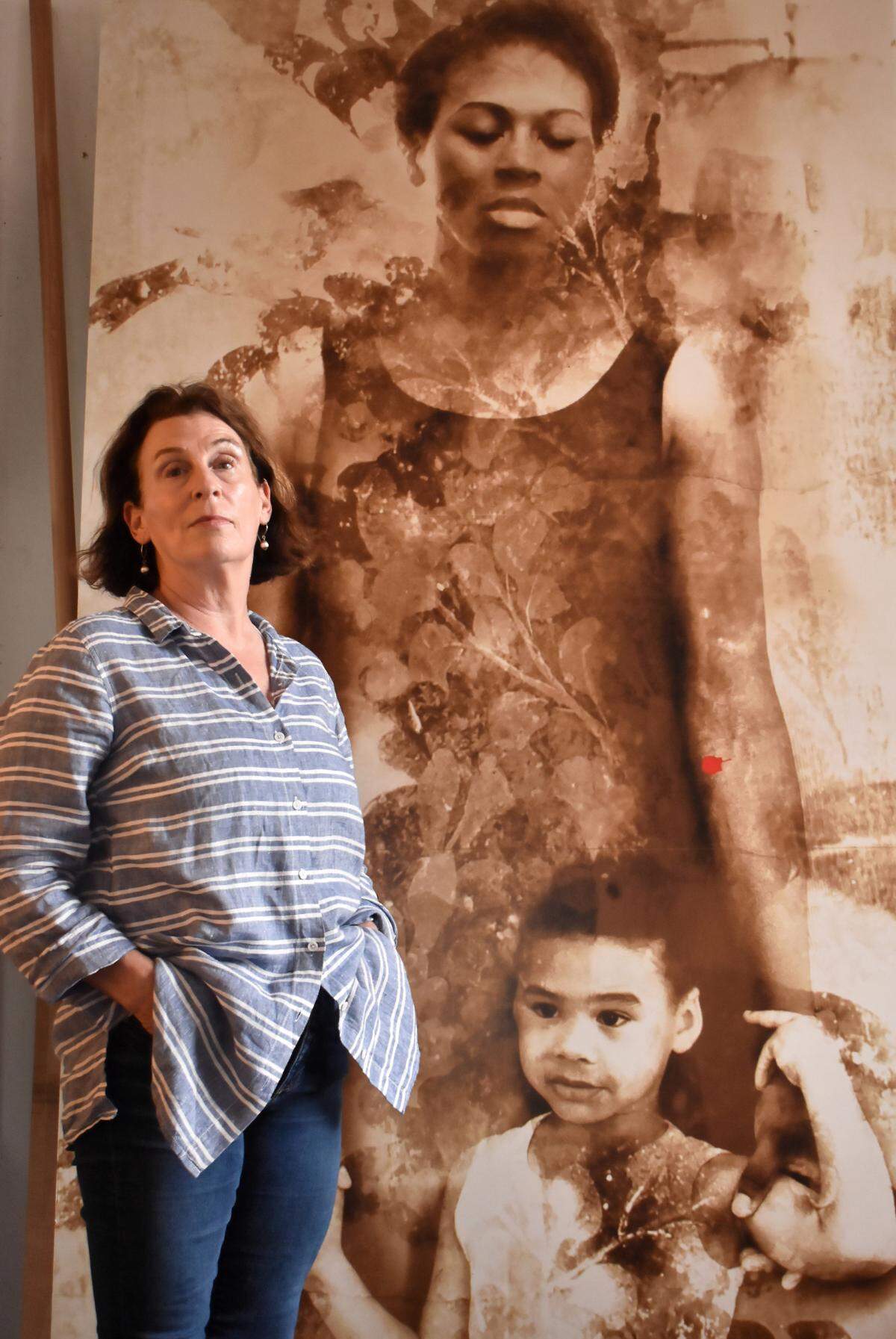
“Ashley was standing by this window,” Guyon recalled in a recent interview in her studio along with Mitchell. “Looking over her shoulder, I had a vision of women and children appearing in the windows surrounding Cheapside.”
She shared it with Grigsby.
“As a Black woman, I’m invisible, and everyone’s afraid of our men,” Grigsby said at the time. “Let’s do it.”
Guyon took some pictures of Grigsby and began layering imagery and other elements onto them, creating what became the first collage portraits of the “i was here” series, which she envisioned as “spirit figures” reminding us of the wound of slavery and its lingering legacy in the lives of all Americans today.
The artist then sent them to Finney, a former Lexington-based poet who now teaches at the University of South Carolina. Finney agreed to write a poem for the project, and also suggested that the series should include “all of humanity,” not just mothers and children.
“They’re not specific people from a specific place,” Guyon said. “They are archetypal images of father, mother, sister, husband, wife, daughter, son. They are emblematic, iconic portraits of those who came before us, and they create a memorial in places where these crimes against humanity took place, like Cheapside.”
Today, she noted, Cheapside Park is typically used for events whose participants may have no awareness of the site’s terrible history. “On Thursday nights, it’s a party place to most of the people there. But it’s actually a sacred space, so the idea was to include the presence of these powerful, beautiful, dignified humans into the public sphere and, in the process, to shift the spirit of the country.”
With the scope of the project expanding, Guyon reached out to Mitchell, one of Lexington’s leading portrait photographers, who quickly signed on as her collaborator. Drawing on his background as a local theater artist, Mitchell held auditions for the project and shot its first portraits in Guyon’s studio in February of 2018.
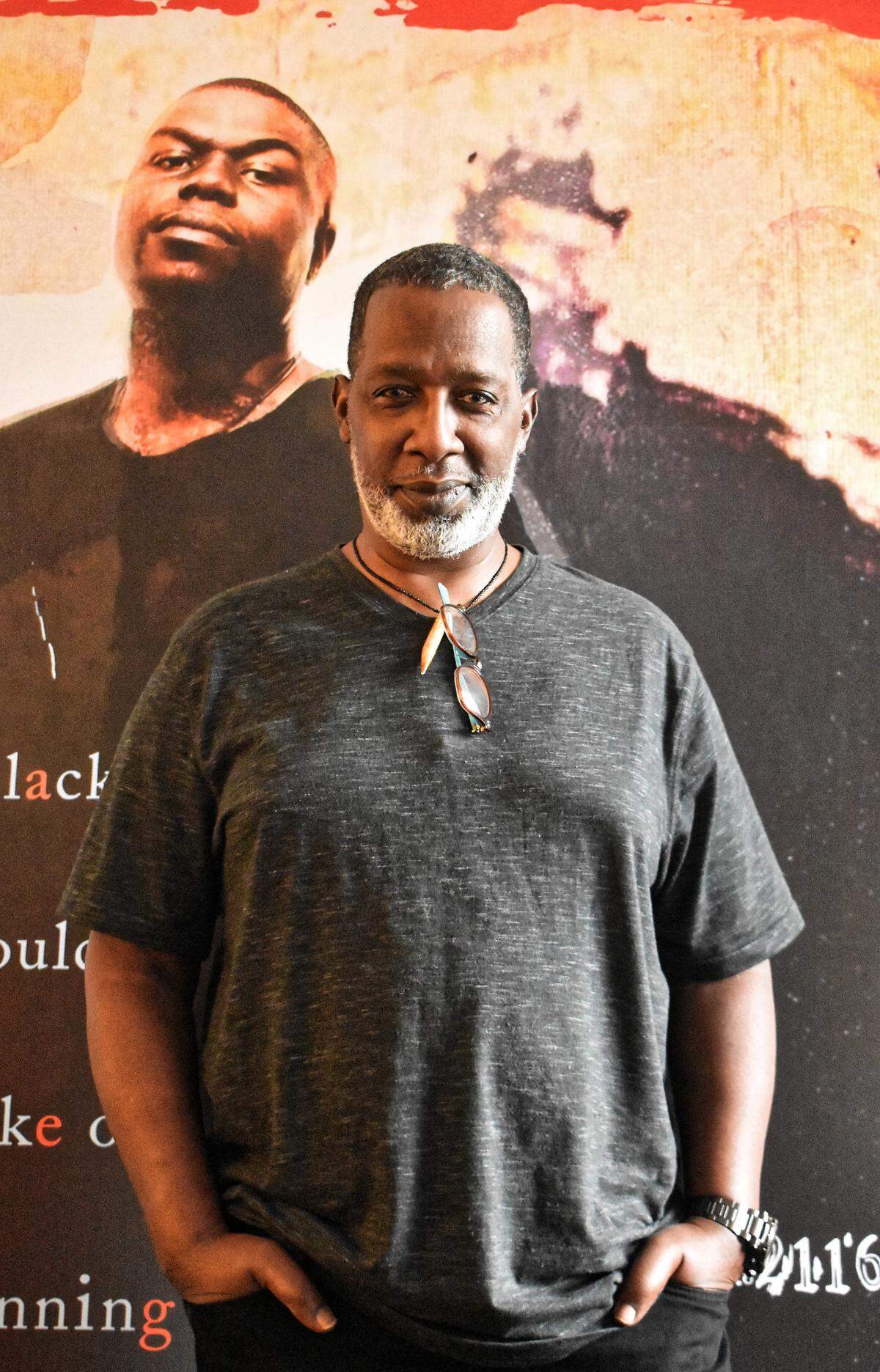
“We approached it as a movie production,” he recalled. “In the auditions for the models, I was looking for them to show me in their faces, in their posture, strength, pride, something that’s going to give an image of what it was like to be sold, what it was like to be human and living in a time when people were being sold — but also to show who they are today. We wanted them to connect, not only physically but with their eyes, to the people downstairs as they walk around the courthouse.”
The first group of “i was here” portraits were transferred onto tapestries and installed in windows downtown beginning in October 2018; they’re visible in windows at City Hall, Courthouse Square, the Central Library and other locations. Some of the portraits are now on display in Winchester, and plans are under way for a new series of installations in Louisville.
The timing of the “i was here” installations in Lexington libraries, originally scheduled for November 2020, is uncertain given the coronavirus pandemic; all the branches are currently closed except for Eastside, which is offering drive-through service only.
“We’re hoping we can have them open by the end of July in some capacity,” said Anne Donworth, the Lexington Public Library’s director of development. “But we’re not sure what that’s going to look like.”
In the meantime, “i was here” seems to take on additional relevance and impact every day in light of the recent social justice protests in the wake of the deaths of George Floyd, Breonna Taylor, Ahmaud Arbery and others.
“It’s extremely relevant to the present moment,” Mitchell said. “One of the goals of the project is to reflect on who we were, who we are, and who we could be. How the police — white people, anybody who means to do any human harm — see us, that could be connected to how they see these images. When these spirit figures appear, larger than life, and look at you, it changes things.”