
For glass artist, work matters more than what results
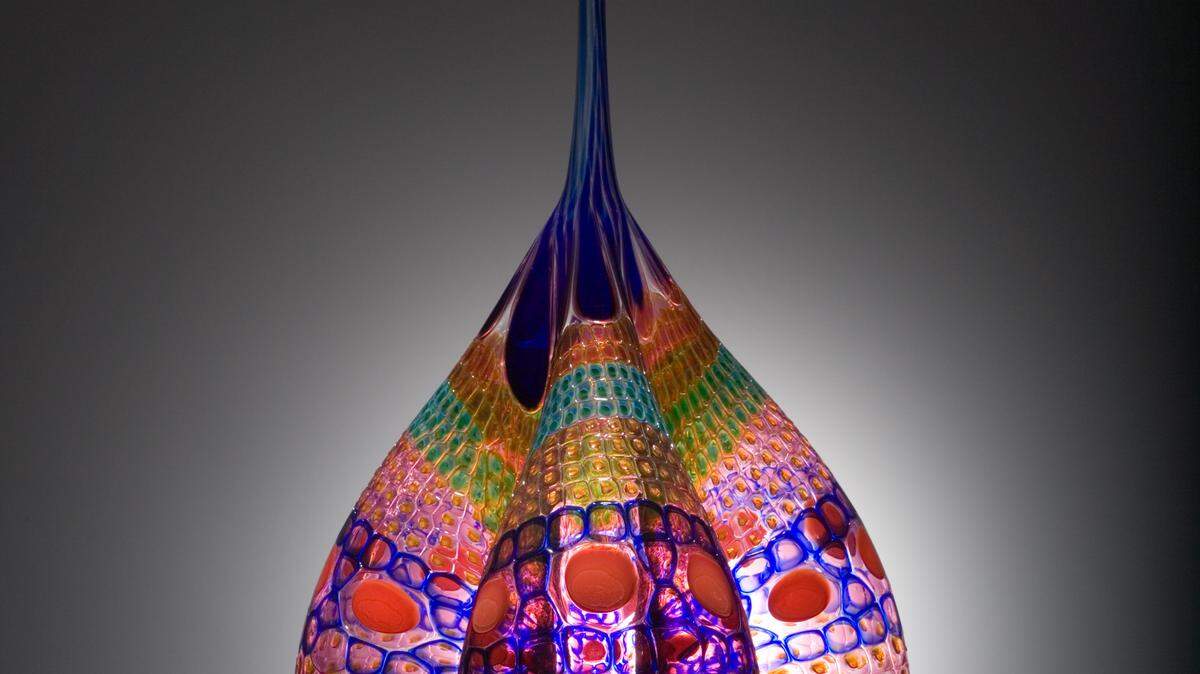
DANVILLE — Stephen Rolfe Powell prepares to create art the way the former semi-pro tennis player used to get ready for a match: push-ups, sit-ups and a lot of stretching.
Powell does his quick workout on the floor of an empty classroom near his Centre College studio, where a furnace is heating clear glass to more than 2,000 degrees. His four-person crew arranges tools and gets ready for action.
Powell is soon skillfully wielding a hollow steel rod, gathering more and more glass from the furnace and rolling it smooth on a stainless-steel table. When the glob on the end of Powell's rod weighs nearly 30 pounds, he carefully rolls it over a heated mosaic of more than 2,000 bits of colored glass that will determine the finished piece's pattern and texture.
The pace quickens as Powell and his team add just the right amounts of fire, air and motion to manipulate the glass. By the end of this increasingly frantic dance, they will have created a graceful vessel with two squiggly necks that is a symphony of light and color.
"For me, the making of the work is more important than the end," Powell said. "If I couldn't go in the studio and make work, I'd be a basket case. It's a drug for me. When I'm in that process and things are going, especially at the end, I'm aware of nothing else."
The finished vessel, which might sell for $25,000 or more, is the kind of work that has earned Powell an international reputation as a glass artist. This year, it also earned him the Artist Award as part of the Governor's Awards in the Arts. He will accept the prize Oct. 28 at a ceremony at the state Capitol with his wife, Shelly, and their two sons, Hawk, 11, and Oliver, 9, by his side.
"I sort of feel humbled by it," Powell said, "When someone says, 'What do you do?' I rarely say I'm an artist. I say I work with glass. There's no question winning this award gives some kind of legitimacy to what I do."
The award caps a big year for Powell, 58. The Hunter Museum of American Art in Chattanooga recently presented a major retrospective of his work. Several of his pieces were shown in The Alltech Experience pavilion at the Alltech FEI World Equestrian Games. Powell, who is on partial sabbatical from his job as an art professor at Centre, recently bought the old Coca-Cola plant in Danville and is converting its 23,000 square feet into artistic work space.
When singer Tony Bennett performed at Centre's Norton Center for the Arts earlier this month, he spent some time creating glass art with Powell. Bennett, an accomplished painter, also worked with Powell the last time he sang in Danville.
Powell said his success sometimes seems surreal because it wasn't until age 28 that he even discovered hot glass.
As a student at Centre, Powell studied painting. After graduation in 1974, he returned to his hometown, Birmingham, Ala., to coach and play tennis and paint. "I got this studio in an old office building and kept waiting for somebody to discover me, but it never happened," he said, laughing.
Powell taught art at his old high school and an Alabama state prison. Then came graduate school at Louisiana State University, where he was attracted to ceramics because it allowed him to do new things with color and light.
Then he discovered glass.
"I fell in love with it immediately," he said. "I like fire and excitement and spontaneity and I have an athletic background. So glass was just it."
Powell returned to Centre to teach in 1983 and created a hot glass studio with local corporate help. "It turns out this is a glass mecca," he said. "Corning, General Electric, Phillips — they all have plants in this area."
Powell's father was a teacher, and he surprised himself by becoming one, too. "I don't know why teaching is so satisfying and such a strong part of what I do, but it really is," he said.
Powell said most of the Centre students who take his glass classes don't plan artistic careers. Even among the art majors, only one or two each year will focus on glass. Still, several have risen to the top of their craft.
Two former students now run university glass programs: Ché Rhodes at the University of Louisville and Lexington native Patrick Martin at Emporia State University in Kansas. Two others are rising professionals: D.H. McNabb of Seattle and Brook White, who started Flame Run studio in Louisville.
Powell's current crew, except for business manager Mitzi Elliott, are former students. "I really depend on that crew," he said. "What I do is a real team effort."
Powell said Centre's support also has been critical to his success. "I just can't imagine I would have had the same experience at another college," he said.
One example: Centre awarded an honorary doctorate in 2004 to Powell's mentor, Lino Tagliapietra, a Venetian glass master who never attended college. "When I said he's the best in the world, they trusted me," Powell said. "That meant a lot."
Powell has focused his artistic expression on creating vessels because it is a form everyone can relate to. But he tries to keep experimenting with shape, color, pattern and effect. His vessels often have sensuous shapes, and he gives them wacky three-word names, such as Autumn Jealous Cleavage and Bombastic Moxie Gulp.
Now that he has more work space in the old Coca-Cola plant, Powell is interested in experimenting with large installation pieces. He recently completed one for the newly expanded and renovated Boyle County Public Library: 365 colored glass globes hung from the ceiling with aircraft cable.
What does Powell want people to take away from his art?
"I hope my work makes you step back and take a breath and pull away from the rest of the world and just have a moment of pleasure," he said. "That's about all I can come up with."
This story was originally published October 17, 2010 at 12:00 AM with the headline "For glass artist, work matters more than what results."