
Century-old insect drawings reveal the art of scientific illustration
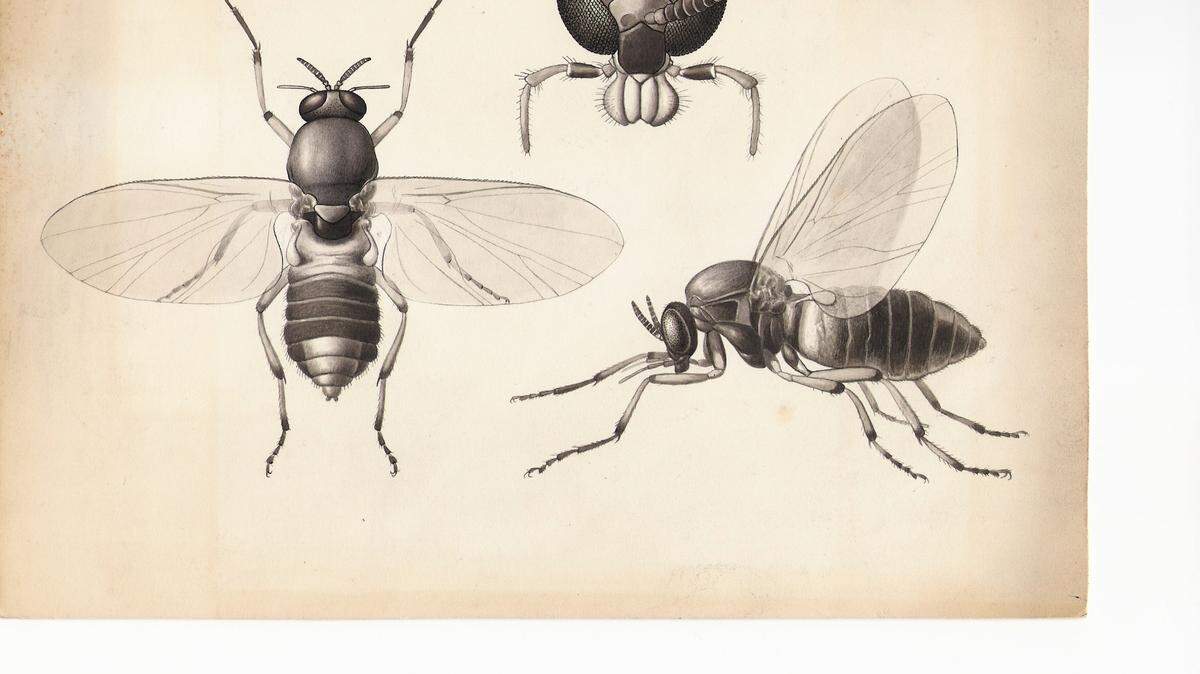
The word beautiful got thrown around an awful lot one recent morning in The Art Museum at the University of Kentucky.
Officials were discussing the fine details of the drawings that were being put up for display, the beautiful shapes and patterns and stunning revelations of the art.
And they were talking about bugs — the kinds of bugs that we usually slap dead if they land on our arms, the ones that a flyswatter was named for. Except for maybe butterflies and a few other species, these creatures are rarely called beautiful.
But the exhibit that opens Sunday takes a much closer look at insects of the Bluegrass, including the common black fly and the mosquito.
The catalyst for the show was the discovery of illustrations by William C. Matthews, who was in UK's entomology department in the early 1900s.
"They had been stored in a desk, and nobody had looked at it for decades," said Blake L. Newton, an extension specialist in the entomology department. "So basically, my department chair gave me this box and said, 'Here, I found this cool stuff. Take a look at it.'"
What he looked at were textbook examples of scientific illustration, a technique in which the artist has to create a photorealistic image that often can give scientists greater insight into the object than a photograph.
"We looked at these and thought they were so incredible, and we wondered if there was some way to display them," Newton said.
He called the museum and reached Janie M. Welker, curator of collections and exhibitions.
Scientific illustration was new to the museum, in Welker's experience.
"I've seen some institutions such as the Smithsonian exhibit scientific illustration before," she said. "It's so precisely detailed, and he did this freehand while looking through a microscope at the bugs.
"We tend not to think of it as fine art, but look at it. It's so beautiful, and his skill is so profound. How can you look at these and not consider them art?"
Even with huge advances in photography, scientific illustration is in use today in exploration of nature including animals, plants and even medicine.
"Sometimes illustrators can portray things in a way that is more useful to scientists than a photograph," Welker said. "Because in a photograph, things can happen like colors shift, perspectives can change, and they can really emphasize the identifying characteristics.
"The art is really amazing when you look at it. They're so beautiful and so finely detailed, it's really amazing."
Newton said that in his own work, he prefers using scientific illustrations, which are intended "to get an accurate description that will distinguish whatever it is you're drawing from any other organism."
He pointed to illustrations of two lady beetles that were next to each other. At first glance, it appeared that one had just a different array of spots from the other. Closer examination revealed other variations in the color pattern and in physical characteristics.
"These are really two different species of lady beetles," Newton said. "If you saw them crawling around, you might just say the sister has more spots than the other one. But with scientific illustration, you can really get down there and show the minute differences. There are a lot of insects that look almost identical one to the other, which is why you really need scientific illustration to show those differences."
Differences can be as little as the number of hairs on a part of the insect's body, he said, pointing out an exploded view of one of the lady beetle's antennae that shows the hair.
A striking aspect of the illustrations in the exhibit is that most of them are black-and-white. It could be partly attributable to many of them being made for early 20th-century journals that were not published in color. Also, Newton said, "Color is not very useful in identifying insects," because of geographical variations and even differences when an insect is alive and dead, their usual state when illustrators are studying them for drawings.
Many of the illustrations are 30 times or more life size, and as exotic as they look at that size, all are native to Kentucky.
For that reason, museum education director Deborah Borrowdale-Cox said, she hopes to get some school traffic from science classes interested in seeing the drawings. There will be a drawing station at the exhibit so kids can try their hands at drawing insects after they see the show. It could reveal the next William C. Matthews.
Welker and Newton said little is known about the onetime UK staff member except he went on to teach scientific illustration at the University of California. The exhibit happily coincides with the UK entomology department's 120th anniversary, so although a museum exhibit is a bit unusual, the timing is perfect.
"We're looking at the science here," Newton said, "and we're also looking at our history."
This story was originally published August 14, 2011 at 12:00 AM with the headline "Century-old insect drawings reveal the art of scientific illustration."