
Cave paintings are spot on
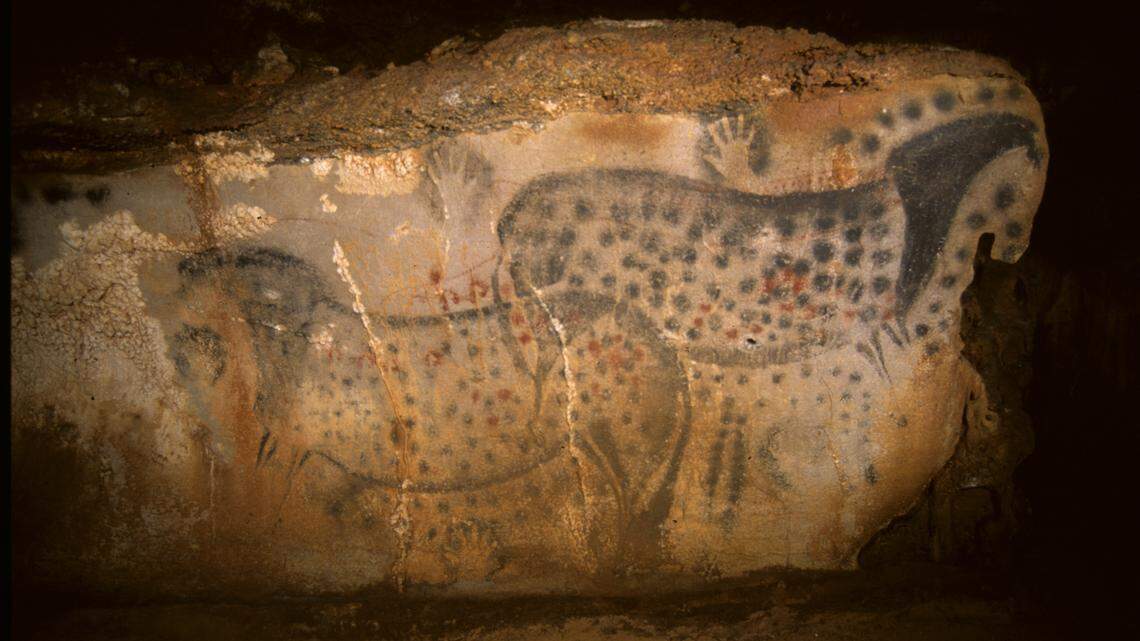
About 25,000 years ago, humans began painting a curious creature on the walls of European caves. Among the rhinos, wild cattle and other animals, they sketched a white horse with black spots.
Although such horses are popular breeds today, scientists didn't think they existed before humans domesticated the species about 5,000 years ago. Now, a new study of prehistoric horse DNA concludes that spotted horses did indeed roam ancient Europe, suggesting that early artists might have reproduced what they saw rather than creating imaginary creatures.
Archeologists have found more than 100 painted caves depicting at least 4,000 animals in Europe, nearly all of them concentrated in southern France and northern Spain. They include France's Chauvet Cave, dating to at least 32,000 years ago and featuring the earliest known cave art, and the roughly 15,000-year-old caves of Lascaux in France and Altamira in Spain. Nearly a third of the animals in painted caves are horses; and nearly all of the horses are rendered in brown or black, similar to the bay or black colors of today's horses.
But a small number of caves, including 25,000-year-old Pech Merle in southern France, feature horses painted white with black spots. Some archaeologists have argued that this leopardlike pattern was fanciful and symbol-laden rather than realistic.
Indeed, in a 2009 analysis of DNA from the bones of nearly 90 ancient horses dating from between 12,000 years ago and 1,000 years ago, researchers found genetic evidence for bay and black coat colors but no sign of the spotted variety, suggesting that the spotted horse could have been the figment of some artist's imagination. Although researchers can only speculate on what prehistoric artists were trying to express, hypotheses range from shamanistic and ritualistic activities to attempts to capture the spirit of horses and other animals that ancient humans hunted.
But in a new paper published online in the Proceedings of the National Academy of Sciences, the same team reports finding that spotted horses did indeed exist about the time that cave artists were doing their best work.
The researchers, led by geneticists Arne Ludwig of the Leibniz Institute for Zoo and Wildlife Research in Berlin and Michael Hofreiter of the University of York in England, analyzed DNA from an older sample of 31 prehistoric horses from Siberia and from Eastern and Western Europe, ranging from about 20,000 years ago to 2,200 years ago. They found that 18 of the horses were bay, seven were black, but six had a genetic variant, called LP, that corresponds to leopardlike spotting in modern horses. Moreover, out of 10 Western European horses estimated to be about 14,000 years old, four had the LP genetic marker, suggesting that spotted horses were not uncommon during the heyday of cave painting.
If so, the team argues, prehistoric artists might have been drawing what they really saw. Prehistoric horses came in at least "three coat color(s)," Ludwig says, "and exactly these three (colors) are also seen in cave paintings. Cave art is more realistic than often suggested."
As for why the spotted type became more rare after 14,000 years ago, the team says that some modern horse breeds with two copies of the LP gene suffer from night blindness, which would have made prehistoric spotted horses more vulnerable to predators. The researchers speculate that the gene might have been beneficial during the ice age, when a white spotted coat could provide camouflage in snowy conditions, but later became rare and disadvantageous until rediscovered by modern horse breeders.
Jean Clottes, France's premier cave-art expert, agrees that cave artists might have painted horses as they saw them, although he argues that such realistic depictions of horses do not rule out possible symbolic meanings. "In (cave) art, you find both naturalism and a departure from it," Clottes says. In the case of the Pech Merle spotted horse, for example, he says that "the big dots were not only on top of the horses but all around them. This would probably mean that some special importance was attached to the dots rather than a simple wish to render them realistically."
Marsha Levine, an expert in prehistoric horses at the University of Cambridge, also thinks that the symbolic aspects of cave painting cannot be shunted aside: "Horses have potent symbolic meanings in all the cultures where they are found, including ours."
This story was originally published November 13, 2011 at 12:00 AM with the headline "Cave paintings are spot on."