
Chicken feet aside, this Lexington Chinese restaurant serves an adventure worth having
For most of its history in China and Hong Kong, dim sum has been mostly served early in the day as a light breakfast or brunch. Since the mid-20th century in Chinese-American restaurants, dim sum has been more an afternoon and evening affair, with patrons ordering several small dishes, tapas-style, which add up to a full, if still light, dinner.
The practical effect is a sort of tasting-menu approach that allows you to try a great variety of dishes — including some more unusual ones that might not normally appear on regular Chinese restaurant menus outside the Chinatowns of major cities such as New York, San Francisco or Chicago — in a single meal.
Chicken feet, for example. Various organ meats, including beef tripe.
Yes. The people of the province of Canton, now known as Quangdong, are known for incorporating virtually every part of many animals, including entrails, into their cooking, which many Western diners find daunting at best.
Many Chinatown restaurants in Chicago, where I lived for several years, acknowledge this by offering separate “Chinese” and “American” menus.
Dim sum at Panda Cuisine
That’s why, when some old friends and former colleagues and their daughter agreed to join me recently for a culinary adventure at Panda Cuisine, one of the few Chinese-American restaurants in Lexington that offer dim sum, I half-jokingly texted that I wouldn’t make them eat any chicken feet.
What I didn’t say was that I was also a little queasy at the thought of eating chicken feet, not to mention beef tripe. The truth is that I’m as big a wimp as anyone, chicken-feet-wise, but I did hope we’d all be brave enough to veer at least a step or two off Chinese food’s beaten path.
On the menu
And so we were, if only baby steps. Placing our order by checking two boxes each on a small printed sheet, my friends and I decided on shui mai (dumplings shaped like tiny sacks of gold), short ribs with honey sauce, bean-curd skin stuffed with pork and shrimp, barbecue pork buns and lava buns (the latter Easter-egg yellow and filled with with a sweet lemony pudding).
We were equal parts dubious and intrigued by something called pan-fried turnip cake, with intrigue barely prevailing. I was also curious about Durian pastry, and asked our waiter for a description.
“Not too many Americans can take it,” he said with a half-apologetic, half-amused smile.
Why not?
“They say it’s kind of, well, stinky.”
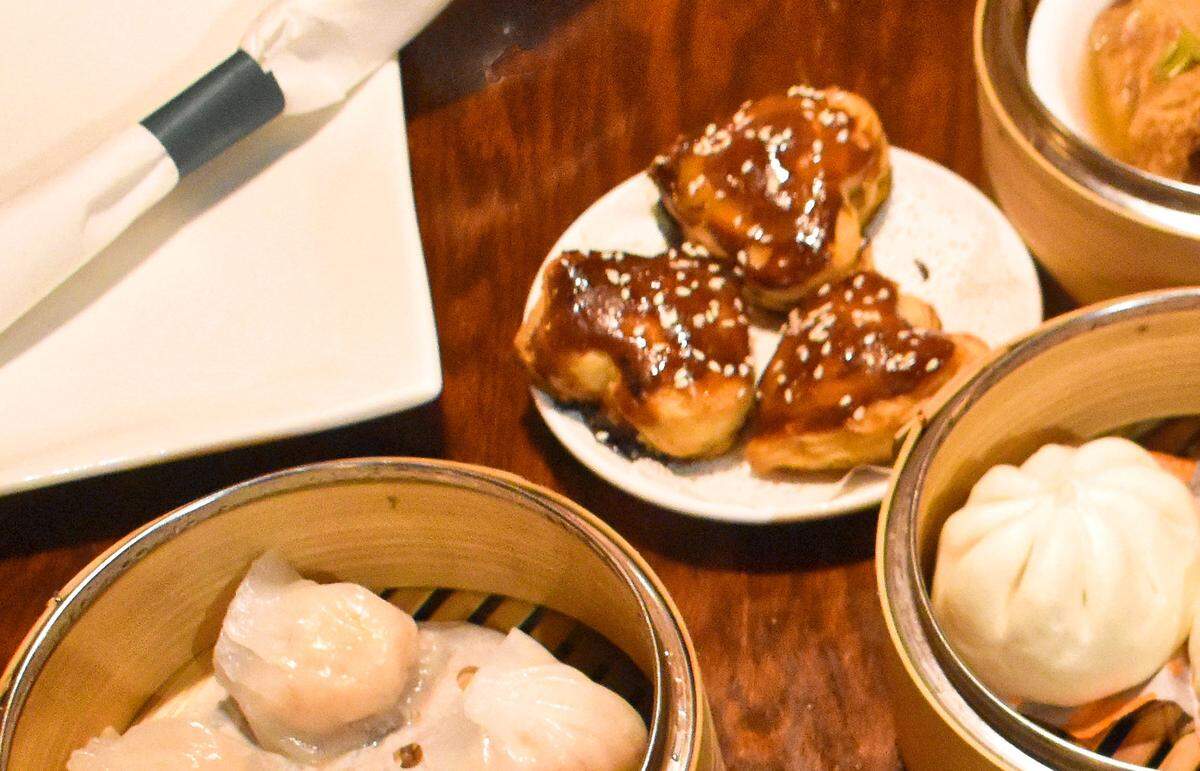
A great many delicious things, certain strong cheeses being the most famous example, are said to be stinky. Besides, I felt as if a gauntlet were being thrown down. My culinary courage, chicken feet notwithstanding, had been challenged. And so I ordered the Durian pastry.
History of dim sum
As we were waiting for the food, I reviewed what I knew about the origins and history of dim sum, which I’ve had many times over the years. Some say the tradition has its roots in the 4th century when a Chinese general ordered small cakes, buns and other tasty treats for his troops to express his appreciation for their military prowess.
Others believe it began some 600 years later, when an official chronicle of the Tang Dynasty included the first known written reference to dim sum. “I have not finished preparing myself and been ready for a proper meal,” someone tells a companion, “therefore you can treat yourself with some small snacks.”
In the original Cantonese, the final two words, “dim sum,” translate as “touch your heart lightly” or, in less poetic terms, “fill your stomach, just barely.”
What’s clear is that for at least a millennium, dim sum — small portions of classic dishes served in steamer baskets, often as accompaniments to the main event of “yum cha,” or social tea-drinking — has been a popular Chinese way of snacking when a full meal isn’t called for.
A flurry of steamer baskets
At Panda Cuisine, when the food arrived in a flurry of steamer baskets, we were, on balance, delighted.
Perhaps predictably, the shui mai and pork buns were savory little bundles that exploded with rich, dark umami flavor in our mouths. The bean-curd skin, floating in a rich brown broth, had an unappealingly slimy texture (one dining partner in particular gave it the fish eye), but the filling was yummy. Ditto the short ribs, though they had too many bones. Another companion was gaga for the lava buns, to the point of being reluctant to share them.
The surprise star attraction of the meal was the turnip cake, which knocked all of us out with its delicate flavor, frittata-like texture and root-vegetable earthiness. I could have eaten an entire plate of it and I was reluctant to share.
And the Durian pastry? A little underwhelming, but not bad. Glazed, heart-shaped puff pastry wrapped around a semi-sweet filling that tasted a bit like apricots, a bit like rutabagas, and certainly not like anything any of us had put in our mouths before. I wouldn’t call it stinky, just a little exotic, a little indefinable. But given the dish’s bad press, I was proud of us for trying it.
Our youngest diner was proud, too. “We should do this kind of thing more often,” she said at the end of the meal.
Yes.
Panda Cuisine
Where: 2358 Nicholasville Rd.
Phone: 859-299-9798
Online: pandacuisinelexington.com
Hours: 11 a.m.-10 p.m. Sun.-Thur; 11 a.m.-11 p.m. Fri., Sat.
Dim sum: Served 5 p.m. to 11 p.m. Fridays. Individual dishes range from $1.95 to $5.25.