
After 150 years, Weisenberger Mill still grinding out flour, cornmeal, pizza crust and more
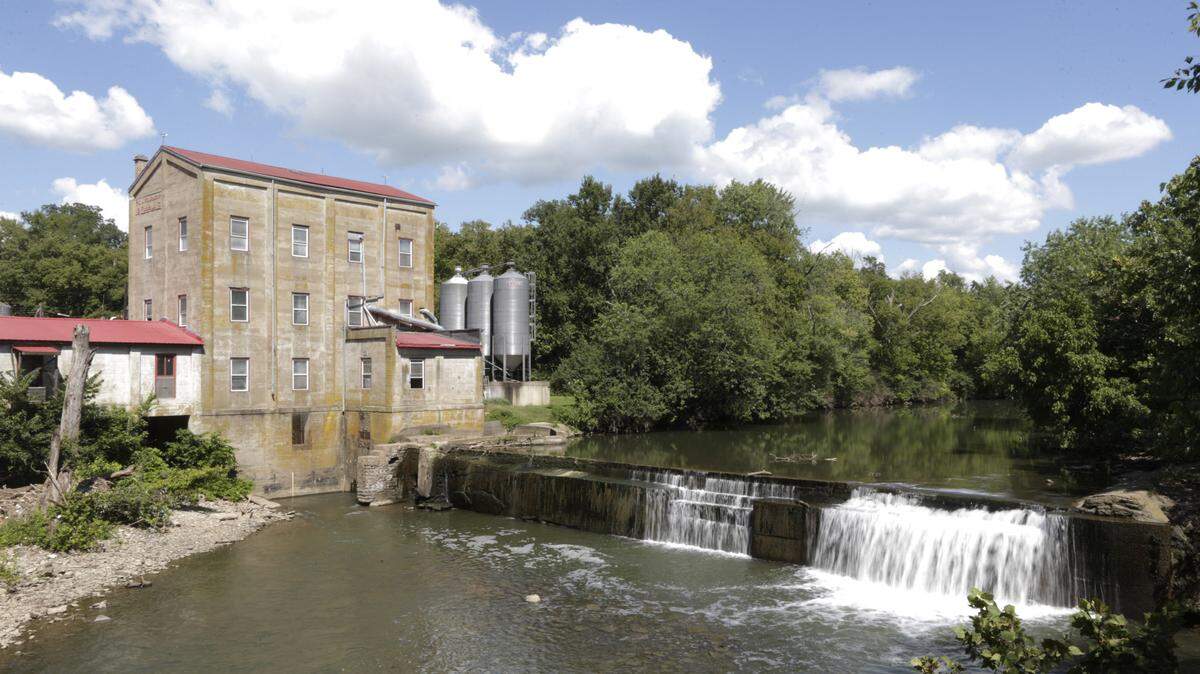
MIDWAY — On a warm afternoon beside Elkhorn Creek, the air was filled with the sound of late summer cicadas and a faint sweet smell, like cake.
"That's because we were making our funnel cake mix today," said Philip Weisenberger, the sixth generation of his family to operate Weisenberger Mill along the Central Kentucky waterway.
This year, Weisenberger celebrates 150 years in business. In 1865, founder August Weisenberger bought an existing mill and began milling corn and wheat into flour, using the creek to power the grinding equipment.
"Not much changes around here. That used to drive me crazy growing up around here," Weisenberger said. But changes in American food culture have swung back their way, with the push for local and less processed ingredients.
"We sell a lot more unbleached flour than we used to sell," he said — 10 to 20 times as much.
The mill was torn down and rebuilt in 1913, and it has remained almost the same ever since. The elaborate system of belts is still powered by the creek, although today the power comes from an electric generator and the mill sells power back into the grid when it isn't using it.
Last spring, when heavy rains flooded Central Kentucky, being right by the Elkhorn seemed like too much of a good thing. The water rose to cover the entire falls outside the mill, the road over the creek, and came nearly to the bottom of the windows on the first floor.
That sounds bad, but Weisenberger shrugs it off as just another flood, and not even the worst. (Once, water got to the roofline of the first floor addition, he said.)
After the April flood, the mill was cleaned up, and they went right back to work grinding corn and wheat, he said.
Their products are much in demand by restaurants and home cooks.
"The flour and cornmeal will always be our mainstays. Our flour is maybe a little different — it's soft red winter wheat, makes a biscuit that's really light and fluffy, good for cakes and pastries, with a lower gluten and protein content," he said. "It's different from Midwestern-grown wheat that is used for bread."
The name Weisenberger turns up on menus at better restaurants all over Kentucky, often as grits, which have been at the forefront of the Southern food revival.
"We sell a lot of grits in 25-pound bags to restaurants," he said. "Grits used to be the side item you'd get at, say, Cracker Barrel, but once you get creative with them, they become something different."
When he sees his name on the menu alongside the shrimp and grits, Weisenberger said, "I usually have to order that. ... I've had our grits at Nick Ryan's. They were really good. ... And if I go to Windy Corner, I usually get their shrimp or fish; they use our cornmeal."
Another growing market: Craft distillers such as Limestone Branch in Lebanon and Barrel House Distilling in Lexington, which used Weisenberger for its just-released RockCastle Bourbon.
"We're small enough that we don't require a large order," Weisenberger said. "A lot of the bigger (distilleries) mill their own, but we might do specialty stuff for them."
Chefs are drawn not only to the quality of their products but to the authenticity: Each bag of self-rising cornmeal, for instance, is stamped with the name of the farm where it was grown.
"Most of our business is food service, and we have a relationship with local farmers," Weisenberger said. "We've been buying white corn from a farmer in Hardin Country for 10 or 15 years and buy a lot of wheat from him, too. It's non-GMO. ...
There's such a demand for it, and we pay a premium for it."
Although cornmeal, flour and grits are still popular, these days some of Weisenberger Mill's biggest sellers are its mixes.
"In the 1960 and '70s, my grandfather began developing complete baking mixes, so we do a lot of that," Philip Weisenberger said. They offer everything from hush puppies to blueberry muffins. "Some people are scratch bakers, but a lot of people like mixes."
The spoon bread is considered the "crown jewel" of corn bread mixes and has quite a following.
"We sell a lot here in Kentucky and in Virginia. People ask, 'What is spoon bread?'" he said. It's a moist corn bread that can be dished out with a spoon, rather than just cut into squares. "This is a simple mix. I tell people to bake it in a small dish, like a 1-quart casserole dish, or little muffin tins. An 8-by-8 pan is too thin."
Will there be more new mixes? Probably not right now.
"In the past couple of years, we came out with pumpkin bread and banana bread, but I think we'll hold steady," he said. "We have quite a variety of different products, and sometimes you just got to keep up with what you have."
The biggest seller these day?
"Our pizza crust mix," Weisenberger said. One bag makes a nice thin crust; two bags make a doughier version. "We sell it from here to Texas, to Michigan, all over. Obviously, I'm biased, but I think it's pretty good."
This story was originally published August 18, 2015 at 10:06 AM with the headline "After 150 years, Weisenberger Mill still grinding out flour, cornmeal, pizza crust and more."