
New book shares history of E. Kentucky's Frontier nursing school
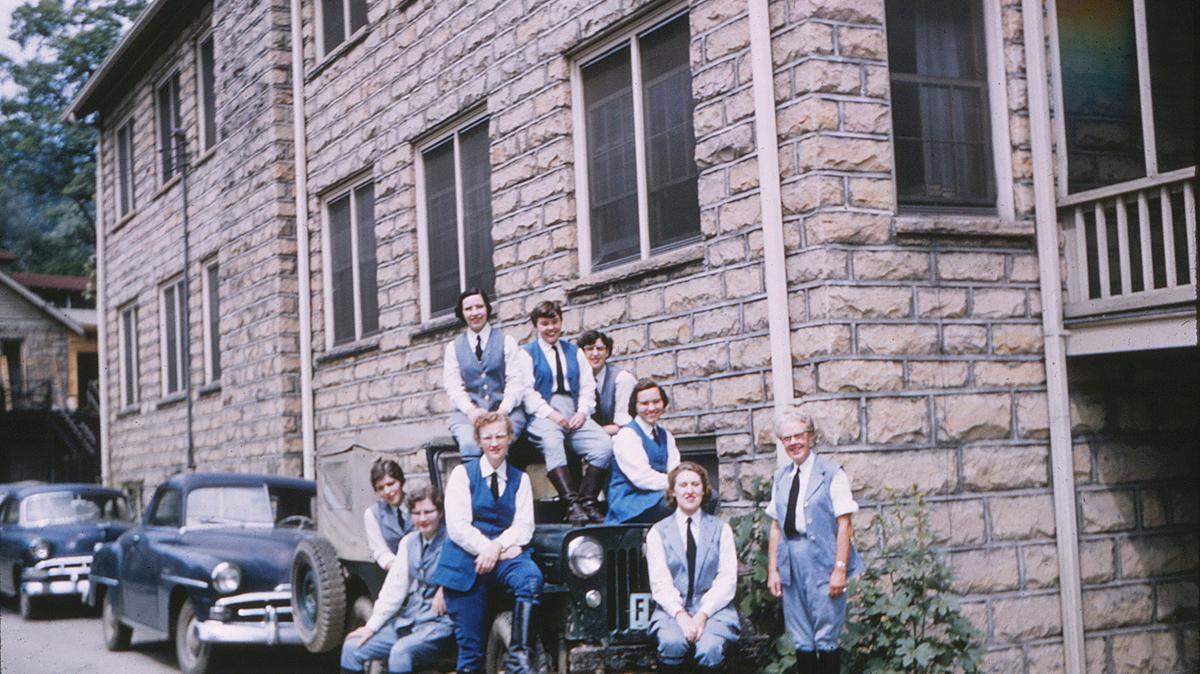
Today's Frontier Nursing Service would surprise founder Mary Breckinridge.
The distance learning nursing school still has its headquarters in Hyden, and students still make the pilgrimage there for clinical experience. But the school has adapted smoothly to the world of the Internet, which Breckinridge, who died in 1965, could not have imagined.
The climate in which the service's nursing school spent its first half-century is the subject of a new book by Frontier Nursing University faculty member Anne Z. Cockerham and nursing historian Arlene W. Keeling: Rooted in the Mountains, Reaching to the World: Stories of Nursing and Midwifery at Kentucky's Frontier School, 1939-1989 (Butler Books, $30).
Cockerham, right, thinks the 160-page book will be of interest to more than those who have a connection with the Frontier Nursing Service. Students of Kentucky history and particularly those with an interest in Eastern Kentucky before the advent of Lyndon Baines Johnson's Great Society poverty reforms may also want to take a look at the book.
"Lots of Kentuckians are not very in touch with this history," Cockerham said. "I hope this gives them a readable insight into their history. ... When we can really focus things on people, it's much more interesting to read. Over 50 years the situation changed so much."
When Breckinridge arrived in Eastern Kentucky in 1923 after stints in France and New York, she rode 650 miles talking to "granny midwives," concluding that "the care given women in childbirth and their babies, thousands of them in thousands of square miles, was as medieval as the nursing care of the sick in the public hospitals of France."
Eastern Kentucky residents often lived far from the towns, in rudimentary settlements. Often they lacked cars, reliable heating, basic sanitation and what we now would consider essential furnishings.
And always, they lacked someone to give them vaccinations, show them that intestinal worms could be eradicated, minister to their injuries and deliver their babies.
Their water was suspect and their food hardly the stuff of the romanticized "heirloom vegetables" of today: Think bread and gravy.
Into this terrain came Breckinridge, who had lived a well-to-do life, attending a Swiss boarding school where she came to love the mountains, and had married and had two children, both of whom died young.
Having lost her children, Breckinridge was determined to give others a chance: "It is because I wanted other children to feel that they could fly — as well as fall — that we have the Frontier Nursing Service today."
The Frontier Nursing Service eventually would build its first six centers, located about 10 miles apart, from 1927 to 1930. Cockerham's book says that the centers served about 700 square miles and almost 10,000 people.
In her memoir Wide Neighborhoods, Breckinridge recounted some of the early medical challenges: "What kind of patients did we have in those early days? I recall a six-year-old boy with ... skin like parchment from hookworm. Then there was a four-week-old baby brought to one of our nursing centers ... and rushed by the nurse, on horseback, to Hyden Hospital, with both eyes so blinded by pus that it was impossible to tell at first whether any sight could be saved at all. More than one expectant mother came in near the end of her pregnancy, and even in labor, riding sideways, on the rump of the horse, behind the nurse-midwife."
The Frontier Nursing Service would become known for its hearty nurses, who made horseback runs in treacherous weather and delivered babies in conditions that would give modern obstetrical units the vapors.
One Frontier nurse, Martha Morrison, recalled being called out to deliver a baby in a cabin so cold the birthing supplies were frozen, including the lubricant K-Y jelly. Nurse Kathryn Nimmo Foust tried to shoo away a hen from the bed where a woman was laboring, only to feel the chicken slip through her legs as Foust was delivering the baby, causing her to jump in surprise.
The nursing service added a school in 1939: Its first class consisted of two students. Asphalt eventually snaked its way through the mountains, and horses were traded for Jeeps. But an even bigger development was in the offing: the widespread availability of birth control.
Women were freed from having babies every year or two and embraced the availability of contraceptives. But for Frontier Nursing's students, that meant a drop in the number of babies to deliver — and a need to find other places for them to gain experience.
Cockerham says that Breckinridge would be proud of the school's imaginative adaptations from frontier nursing to a frontier that extends across the Internet:
"I think she would wholeheartedly support whatever it takes to have this continue. She was so imaginative."
This story was originally published July 17, 2012 at 9:54 AM with the headline "New book shares history of E. Kentucky's Frontier nursing school."