
Just in time for Derby, the beaten biscuit makes a comeback
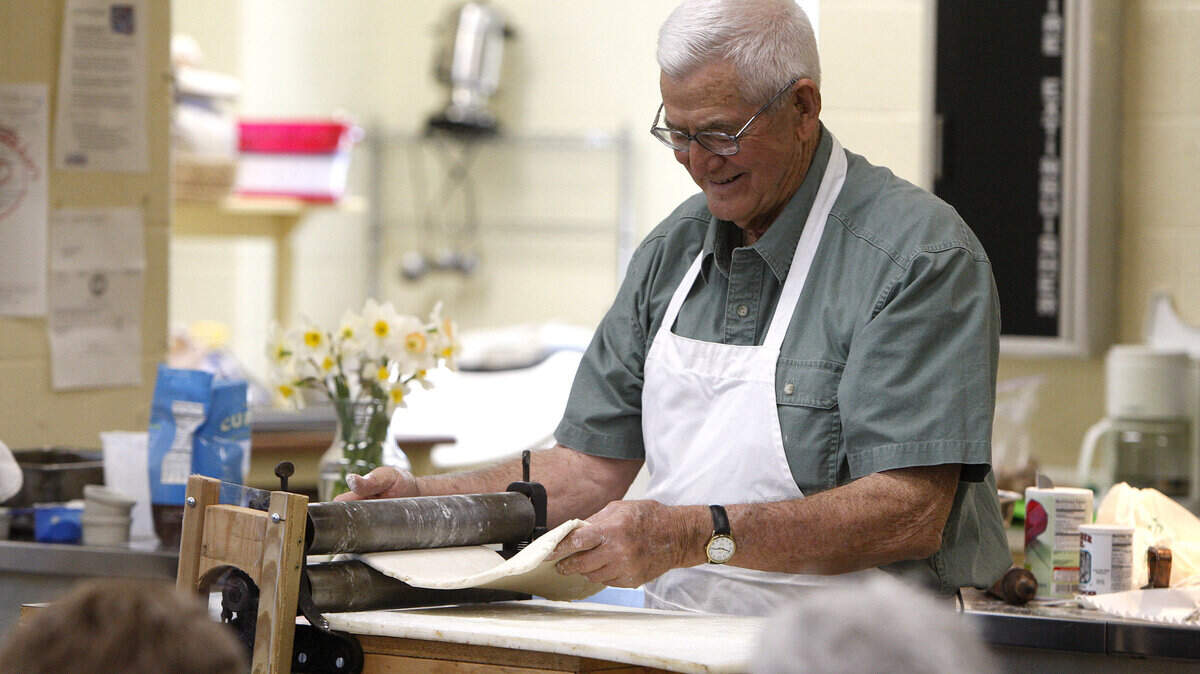
MIDWAY — The beaten biscuit — small and flat compared to the huge, fluffy mounds more often seen today — is making a comeback in a big way.
On a recent Saturday afternoon, nearly 100 people turned out to watch a master beaten biscuit maker at work. This was the second year that Charles Logan had conducted his biscuit workshop — part cooking show, part comedy routine — as a fundraiser for The Homeplace at Midway, a new nursing home.
This time, besides Central Kentucky chef Ouita Michel, he had another new convert on hand to demonstrate: Jody Jaggers, a Versailles pharmacist. Jaggers attended the workshop last year and was bitten by the beaten biscuit bug.
"I'd eaten beaten biscuits before, but I'd never made them," Jaggers said. "So I came, and the rest is history. I enjoyed them and then started looking for my own brake."
The brake Jaggers was referring to is a roller that is used to flatten the beaten biscuit dough.
As Logan, 83, explained, the dough is flattened by the rollers, then folded over and flattened. By doing this over and over, the dough develops many, many layers, rendering it fluffy even without leavening.
It's a process akin to making puff pastry, Michel told the crowd, and was a way of making biscuits before the introduction of baking powder in the 1850s.
Originally, the dough was beaten with paddles or by hand to flatten it. Then brakes or rollers came on the scene. Logan has attached a motor to his, which he works with a foot pedal. Most, like the ones Michel and Jaggers used, are hand-cranked.
"The brake is just a set of rollers," Logan said. "I don't know how they got the name. The only thing I've heard in the past is 'biscuit kneader.' Very similar to old-fashioned washing machine rollers, which were covered in rubber. But these are steel. All the kneaders you can find — they haven't been made in last 75 years — have crank handles on them. The top roller is adjustable so can adjust for thickness you want."
When he finds a set, Logan reconditions them. And there is rarely, these days, a shortage of buyers. A set auctioned at last year's workshop sold for $300.
The machinery is the key to successful beaten biscuits, Logan said. They can be done by hand, but it's difficult to get the consistency required.
Sometimes, a "biscuit board" is used, with one roller, often ribbed rather than smooth, braced against a board. This method seems to be more common in New England, according to biscuit experts.
The layers make the dough compact and dense, but a good beaten biscuit will flake cleanly apart.
Often the pale, canapé-size biscuits are accompanied by salty country ham. Michel said she likes to add a little apple butter as well.
Logan's are best hot out of the oven, slathered in real butter and possibly a dab of good sorghum or honey, he said.
These days, the tiny ham biscuits often are served at parties or special occasions.
Michel offers them as an appetizer at her Holly Hill Inn restaurant in Midway, but when she wants enough for a party she calls Logan, who is known as the king of the beaten biscuit, she said.
"I'll tell you right now, Charles' biscuits are the best I've ever had," Michel said.
Last year he made 300 for her Kentucky Derby party.
"I make them for friends," he said. "For one wedding reception I made 500, and they ran out."
Logan learned to make them from a neighbor when he moved to Midway 64 years ago, he said.
The recipe is deceptively simple; the trick is in the making. This is not a recipe for the weak of limb, unless you use a motorized kneader.
Rosa Thomas showed Logan the secrets and shared her recipe. Her granddaughter, Patsy Mitchell, came to his Saturday workshop with her family.
"I still make them, but not as often as I used to," Mitchell said. "I have my Grandmother Rosa's biscuit kneader, but I prefer one with a crank. Hers has a motor on it."
Some makers prefer the traditional lard.
Logan uses plain Weisenberger wheat flour, shortening and 2 percent milk, with a little Equal to sweeten it, and salt, he said. He also adds a little baking powder for a bit of rise.
Michel credited John Egerton, author of Southern Food: At Home, on the Road, in History and one of the founders of the Southern Foodways Alliance with sparking her interest in beaten biscuits.
"He was a huge enthusiast for the beaten biscuit," Michel said. "I'm using his recipe, his grandmother's recipe, with butter and buttermilk."
Michel likes to keep her butter very cold and grate it into the dough so it blends evenly, she said.
Logan said that it's important to put the nine holes in the top of the biscuit to let steam out in the baking. He uses a three-tined fork from his mother to put in exactly nine holes.
"Scientifically proven to let the steam out in exactly the right order," he joked.
Recipes
Here's Charles Logan's recipe for beaten biscuits.
Beaten biscuits
4 cups Weisenberger plain, soft wheat flour
1½ teaspoons baking powder
1 teaspoon salt (approximately)
2 tablespoons sugar (or two packets of Equal)
2⁄3 cup shortening like Crisco
1 cup + 1 tablespoon milk
Mix dry ingredients, then add shortening and cut it into the dry mix until it looks more like cornmeal than flour. Then add the milk and gather into a dough ball.
Knead the ball, adding flour as needed. Knead until the dough is pliable enough to flatten and run through the rollers. Keep folding the ends together and running through the rollers for 20 to 30 minutes, or until it makes a "pop" when you feed the dough in ends first. If you let the dough rest for brief periods, it will knead smoother.
Set the rollers to flatten the dough to a quarter-inch thickness and cut the biscuits out with a round, 11/2-inch cutter. Poke holes with the tines of a fork or toothpick.
Place them on an unfloured, insulated baking sheet and bake for 30 minutes at 350 degrees. Makes 72.
This is John Egerton's grandmother's recipe that is used by local chef Ouita Michel.
Beaten biscuits
3 cups all purpose flour (Michel uses Weisenberger)
½ teaspoon salt
½ teaspoon Clabber Girl baking powder
2 tablespoons sugar
½ cup lard or butter, or 1/4 cup of each
¾ cup milk or buttermilk; or half milk, half ice water
Sift all the dry ingredients together. Cut in the lard. Add the milk and make a dough. Roll until smooth and cracking. Cut. Prick with fork. Bake 350 degrees for 20 to 25 minutes, turn the oven off and let sit for a few minutes.
John Egerton lived in Lexington for a time and was a friend of Michel's family, although Ouita Michel met him only as a child.
"I dearly hoped to make a beaten biscuit with him one day, but he passed away in 2013," Michel said. "His passing, and his book, prompted me to get off the stick and learn to bake beaten biscuits. His book was also the source I used for the historic information presented here."
This story was originally published April 21, 2015 at 11:21 AM with the headline "Just in time for Derby, the beaten biscuit makes a comeback."