
Now's the time to plant spring bulbs for shady spots
WASHINGTON — It's spring bulb-planting season. Get yourself a kneeling pad and a stout trowel, and set aside a day or two over the next month to plant as many little bulbs as you can stand. In March and April, the garden will spring to life in a way that will lift your spirits.
If your beds are at all shady, choose your bulbs carefully. The more shade you have, the harder it is to get bulbs to perform as you would like. Tall bulbs such as hybrid tulips wander sideways in search of light. The catalogs depict ballerinas, but you might end up with limbo dancers.
Bulbs that are supposed to return reliably — daffodils and grape hyacinths — don't if they are starved of sunlight. They grow weak and dull.
A dark corner overshadowed by pines, hollies or other evergreens is the most challenging, but even a woodland of oaks and maples can upset a bulb's internal equilibrium. A daffodil might bloom in April, when the tree leaves are barely showing, but its own leaves won't receive the light they need in May and June to keep the bulb blooming year to year. If you are digging against an impenetrable mat of roots, beneath a silver maple, say, you might want to pass on bulbs and pretty much everything else. But most sylvan beds are more accommodating.
Select shade-tolerant bulbs, typically ground-hugging minor bulbs that flower early in the season. Their leaves wither naturally in May, the bulb-building work done before the trees fully extend their canopy.
Shade-tolerant bulbs such as snowdrops and scillas are daintier than brassy tulips, daffodils or alliums. You need more of them to make a show, but they're cheaper and easier to plant. Think big and don't plant fewer than 100.
Some early-season daffodil varieties will handle the shade garden. Try February Gold, Rijnveld's Early Sensation, Ice Follies, Itzim and Toby the First.
A woodland tulip species named Tulipa sylvestris also will work.
"A wonderful little tulip," says Brent Heath of Brent and Becky's Bulbs in Gloucester, Va. The tulip is small, starry and yellow, and it spreads by runners.
If you visit Winterthur Museum's March Bank, the lovely woodland garden near Wilmington, Del., you will see the following succession of bulbs between February and April: snowdrops, winter aconite, crocus, glory-of-the-snow, squill, anemone and bluebells.
Each has a capacity to cover the woodland floor enchantingly. Together and successively, they simply intensify the thrill of early spring. I have grown the following for years and love to see them spread year after year in shadier parts of my garden.
Snowdrop. Fancy, pricey varieties are all the rage among snowdrop fanatics, but two basic types will add cheap and cheerful ornament in late winter when you most need it: Galanthus elwesii and the smaller-flowered G. nivalis. They multiply in rich woodland duff.
Winter aconite. Slow to establish, the buttercup-like blossoms spread prolifically by seed after a few years. The blooms open as early as February and elongate as they grow over several weeks. It is sometimes sold by its botanic name, Eranthis hyemalis.
Crocus. There are lots of lovely crocus varieties, but the workhorse crocus for the shade garden is the early-flowering species named Crocus tommasinianus. Bulb fans call them "tommies." It's a crocus that is most likely to spread year to year, forming carpets of lavender blue. Named varieties of tommies are available in various shades, but they don't spread as vigorously as the parent.
Glory-of-the-snow. This is a petite bulb with starry blue flowers facing upward. Valued for its massed effect, it often is called by its botanic name, Chionodoxa.
Squill. Varieties of squill or scilla form the heart of March Bank's blue phase in early April. They display clusters of dainty blue flowers that tend to hang in little bells. Scilla bifolia starts to bloom before glory-of-the-snow, and Scilla siberica extends beyond it. Heath is a big fan of the shade-loving S. mischtschenkoana, a squill with sky blue blooms on generous flower spikes.
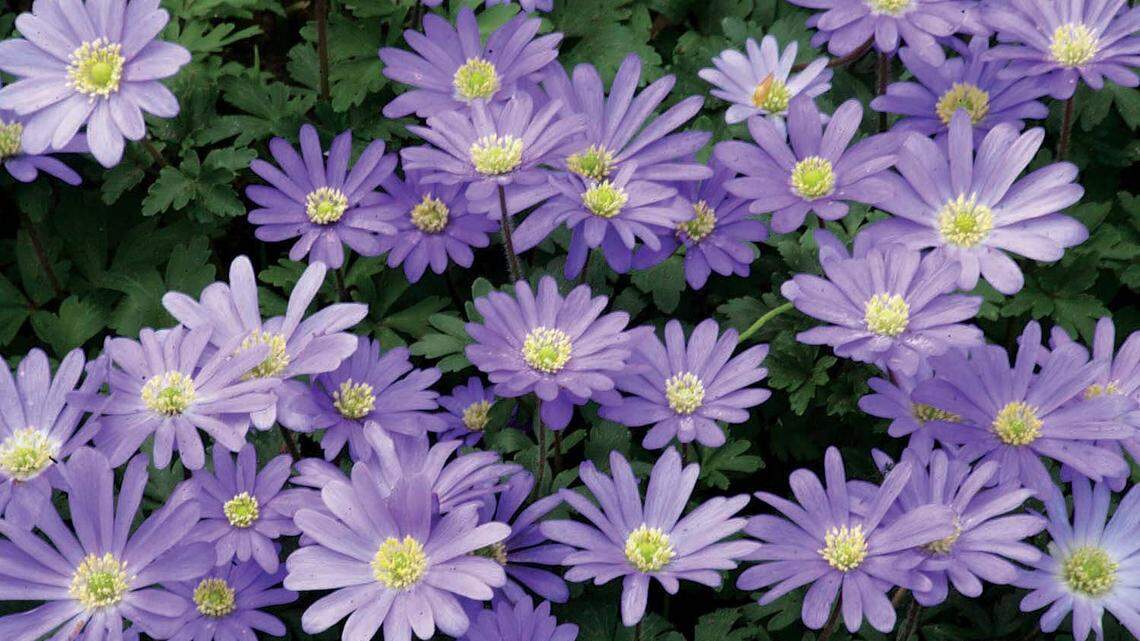
Anemone. The anemone, or windflower, that carpets March Bank is the Italian species Anemone appenina. It's a little finicky and difficult to find. Most fans of this lovely spring flower go with the Grecian windflower, A. blanda. This is variable in color, blooming blue, white or pink. Named varieties give predictable color.
Bluebells. The traditional English bluebell struggles to establish and spread in the heat of the mid-Atlantic, but the more upright Spanish bluebell does well and naturalizes in a woodland setting. It is known botanically as Hyacinthoides hispanica.
Snowflake. The snowflake, or Leucojum, looks like an oversize snowdrop but blooms in April, when the garden has filled in. The common sort is called Leucojum aestivum, and a popular larger variety is named Gravetye Giant.
Bulbs can be planted until the end of the year, or until the ground freezes, but they might bloom later than normal in their first season. The earlier you can plant them, the better, especially for winter bloomers such as snowdrops and winter aconites. I like to plant them base-down, but I have seen Dutch experts just throw them in a hole without worrying about their orientation or spacing. If you can't tell up from down, which is often the case with anemone bulbs, plant them on their sides.
Count on planting these specialty bulbs at between eight and 12 per square foot, depending on size.
This story was originally published November 6, 2010 at 12:00 AM with the headline "Now's the time to plant spring bulbs for shady spots."