
Boxwood, yews provide any number of shapes, uses in landscape
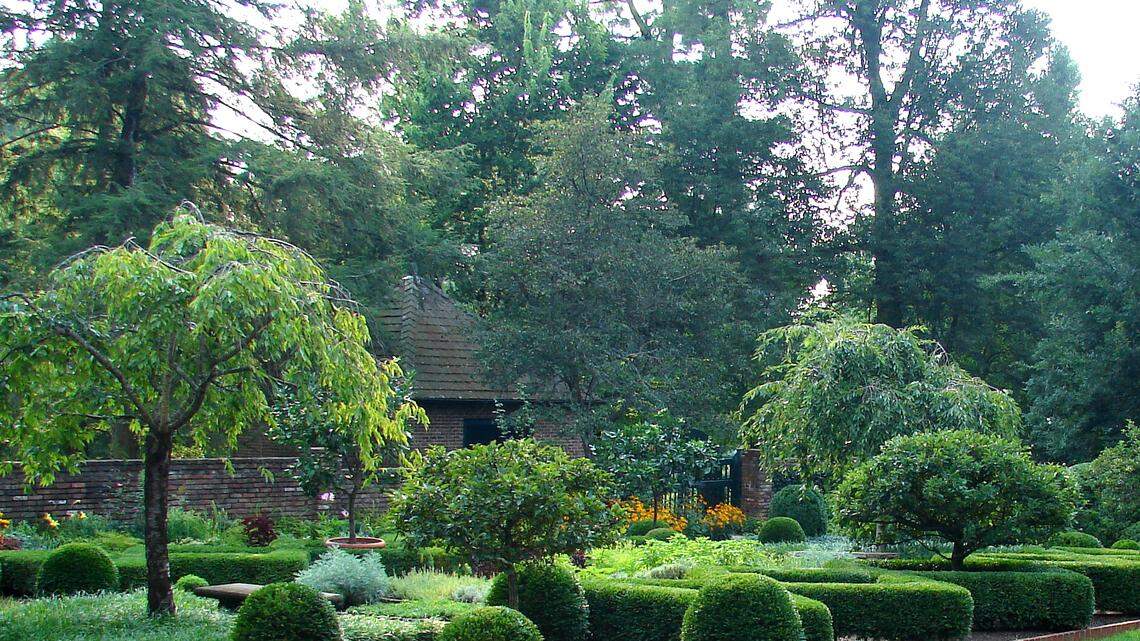
To discover evergreen hedges, just travel around town. The neatly clipped bushy borders line sidewalks, driveways, house foundations and property lines.
You'll find them in all shapes and sizes, from a series of perfectly clipped 2-foot round sheared spheres to massive 12-foot-tall privacy-wall bunkers.
These year-round touches of green soften the look of our homes, cast cool, energy-efficient shade and offer opportunities for creative expression. Where ordinances might restrict the height of privacy fences, shrubs and trees can stretch to the sky. Two of the most common to explore in your landscaping this fall are boxwoods and yew.
Boxwood
Boxwood is the quintessential tidy border hedge, brought from the Old World to the New World in the 1600s and tweaked by new cultivar adaptations to meet growing expectations here.
The glossy, clean-cut foliage has generally ovoid leaves only about a half-inch long, packed densely together at the sheared surface of whatever shape the bushes are pruned to take. Boxwoods are well suited to meet regional landscaping demands because they are slow- growing, cold-hardy in Kentucky and favor just a bit of daily mottled shade; they do need well-drained soil.
Mulching of newly planted boxwood is recommended. When planting, keep in mind that boxwoods emit an astringent odor, especially in the sun-warmed spring. Cutting off the end buds encourages side buds to sprout, resulting in fuller greenery. Experts advise angling cuts so the base of the plant is wider than its top, to allow sunlight to reach the bottom branches more easily.
If you're going for a more natural look, hand pruners are needed to develop an in-and-out three-dimensional effect by cutting closer inside the bush at branching junctures.
The work can be made a lot easier if you use tools that feature extra leverage, such as Fiskars' Arthritis Foundation-approved Power Gear line (Fiskars.com) and Corona's compound-action hedge shear (Coronatoolsusa.com) with ergonomically designed handles. For more power, Stihl (Stihl.com) has a new cordless lithium-ion trimmer that will give you freedom to roam. You can use an underlying tarp for quick cleanup.
There are plenty of boxwood choices for various needs. The classic English boxwood cultivar Buxus sempervirens Suffruticosa would be a good selection for a dwarf hedge. A Korean boxwood cultivar, B. microphylla Wintergreen, was bred to hold its green coloration longer into winter and grows to about a 4-foot diameter.
Pruning techniques also vary. Many gardeners prefer a formal look with a smoothly sheered surface, either curved or flat. For others, going natural allows branches to grow into a compact plant with more surface depth. Popular lately is the practice of "clouding," which results in a look somewhere between formal and loosely nipped. For clouding, you gather shoots along each branch into a central bunch, like a ponytail at their outermost ends, and snip off the tips at the gathering point before releasing the branch. The resulting length gradient creates smaller pillow shapes at the branch ends, instead of a perfectly round surface.
For larger borders, B. sempervirens Pullman, which can reach a height of 6 feet, is suggested by a University of Kentucky Cooperative Extension Service publication (go to www.ca.uky.edu/agcomm/pubs.asp and search for HO-55). The publication, Guidelines for Choosing Hedges for Kentucky Yards, also contains information on cultivation, pest resistance and selection comparisons.
Another information source is the American Boxwood Society (Boxwoodsociety.org), which offers tips on the best time to plant (the fall) and pruning practices. The Web site of Virginia's Saunders Brothers Nursery (Saundersbrothers.com) offers helpful cultivar photos and trial reports; click on "The Nursery" and then "Boxwood."
Yew and other evergreens
Yew, known in the nursery industry as Taxus, its genus name, seems to be planted everywhere. Birds like their tiny red berries, but the plant is toxic when eaten by dogs, cattle or people. Still, these sturdy bushes with their holiday-green boughs, lined with rows of short, flat needles, are long-lived and shade- and sun-tolerant. They also are easy to grow, demanding only decent drainage.
Forms range from the spreading Everlow and the medium-size, easy-to-care-for Brown to the 20-foot columnar Hicks. These resilient bushes respond well to being trimmed back but can grow out quickly if left untended. Fall is a good time to prune yews.
You can use mass installations of only one plant species to create a strong impact, but after seeing the devastating effects of insects and diseases on individual species in recent years, some landscapers recommend planting a variety of trees and shrubs.
Basic evergreen hedge choices can be expanded by adding other easily trimmed shrubs. The holly cultivar China girl has a profusion of red winter berries as a bonus. Arborvitae, also called thuja or cedar, is another possibility. Check out the small 2-foot Hetz Midget, which has finely-textured, lacy foliage, or the larger rounded Little Giant. If you want the contrast of a 40-foot-high privacy wall of quick-growing, narrower cone-shaped spikes, look at Green Giant.
Often overlooked, evergreen hedges form a great green background for colorful flower borders. Do some investigative work now so you're ready to plant and prune wisely this fall.
This story was originally published August 6, 2011 at 12:00 AM with the headline "Boxwood, yews provide any number of shapes, uses in landscape."