
Bulbs do well when confined to containers
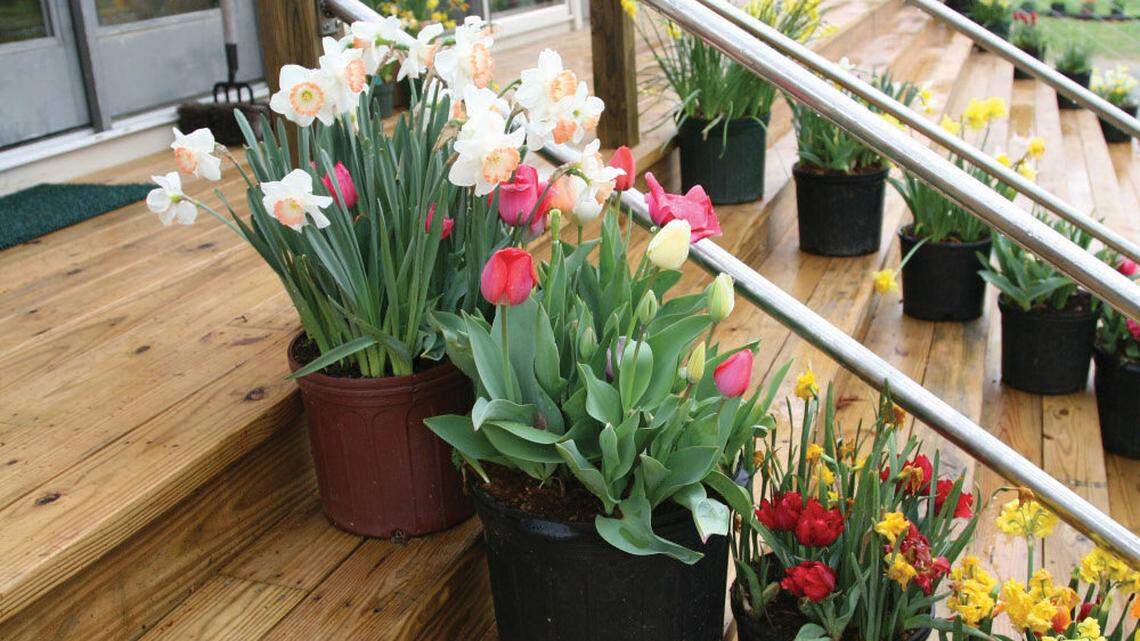
Pots of pretty spring-flowering bulbs can be part of your home's indoor and outdoor décor, with or without a yard.
It's all about the planting method you choose this fall.
For the holidays and wintertime cheer, you can force potted bulbs into early bloom, and use them for decorations or give them as cheery gifts.
Or, you can plant bulbs in large containers with ample drainage holes, place them outdoors where they won't freeze and wait for the color show to happen in early 2012.
"When plants are in containers, the color can be moved around where it's needed," says Becky Heath of Brent and Becky's Bulbs, a mail-order bulb warehouse in southeastern Virginia.
"Sometimes, they can be put in the garden, other times on the deck or on either side of the front door. They can even be used as table decorations.
"When they stop blooming, the bulbs can be planted in empty spots in your garden.
"If you don't have a garden, you can recycle them by giving them to a school, church, library or a friend."
Forced into bloom
Most spring-flowering bulbs can be forced by following a few small steps, according to Heath.
"Just remember that horticulture is not an 'exact science,' and that temperature, humidity, light and even refrigerators can sometimes be different, giving different results," she says.
"Fortunately, plants can be forgiving of imperfect humans — just relax, experiment and enjoy."
■ Using pots with drainage holes in the bottom, place the bulbs in a pot three-fourths filled with potting soil; cover necks of bulbs with 1 inch of soil or gravel. Potting soil should be a coarse growing mix, which is available at garden centers.
■ Water pots and allow them to drain.
■ Place in a cool area — about 50 to 60 degrees Fahrenheit — for one to two weeks until fully rooted. Then, reduce temperature to 35 to 45 degrees for 12 to 16 weeks.
There are a variety of ways and means to achieve this cool period, including:
A refrigerator (an old-fashioned one is best; if frost-free, place pot in hydrator). Take out any ripening vegetables or fruit because they will produce ethylene gas, which might cause bulbs to abort their blooms — or better still, use the "beer fridge" in the garage.
A foam cooler in an unheated garage. The cooler keeps the bulbs at a relatively constant cool temperature — or in a garbage bag or box surrounded with foam peanuts.
Buried outside under a high pile of leaves/mulch — at least 6 to 10 inches deep — preferably on the north side of a building in the shade.
■ Check on the inside pots every other week. If soil appears very dry, you might want to water lightly. When sprouts begin forming on top, they should be about ready to be brought into the forcing environment.
■ If you are forcing bulbs for fun, put the pots in a sunny location where you can enjoy them while they bloom. This should take two to four weeks. Water only as needed, making sure not to drown them.
■ For those who need blooms on a specific date, there is a little more work to do. To control the rate of growth, you must take into account:
Light. During fall, winter and early spring, there is less light than what the bulbs want. You should supply additional cool light in the form of fluorescent or "grow lights" very close, within 1 foot, of the merging foliage. This prevents the plant from getting too tall and eliminates the need for staking.
Bottom heat. Bulbs grow faster if bottom heat is applied. Ideally, potted bulbs should be placed on heating mats, available from greenhouse suppliers. A food warmer, refrigerator top or freezer top can be used, just as long as some heat is produced. A cool environment (50 to 60 degrees) is the ideal room temperature.
■ If foliage and blooms appear to be maturing too quickly, take them away from the bottom heat and place them in a cooler environment, but keep the light plentiful.
■ When they have finished blooming, continue to water as a houseplant. When spring arrives and there is no longer danger of hard freeze, they can be planted outside, bulbs, roots and all, in the garden.
Or, if you bought bulbs already pre-cooled dry (without the pot and soil), pot them just as soon as you receive them because the pre-cooling effect lessens each day they are out of the cooler. Once potted, water well and let drain. Then, put them in a dark, 50- to 60- degree area for a couple of weeks to encourage the roots to develop. Once rooted, you may bring them out to a sunny location, following the suggestions above.
In containers
To showcase bulbs in containers, follow some simple steps, courtesy of the International Flower Bulb Centre:
■ Use potting mix, not garden soil, in a container with lots of good bottom drainage holes to prevent waterlogged soil that easily rots roots.
■ Choose containers deep enough for the bulbs you want to use; catalogs and package labeling tell you what planting depth is recommended for each bulb type.
■ Fill the pot one-quarter to one-third deep with soil, position bulbs at the proper depth. Fill in additional soil to 1 inch below the pot top; the extra space at the top provides room for mulch, if needed, and allows you to water the container.
■ In fall, you can plant more layers in one container to have a spring garden in one pot — a technique called "lasagna gardening." Choose bulbs that flower one after another to get 100 days of blooms in one pot, or choose two types of bulbs to flower at the same time. Once you choose the bulbs, plant the largest bulbs on the bottom, graduating to smaller bulbs as you plant closer to the surface.
■ You can display the planted container as is or sink it into a more decorative outer pot. To promote good drainage, elevate the inner pot by placing it on a brick or inverted plant saucer positioned inside the outer pot.
This story was originally published October 22, 2011 at 12:00 AM with the headline "Bulbs do well when confined to containers."