
Lowe's introduces Iris, a system designed to make homes smarter
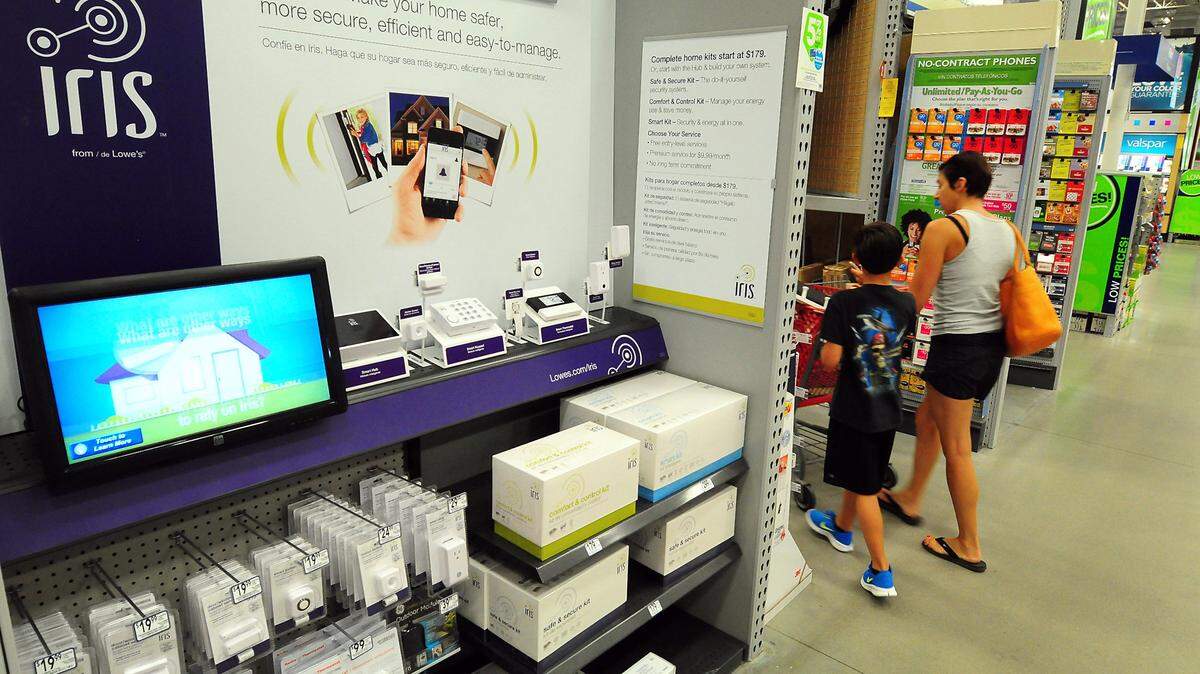
CHARLOTTE, N.C. — Lowe's executives are hesitant to say we've arrived at the home of the Jetsons, with everything in our houses automated and controlled by computers and wireless devices, but they say we're not far off.
"There's been so much hype, we don't usually say 'the Jetsons house,'" said Kevin Meagher, vice president of smart homes for Lowe's. "The reality is, we're getting there."
The home improvement company has started rolling out its Iris system, which it says will help consumers use less electricity, increase security, and help monitor and alert homeowners to everything from freezer doors left open to elderly parents in trouble.
Iris gives users the ability to remotely control and monitor systems such as thermostats, door locks, power consumption, cameras and motion sensors, on a computer or mobile device. Lowe's recently expanded Iris to nearly 500 stores, up from a pilot run in 10 stores. While the products are not listed as being available in Lexington stores, they are available online nationwide.
Lowe's hopes to expand the system to work wirelessly with more household appliances and possibly even electricity meters in future "smart grids."
Iris is the latest in a string of smart home systems. Time Warner Cable has been rolling out its IntelligentHome service. Verizon unveiled a similar system in 2011, and Comcast is pushing its Xfinity smart home system to customers. AT&T is piloting a similar system called Digital Life. And home security company ADT has offered a smart home system called Pulse since 2010.
But there are questions about whether smart homes will truly catch on, or even whether consumers really want them. In June the Pew Internet & American Life Project released a survey of experts on where they see the future of smart home systems.
Just over half agreed with the prediction that fully connected smart homes would be much more widespread and efficient in 2020, while just under half predicted most smart home efforts would fail because of consumer trust issues and the systems' complexity.
Smart home systems certainly will have to overcome hurdles before consumers adopt them. Chief among those, Pew found, is the problem of getting diverse manufacturers to use compatible standards in consumer electronics so they can all talk to one another.
The systems also are more complicated than old-fashioned "dumb" homes, even though Lowe's and others have taken steps to simplify them. And consumers could react negatively to the "Big Brother" aspect of having their energy usage and comings and goings constantly monitored, even if they signed up for the service.
Many of the systems on the market offer similar capabilities. Lowe's Iris, Time Warner Cable's Intelligent Home and Verizon all give users the capabilities to remotely set thermostats, set door alarms, and connect to wireless cameras in the home, for example.
Here's how Iris works: Once Iris is installed, a small hub wirelessly talks to various home appliances and a user's mobile device. Users can set rules, such as turning thermostats down when they leave, or wirelessly turn them back up before they get home. A key fob sensor tells the system whether the user is at home. The system also comes with motion sensors and cameras, sensors to tell whether a door is open or closed, a smoke detector and flood sensors.
Lowe's is rolling out more devices integrated with Iris soon, such as door locks and pet doors, which can be configured to open or close at certain times. The retailer also is leveraging its connections with manufacturers to come up with more connected devices, such as valves that automatically turn off water if a flood is detected, or a water heater that learns your personal routine and heats the water only when you generally need it.
The base cost is $179 for a security kit with an Iris hub, door sensors, motion sensors, and a security keypad. Or you can pay $179 for an energy kit with an Iris hub, one wireless, energy consumption- monitoring wall outlet and a thermostat. A combined kit with everything from both starter kits costs $299.
Adding more sensors and accessories costs more. A wireless video camera costs $129, while each additional key fob and door sensor is $19.99, for example.
Time Warner Cable's IntelligentHome system offers similar capabilities, allowing users to remotely control lighting and their thermostats, and offering security cameras, motion sensors and alarms. The system comes with a $99 installation fee and a $99 equipment charge, and costs $33.99 a month, with an 18-month contract.
Meagher, of Lowe's, said the market for smart home systems has yet to take off, but he thinks their widespread adoption is inevitable as more devices become available to connect.
"The value to the consumer of connecting everything in the home is considerable," he said. "Everything will be connected."
This story was originally published August 4, 2012 at 12:00 AM.