
England's Dorset and Devon counties: geological, historical wonders
DORSET, England — On a late summer afternoon, I stand atop a cliff and look down at Durdle Door, a natural stone arch rising out of the Atlantic Ocean, carved by millions of years of wind and water.
The sun burnishes the cliffs and rocks here along the southern English coast with a brilliant golden sheen, providing a dazzling spectacle. Not surprising, because these are not just any cliffs and rocks, and this is most definitely not just any coast.
This is the Jurassic Coast, covering 95 miles of the English counties of Dorset and Devon. In 2001, it was designated a UNESCO World Heritage Site, placing it in the same category as other natural wonders including the Grand Canyon in the United States and Australia's Great Barrier Reef. Along this stretch can be found fossils and other geologic formations that date back 180 million years, spanning not just the Jurassic period but the older Triassic and younger Cretaceous periods.
When the ancient tropical sea that once covered this area receded, it left a landscape of swamps and lagoons where dinosaurs roamed. Today, their footprints can be seen embedded in stone formations in an area known as the Isle of Purbeck; a fossil forest has been uncovered near tranquil Lulworth Cove; and the frighteningly large (8 feet long) fossilized skull of a sea serpent — thought to be the world's largest — was discovered off the coast of Charmouth last year. In other words, the kids will love this place.
The kids aren't the only ones. In the past couple of years, Dorset, a primarily rural county three hours southwest of London, has become one of the travel world's hot spots. An increasing number of discriminating travelers are discovering its myriad charms: gorgeous villages that look as if they could be sets for a BBC period drama, lovely countryside that so impressed author Thomas Hardy that he used it as the backdrop for his novels, and, of course, the incomparable sea coast.
Pretty villages galore
Picture-postcard villages can be found throughout the county, but two of the prettiest are Sherborne and Shaftesbury.
The former has an abbey dating to the 8th century and an adjoining 15th-century almshouse, as well as pricey offshoots of several London stores (to better service Londoners who flock here on weekends).
The latter is home to the Shaftesbury Museum and Garden, on the site of a monastery established by the Saxon king Alfred. Its primary claim to fame is Gold Hill, one of the most photographed spots in Britain. Running along the side of King Alfred's abbey, the extremely steep cobbled street lined with thatch-roofed cottages is the very definition of picturesque. While you're in Shaftesbury, be sure to stop at King Alf's Pub at teatime for piping-hot scones and the best clotted cream I've ever tasted.
Dorset's coastal towns have their own charm. Bournemouth has a Southern California "endless summer" vibe, and Lyme Regis, known as "the pearl of the Dorset coast," has origins dating to the 11th century. Moviegoers who saw The French Lieutenant's Woman will recognize the Cobb, the harbor wall where Meryl Streep stood and stared out to sea.
Weymouth is gearing up for its time in the limelight as the sailing venue for the 2012 London Summer Olympics, but for sheer cachet, nothing comes close to Poole. Not only does it have the world's second-largest natural harbor (after Sydney, Australia's), it has what some insist is the second most expensive slice of real estate on the planet: the sliver of beach known as Sandbanks. It's often referred to as Britain's Monte Carlo, and homes here routinely sell for as much as 10 million pounds, or roughly $16 million.
Heading inland
Anyone familiar with Hardy's novels will have no trouble recognizing Dorset as his fictional Wessex. The rural landscape is about as perfect as it gets: Patchwork quilt fields where sheep and cattle graze; hedgerow-bordered country lanes; market towns dating to Saxon times; and the lovely Purbeck Hills, where adventurer T.E. Lawrence, better known as Lawrence of Arabia, lived and died. Dorset, in fact, is the very essence of anti-development; more than half its countryside is a recognized Area of Outstanding Natural Beauty, making the landscapes some of the most important in Britain. Protected in perpetuity, this area is forever safe from Starbucks, big-box stores and fast-food restaurants.
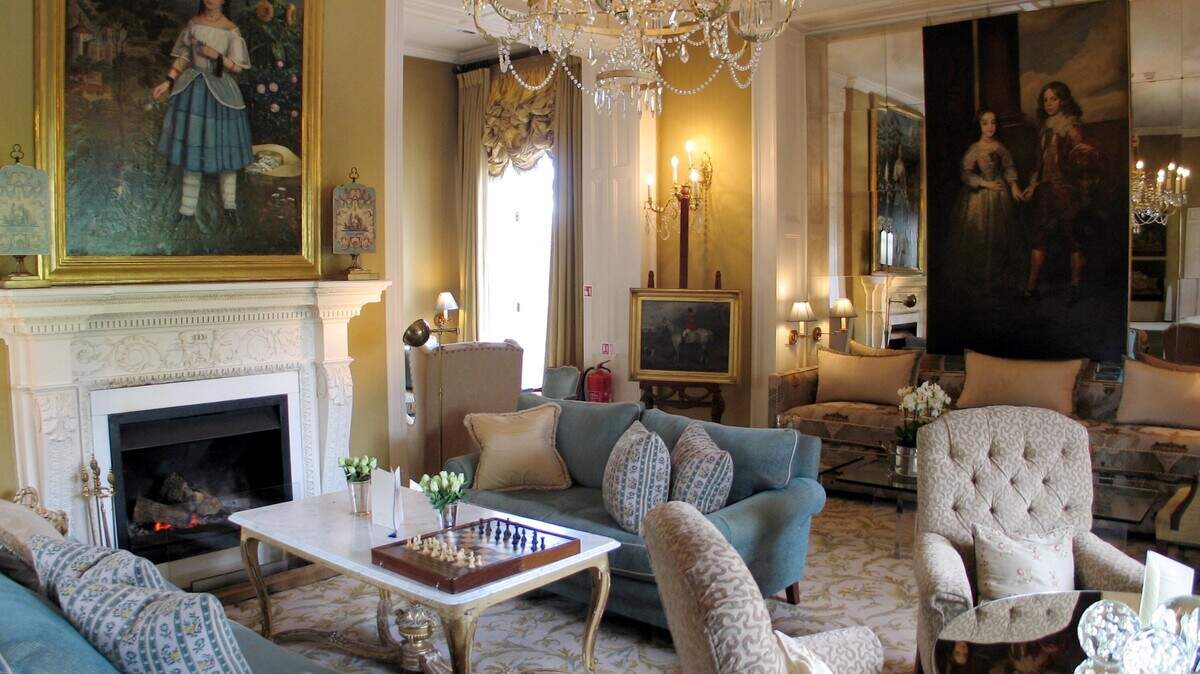
What it does have is one of the loveliest hotels I've ever stayed in. Summer Lodge, in the minuscule village of Evershot, is a country cousin of London's prestigious Red Carnation Collection — albeit a country cousin of unrivaled style and sophistication. Summer Lodge lives up to its name. I suspect that even in the middle of winter, the hotel, surrounded by an expanse of green lawn and flower gardens, would evoke that gentlest of seasons.
The New Forest
While technically not in Dorset — it's just over the county line in neighboring Hampshire — the New Forest is definitely worth a day's detour. Now a national park, the forest was created in 1079 by William the Conqueror as a royal hunting preserve, and because of its protected status — it still belongs to the Crown — areas within have remained virtually unchanged for more than 900 years.
An area of heath, bogs and woodland, the New Forest is not only saturated with history but shrouded in mystery. To create his private hunting grounds, William had to displace the local inhabitants, and you know what they say about karma. William certainly found out: Two of his sons met their deaths in the forest — Richard, who was mauled by a stag, and William Rufus, who was shot with an arrow in a suspicious hunting "accident."
Today's visitors will find a decidedly less lethal atmosphere, although they do have to watch out for adders, Britain's only poisonous snakes (easily recognizable by the zigzag pattern running the length of their bodies). Not to worry: You are much more likely to encounter the friendly New Forest ponies than the unfriendly adders. The ponies — 4,000 of them — are allowed to roam freely throughout the forest to the delight of visitors, who come to hike, cycle, visit the impressive National Motor Museum in Beaulieu, and stop for cream tea in the sunlit garden of the Montagu Arms Hotel.
It's impossible in one article to do justice to the wealth of treasures that await in Dorset. I haven't even touched on Abbotsbury Subtropical Gardens near Weymouth, where blood-red Himalayan rhododendrons, exotic Chusan palm trees, golden mimosa blossoms and banana trees create a riot of color that changes with every season. Neither have I mentioned Corfe Castle, reduced to ruins by Oliver Cromwell during the English Civil War, and I haven't talked at all about badger-watching in Buckland Newton; crab fishing at Mudeford Quay; climbing to the top of Golden Cap; the highest sea cliff in southern England; or walking along Chesil Beach, one of the finest barrier beaches in the world.
All the more reason for you to go and see for yourself why Dorset is so special.
This story was originally published September 19, 2010 at 12:00 AM with the headline "England's Dorset and Devon counties: geological, historical wonders."