
Mobile: Antebellum charm year-round, and the first Mardi Gras in America
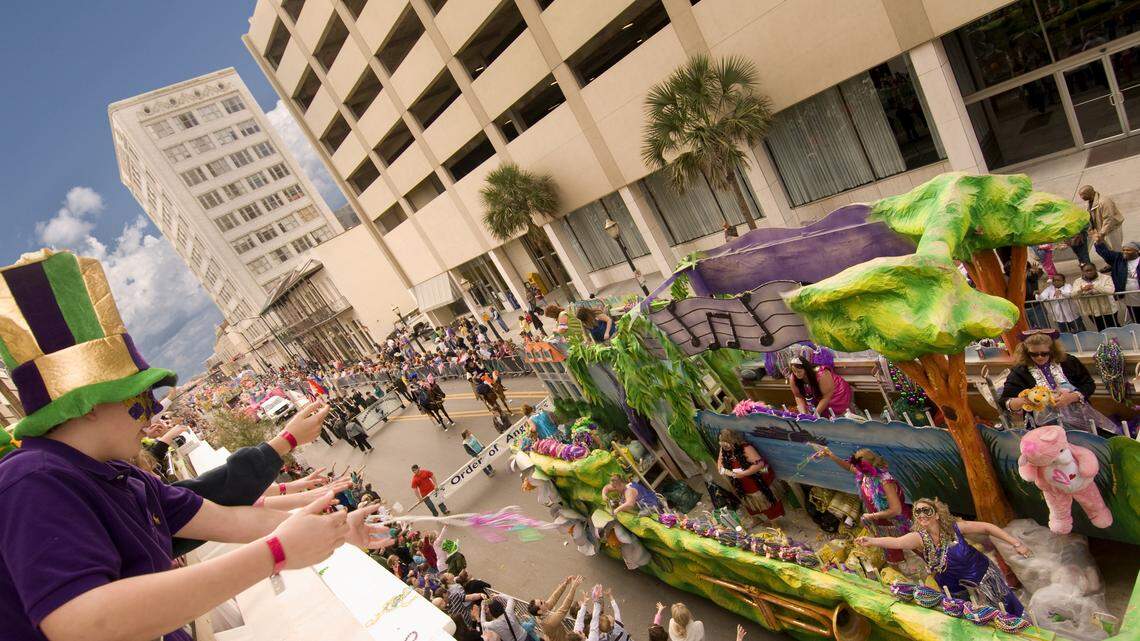
MOBILE, Ala. — After years of attending Mardi Gras celebrations in New Orleans, I've become numb to the lengths to which people will go for a strand of plastic beads. You might think that women (and men) would be more selective, giving the crowd an anatomy lesson only when the reward was commensurate with the act.
A bejeweled shoe from the Krewe of Muse or a painted coconut from Zulu — maybe. But beads? Really? There's no need to risk frostbite (this year) or sunburn (in years past). If you can't wrestle them away from small children or uncoordinated adults, just wait until the end of the day, when revelers, in danger of neck injury from the strands draped around their necks, will happily give you a few.
This Carnival season, I attended Mardi Gras in Mobile, Ala. Its slower pace made a refreshing change from the ribald revelry in the Big Easy. Crowds were smaller; parade-goers shared their beads — and Moon Pies, Mobile's unofficial Mardi Gras emblem. Best of all, everyone kept his/her clothes on.
It might come as a surprise to many that it was Mobile, not New Orleans, where Mardi Gras originated, dating to 1703, although it wasn't until 1711 that the first parade rolled. "Parade" may be a bit misleading; in the early years, Carnival was sedate, emphasizing feasting on the fatted calf (le boeuf gras) before the advent of the Lenten season on Ash Wednesday.
That changed in 1831, when a group of overly stimulated young men, calling themselves the Cowbellians, took to the streets on New Year's Day with cowbells, hoes and rakes, banging on everything in sight.
The story goes that dignified Mobilians were less than pleased with the raucous symphony, and the lads were "invited" to take their celebration some place where the citizenry appreciated that kind of tomfoolery — namely, New Orleans, some 140 miles to the west. They did that, with a few of the Cowbellians making up the core of that city's first Carnival organization, the Mystick Krewe of Comus.
Back in Mobile, Carnival continued on a more low-key note, with grand balls being held throughout the season. The Civil War put a stop to the festivities, but in 1867 a man named Joe Cain revived them when he and six of his fellow Confederate veterans decorated a wagon and took to the streets.
King Felix III is the official monarch of Mardi Gras, but it's Cain who captured the hearts of Mobilians. Joe Cain Day, celebrated on the Sunday before Mardi Gras, features the largest of the city's 35 parades, the "People's Parade."
In a tableau within a tableau, a Mobile resident portrays Cain portraying his alter ego, Chief Slacabamorinico, a Chickasaw warrior. Got that? The feathered and beaded Chief Slaca, aka Joe Cain, is accompanied by his mistresses, fetchingly clad in red dresses and veils, and his widows, who toss black roses and beads to the crowds and verbal insults to the mistresses.
Afterward, Cain's Merry Widows, hidden behind black veils, adjourn to his burial site at Church Street Graveyard, where they lay a wreath on his grave, all the while keening and wailing in melodramatic fashion.
If you're looking for a place to quench your thirst on Joe Cain Day, make sure you have a reservation at Café 615, where you can be served by the Champagne Angel (attired in a flowing white gown and wings) or the Bloody Mary Devil (dressed in red leotard and sparkly tail).
A traffic gridlock prevented me from catching the parade of the Mystics of Time organization, but my group did make it to the Civic Center for the presentation of the royal court, signaling the start of one of Mobile's premier Mardi Gras balls.
All too soon it was over — the dances danced; the king cakes eaten; the throws caught; and the Lenten resolutions made. The rolling of the final parade, the Order of Myths, brought Mardi Gras to a close — at least for a few months, when preparation for the 2015 season starts.
Mobile beyond Mardi Gras
Bragg Mitchell Mansion. Mobile is a city of beautiful antebellum mansions, and this one, built in 1855, is one of the most beautiful. An allée of oaks and, in spring, fiery azaleas, leads to the white-columned house, whose fine antiques and crystal chandeliers are a testament to the wealth spawned by King Cotton. (1906 Springhill Avenue. Braggmitchellmansion.com.)
DAR Richards House Museum. The iron lace balconies of this Italianate-style townhouse make it one of the most striking in Mobile's historic district. Built in 1860 by a sea captain from Maine to please his wife, an Alabama belle, it boasts mantels carved from Carrara marble, brass, bronze and crystal chandeliers and a magnificent cantilevered staircase. (256 North Joachim Street. Richardsdarhouse.com.)
Mobile Carnival Museum. For anyone fascinated by the intricacies of Mardi Gras, this is a must. Two floors of exquisite exhibits tell the Carnival story, from regal to raucous. Prepare to ogle the intricate handmade trains of Mardi Gras royalty that can weigh as much as 25 pounds. (355 Government Street. Mobilecarnivalmuseum.com.)
Mobile Museum of Art. The largest art museum on the Gulf Coast between New Orleans and Tampa, Fla., it has African, Asian, European and African-American galleries, although my favorite was the impressive glass collection. The museum's location in a lovely park studded with stately oaks is adjacent to the city's botanical gardens. (4850 Museum Drive. Mobilemuseumofart.com.)
5Rivers Delta Resource Center. If you're looking for a wild experience that doesn't involve fighting for beads, let Captain Michael Dorrie take you on an eco-tour of the Mobile-Tensaw Delta. The second-largest river delta in the United States and the best remaining delta ecosystem in the country, it's home to 126 species of fish, 300 species of birds (the osprey I saw on my night cruise was magnificent), 40 species of mammals, 69 species of reptiles (alligators proliferate here) and 300 species of plants. Nature lovers, this one's for you. (Spanish Fort. 5RDS.com.)
This story was originally published March 23, 2014 at 12:00 AM with the headline "Mobile: Antebellum charm year-round, and the first Mardi Gras in America."