
In Provence, history is everywhere
PROVENCE, France — Many travelers to the French Riviera intent on sunshine and sensual pursuits don't realize that the Cote d'Azur may have a remarkable coastline, but it has an equally remarkable interior.
The Riviera is part of the vast department of Provence, one of the most diverse and glamorous regions in France. From Roman ruins to Romanesque architecture; from Riviera beaches to Maritime Alps; from fields of purple (fragrant lavender) to fields of gold (Van Gogh's beloved sunflowers); from sinners (the gamblers and gambolers, courtesans and con artists of the Riviera) to saints (seven Roman Catholic popes held sway in the town of Avignon during the 14th century), Provence has something for everyone.
It would indeed take A Year in Provence to experience all that this beautiful and historic region has to offer, so we are going to focus on two spots away from the glitz of the Riviera: Avignon and Aix-en-Provence.
A city fit for popes
While some may have trouble reconciling the saintly aura of Avignon with the sexy aura of the French Riviera, this historic Provençal city is just about an hour and a half from Marseille.
Avignon's main claim to fame is that for more than 100 years, from 1309 to 1423, it was home to seven Catholic popes who broke ties with Rome in a movement known as the Schism, Clement V being the first to set up shop here. Proving that popes could hold their own with the continent's royalty in lavish spending and pomp and circumstance, Avignon was the site of one of the richest courts in Europe during the 14th century.
The Palais des Papes (Palace of the Popes) hosted dignitaries, dilettantes and downright rogues who flocked here to curry favor with the Holy Father. When the seat of Catholicism returned to Rome, the palace — equivalent in size to four cathedrals — languished. Today, 24 of its rooms have been opened to the public, allowing a glimpse into the Golden Age of the world's largest Gothic palace.
After touring the palace, check out the Chapelle St. Jean, with 14th-century frescoes, as well as the nearby Petit Palais. The latter, once the archbishop's palace, contains Italian paintings dating from the 13th to the 16th centuries, most notably Botticelli's Madonna and Child.
Avignon Cathedral, better known as Notre-Dame Des Doms d'Avignon, rises majestically next to the Papal Palace. Originally built in the 12th century in Provençal Romanesque style, the cathedral was quickly overshadowed by the grandiosity of the papal digs.
Perhaps to compensate for that, various additions to Notre Dame have resulted in a clashing mix of styles, from Byzantine to Baroque. The cathedral contains the mausoleum of Pope John XXII, immortalized in Umberto Eco's novel Name of the Rose.
With its vast collection of monuments, museums, historic buildings, ancient churches and chapels, and the intact ramparts which surround the city, Avignon richly deserves its UNESCO World Heritage ranking. However, I was taken aback by the ubiquitous graffiti on the magnificently rendered buildings, and couldn't help wondering if the city fathers might have provided these would-be-artists with canvases other than 800-year-old façades.
Avignon lies on the bank of the Rhone River, and at one time you could cross it on the picturesque Pont d'Avignon. Alas, that's not possible today, as only four of the original 22 pilings remain.
You may not be able to cross the bridge, but seeing the graceful scallops of the remaining piles (one holds the tiny Romanesque/Gothic chapel of Saint-Benezet) may cause you to hum that ditty learned in nursery school:
Sur le pont d'Avignon
L'on y danse
L'on y danse
(On the bridge of Avignon
We all dance there
We all dance there.)
The 'Aix' Factor
Aix-en-Provence has frequently been referred to as the "Paris of Provence." Part of that may be attributed to its significance as a cultural and historical bastion, but part, no doubt, results from the slightly superior attitude of its residents. Even the stone lions guarding the entrances to the Boulevard Cours Mirabeau have a haughty expression.
I'm inclined to forgive them their overweening civic pride, as this city of flowers and fountains is a stunner any way you look at it. Aix (pronounced X), as it is commonly called, has been a city since Roman times, and a visible trace remains in the Thermes Sextius Spa, while Aix Cathedral occupies the site of what was once a Roman forum.
The Romans weren't the only ones to leave their architectural mark on Aix. Examples of Gothic (the cloisters at the Cathédrale Saint-Sauveur) and neoclassical (villas in the Mazarin Quarter) while at opposite ends of the design spectrum, co-exist harmoniously.
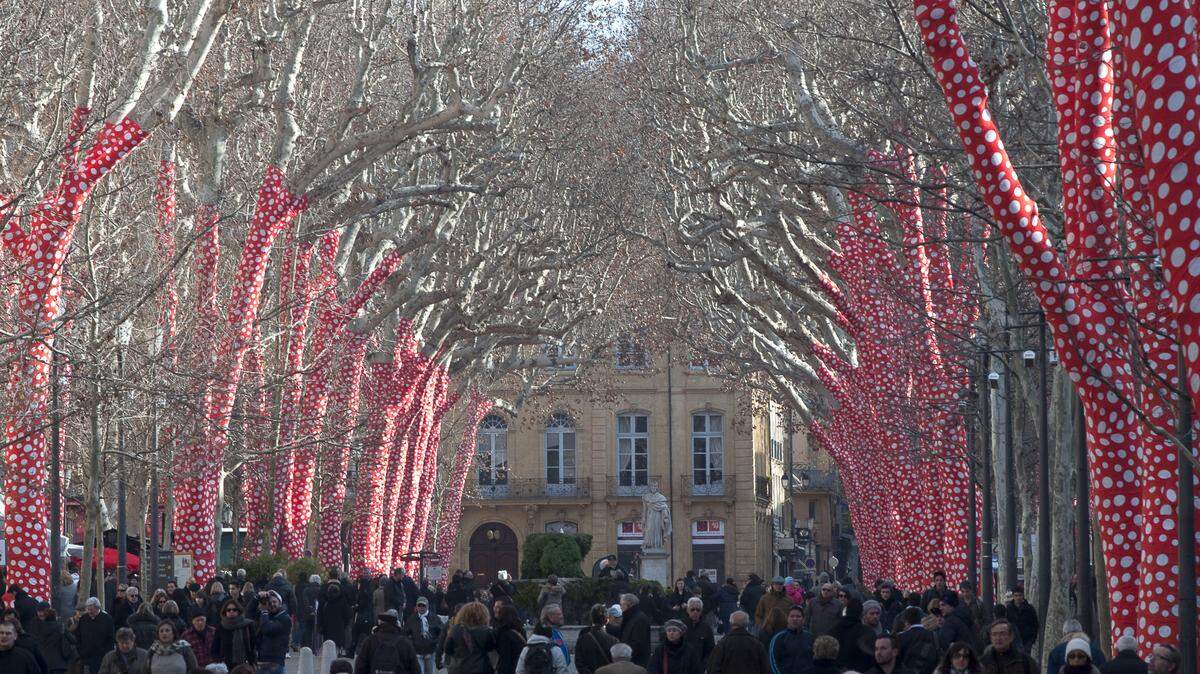
For a visitor trying to get his or her bearings, Aix is split in two by the wide expanse of the Cours Mirabeau, flanked by its stately umbrella-shaped plane trees. South of the boulevard is the newer town, while the picturesque Old Town lies to the north.
For many, the Old Town holds most of the appeal. In addition to the Cathédrale Saint-Sauveur (a must for the 15th-century triptych, The Burning Bush, a joint tribute to the Madonna and Child and Good King Rene and his wife, Jeanne de Laval), there is the Musee des Tapisseries and the Atelier de Cezanne.
The Musee, housed in a former archbishop's palace, has a series of 17th- and 18th-century tapestries lining its gilded walls. The Atelier was once the studio of native son and forerunner of Cubism, Paul Cezanne. It remains much as it was upon his death in 1906, with the artist's hat and coat still hanging on the wall. Be forewarned: it's an uphill hike, but if you love Cezanne, it's worth the sore calf muscles.
Enjoy the Old Town, but don't miss the south side of the Cours Mirabeau, particularly the colorful Quartier Mazarin. Designed and laid out in the 17th century as a neighborhood for the city's gentry, it is an area of beautiful villas and mansions, many with lacy wrought iron balconies reminiscent of New Orleans.
You can stand around and gawk or you can begin exploring some of the Mazarin's attractions. Among them is the 13th century Church of Saint-Jean-de-Malte, associated, as its name suggests, with the Knights of Malta.
The nearby Musee Granet is a treasure trove of European paintings and sculpture, featuring works by Rembrandt, Rubens and Van Dyck. A short walk from the museum is the Place des Quartre Dauphins (Plaza of the Four Dolphins) and its namesake fountain, dating from the 17th century.
In fact, you may find that your favorite activity is discovering (and counting) the beautiful fountains scattered across the entire town. It will not be an easy task as there are reputedly 1,000 of them. Start counting.
This story was originally published July 25, 2015 at 1:39 PM with the headline "In Provence, history is everywhere."