
Local baker seeks help from UK to grow all the flour he needs for his bread
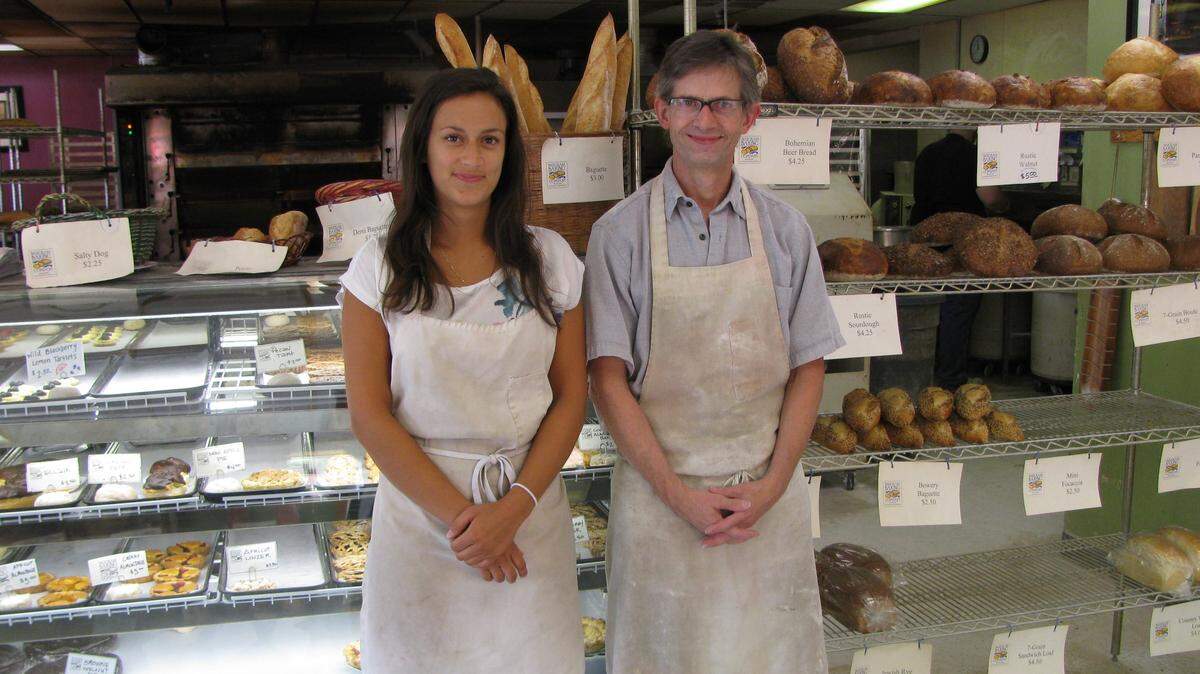
Jim Betts is owner of Bluegrass Baking Co. in Lexington. You find his breads, bagels, and other goodies all around town and chances are good that you’ve sampled some of them. He joined Tom Martin to talk about the bakery business.
Question: When and how did you get into this business?
Answer: Well, it started as a hobby. In college (Oberlin), I was part of a food co-op and my first two jobs there were dishwashing and baking bread and I went with baking bread. It’s just it’s anyone who’s baked at home knows it’s a very satisfying and relaxing activity, so it just drew me.
Q: All that kneading.
A: Yes.
Q: With a “K-N.”
A: And eventually with an N. It’s a great stress reliever and it’s one of those things that you can fit into your schedule.
Q: So, when you decided to go into business with this, how did you develop a product line?
A: A lot of that was kind of ‘what do we like to do’ and also ‘what does the public like?’ When we first opened someone would walk in and say, “Do you make this?” I said, “No, but funny you should mention that, I was planning on doing it tomorrow.” So, we’d try anything at first and then as we got a little bit more successful we started honing our product line.
Q: I think of the bakery business as being a very early morning endeavor. Is that true? Do you have to get up early in the morning?
A: Oh, yes, yes, and we’d stay up late. We basically are baking 24 hours. But, yes, if you want fresh goodies at 7 o’clock in the morning, someone’s up at 4 or 3 making those.
Q: And, are you able to hold it down to a five-day week or is it more than that?
A: Well, I don’t consider myself to be a particularly good manager, so I tend to work six to seven days a week.
Q: I put out a call on Facebook to offer some questions for you and we have one here Meg Tipton Boden. She asks: “What is your favorite bread recipe? What’s your favorite item in your bakery?”
A: My favorite bread to make is a baguette. It’s water and flour and yeast and salt. The baguette is as simple as you get and it’s all about technique. And I’d like to say the bread will rat you out. If you do it well, it shines, it glistens. The baguettes crackle when they’re done, they have a beautiful golden hue. And if they don’t work well, it’s pretty obvious — you’re pretty naked with them.
Q: The tension between making a product look really good, versus tasting good, but not necessarily looking good. If you have to go one way or the other, which way do you go?
A: We’ve always skewed toward tasting good. And the great thing about a well-made baked anything is that it looks good, even the rustic ones, even the hand-formed ones. Look at the pie that granny makes. It looks amazing when she’s serving it to you. We’re more of a rustic style bakery as opposed to a French high quality high standard look and so we tend to skew toward taste.
Q: OK. Another friend from Facebook, Debra Alexander, asks: “Is it possible to make a good gluten-free bread?”
A: No. You can approximate. You can make something that if you couldn’t eat gluten, you’d be thrilled to have. But there are huge differences.
Q: What’s the most useful tool in your shop?
A: Our oven. We have a big deck oven. If you think about a pizza oven that is massive, that’s what we have. It’s stone-floored, steam-injected, and it allows our breads to be crusty. We bake at 480 degrees and it gives a beautiful heat for breakfast pastries and the like.
Q: Have you ever encountered any unexpected challenges with owning and operating a bakery?
A: When we started the bakery, we just liked playing with breads and we thought, well, this is something we know how to do, let’s open a bakery. Probably the biggest concern with running a bakery is the running of the bakery. We can bake the stuff, but managing all the bits and pieces of what it is to be a business owner was not what I thought I was getting into when I opened the bakery.
Q: Steve Stone is asking “what is a good bread to start with and work on? Maybe sourdough?”
A: I would say sourdough is sort of a graduate level bread just because the sourdough itself is something you need to manage.
It’s very easy to make a starter at home; it just takes a lot of management. Someone says it’s like having a pet, you have to feed it, you have to take it out and exercise it every now and then. I would say a white bread, a yeasted white bread is very easy to make at home. You can make it with just the four ingredients I mentioned, you can also add all kinds of things to it.
Q: We were talking about kneading earlier; Julie Wilson wants to know how you know when to stop kneading.
A: I’m sort of a junkie about bread. Bread is very satisfying, has a great visceral feel. Pick up a loaf of bread, smell it, it just transports you to different places. Kneading, the same way. You knead, you knead, it’s kind of rugged and rough and eventually you’ll get to the point where it starts getting smooth. I say if it kind of feels and looks like a baby’s butt, you’re right in the right department.
Q: On the business-side of baking, what sorts of market dynamics and trends do you watch?
A: The whole “buy local” movement has been something that we’ve been really interested in. We watch what can we do to utilize the locally grown materials around us. We’re working with the University of Kentucky to see if we can grow some bread wheat. Kentucky has more of the pastry low-gluten type of flours, so we’re looking to see if we can work with UK Agriculture Department. And we’re probably a year or two away from being able to grow all the flour that we need for our business here in Lexington.
Other market dynamics: what do the restaurants want? What are people eating? And how does that fit in with what we want to do? We don’t want to just cave to the public demand, we want to maintain the integrity of our business design, but at the same time we want to give people what they want.
Q: OK. Another question from Facebook friend, Tanya Tyler. She asks: “what is the optimum temperature for yeast?”
A: Ah. Well, yeast likes body temperature between 80 and 100 degrees, it is very happy very active. If you’re not using it, keep it in your ‘fridge, that will keep it retarded, slow it down. So, lower temperature, 70, 80 degrees is good. It takes longer, the flavor results are excellent.
Q: What is your vision for the future of your business your bakery business?
A: Continuing with our artisanal line of goods. Artisanal basically means hand-shaped, hand-worked. It means that we’re taking the extra time to work it by hand. So, we’re going to continue with that and continue playing with local or ancient grains trying to derive a more healthy and flavorful product.
Tom Martin’s Q and A appears every two weeks in the Herald-Leader. This is an edited version of the interview. To listen to the full interview, find the podcast on Kentucky.com. A feature based on the interview also will air on WEKU-FM 88.9FM on Mondays at 7:35 a.m. during Morning Edition and at 5:45 p.m. during All Things Considered.
This story was originally published October 19, 2018 at 9:15 AM.