
Clean up in aisle four? This Nicholasville company’s robot can take care of it.
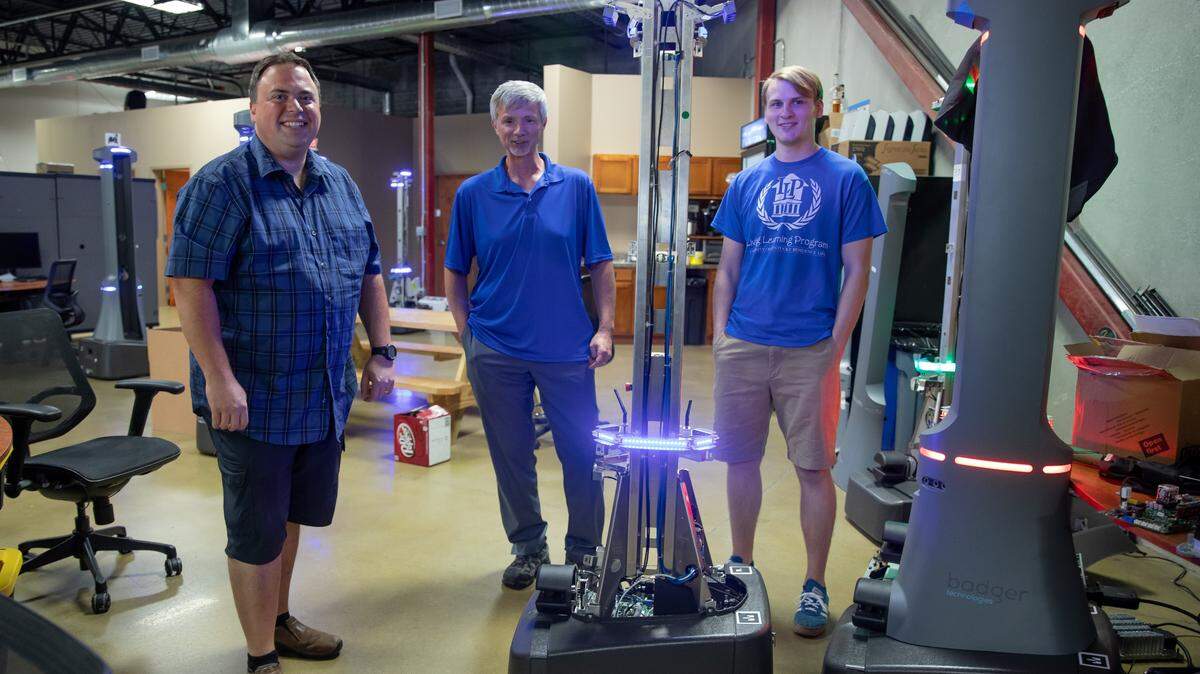
Tom Martin talks with Tim Rowland of Badger Technologies, a tech company based in Nicholasville that is bringing big changes to retail.
Tom Martin: What does Badger Technologies do, Tim?
Tim Rowland: We make robots. The robot is kind of the fun part, but fundamentally we’re trying to find a way to look into store locations and help them do their operations better.
Q: Your website says that your goal is to help retailers incorporate new technologies and embrace transformative business models. Can you elaborate on that?
A: In the past, retailers have tried a lot of technologies. There’re just some troublesome problems with helping stores run better. So, how can we leverage artificial intelligence, computer vision, robotics, kind of all the cool buzz words today? How can we bring that into that environment that will have a business impact?
Q: Another cool buzz word of the times is disruption. And I think what we’re talking about here is disruptive to the retail experience as we’ve known it, but it’s evolving. Right?
A: It sure is. We’ve made it a practice to be in these stores watching our robots. And it’s a disruption. Now, fortunately it’s a positive one, but people are some version of ‘Oh, my God, what is that in my grocery store?’ And watching those reactions have been fascinating.
Q: I want to get to those reactions and interactions in a moment, but I do know that you’ve landed a pretty good contract to provide autonomous robots to a retailer. Can you tell us about that?
A: Yes. The organization is Ahold Delhaize. Not a household word yet, but they own the companies Food Lion, Hannaford Brothers, Stop & Shop, Giant Foods and Giant Martins. So, a large company, mostly mid-Atlantic and Northeast. And they’ve been testing our product for almost a year now with great success.
Q: A video that’s been produced by the University of Kentucky shows your robot slowly going up and down the aisles of a grocery store. What do they do?
A: Two things. We have 2 models. One we refer to as Inspect, which will look for spills or products that’s fallen off shelves — anything that’s a safety hazard. And once detected, it will report that over the PA system and ask an associate to come “clean up on aisle 4 “ and make the store safer. The second version goes up and down the aisles looking for the product. Is it displayed properly? Is it stocked properly and are the price tags accurate?
Q: “A spill on aisle 4,” checking inventory, those kinds of things have required the attention of human beings. So, the implication here is that those humans would be replaced. Is that in the offing?
A: Well, that’s probably our biggest objection. What we find, however, is retailers can’t get enough workforce. A lot of these jobs are not getting done today. They’re tedious, error-prone. A best application for a repetitive robot machine is to just do mundane tasks over and over and be very consistent. So, we really do think we’re augmenting or getting to areas that retailers can’t.
Q: So, as these machines are moving around the store, of course, there are people moving around the store. What about that interaction between human and robot?
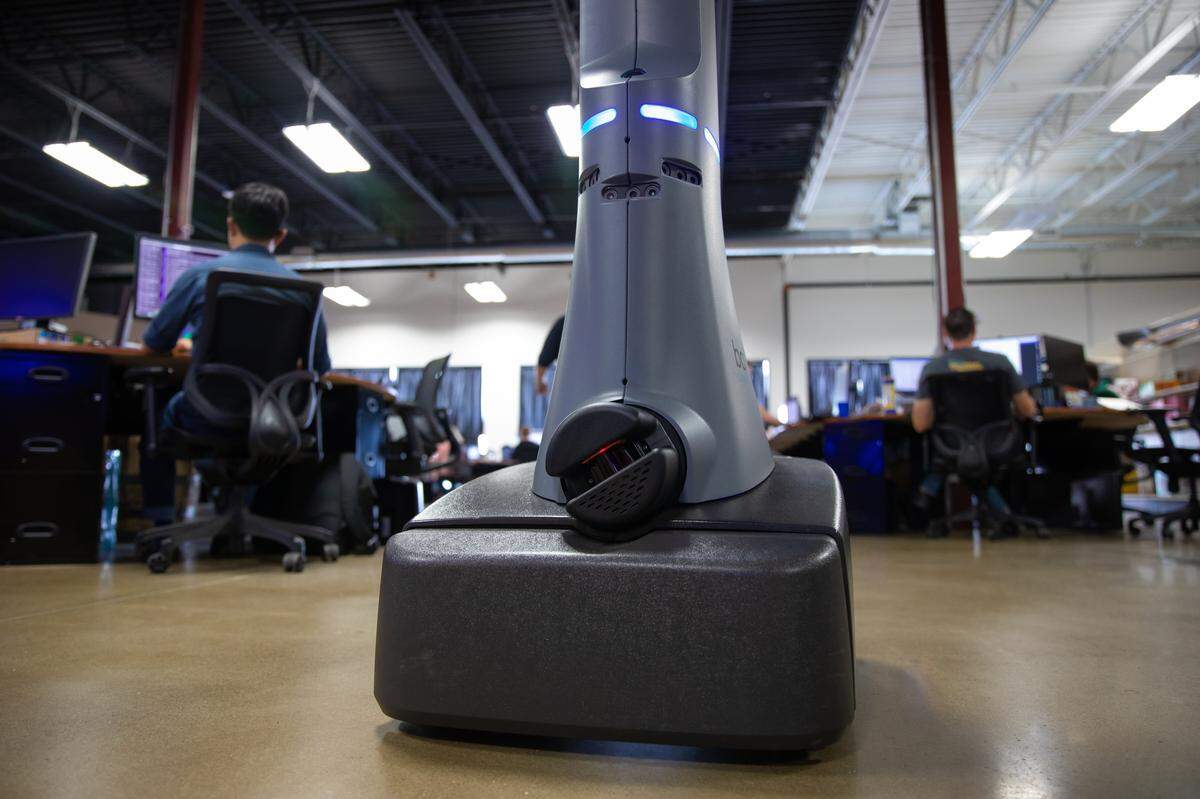
A: What a topic to think about how an autonomous robot doing its own thing running around with the real life or “out in the wild,” as we like to call it. We have purposely had so many safety measures put in our machine that it will stop, it will wait for the shopper, it will pause-pause. Eventually, it will reroute itself, but we try to make sure that it’s very polite and it just slowly does its job as much as it can.
Q: As these robots moving around the store, are they collecting data? And if they are, do you provide that data to the retailer and help make sense of it?
A: Not only the data that you mention, but also imagery: trying to recognize “is that honey nut Cheerios or is that regular Cheerios?” Those images are a lot of information. Also, are the proper numbers of those product on the shelf? Is the price tag the right number? We’re collecting all that data, processing some of it right there on the robot, and then shipping that information out of the store into the cloud. We process the information and then deliver back reports or some actions that the stores need to take.
Q: Is the technology actually capable of distinguishing between those two different kinds of Cheerios?
A: Yes, it is. It’s a derivative of facial recognition.
Q: Do you incorporate artificial intelligence?
A: We do.
Q: I understand that AI, as it’s referred to, is now capable of reading and responding to human emotions. And I just wondered. Do you envision incorporating those capabilities? Do you already?
A: Not that aspect of artificial intelligence. Our version is if I show it bags of Snickers in various forms and configurations, eventually, if I show it bags of Snickers, it will recognize. So, what we call “machine learning” or “neural net technology” is part of that artificial intelligence. A lot of companies are using other versions as you mentioned. Would that be our roadmap down the road? Potentially. Sensing frustration on the part of a customer and taking a little different action on a robot would make a lot of sense. So, again, some folks, they don’t want anything in their way. Some folks are fascinated — they want to take a selfie. So, if we could determine the difference, we’d act differently.
Q: Do you plan to expand the capabilities of these robots?
A: Potentially, we do. Our next steps would be, could we help in the fresh produce area and actually help you detect that it’s time for a carton of strawberries to be turned over or put on sale and moved quicker? Can we detect freshness in your meat and seafood area? We’re looking at improving the store’s operation, eliminating waste, making them more efficient, leveraging their workforce in a better way.
Q: How many people do you employ?
A: Right now, there are 55 of us in Nicholasville.
Q: Where did you find your talent?
A: Well, a lot local and some farmed in. A lot of our employees are engineers and in computer science. We have some business degree folks. But great places to find talent are the University of Kentucky and Louisville — and a lot of us have kind of dragged in buddies from Georgia Tech and other various spots. The university community is very rich here in the bluegrass. We’re also finding unfortunately some organizations are having to downscale around us and we’re taking advantage of some great talent that’s available on the market. It’s surprising how readily we found the kind of skillsets we need.
This story was originally published December 14, 2018 at 10:37 AM.