
Solar farms face an uphill battle in Lexington. ‘Agricultural economy at risk.’
Private companies want to build solar farms in Fayette County, but they can’t.
There are no local laws prohibiting solar farms in Lexington. There are also no laws allowing them.
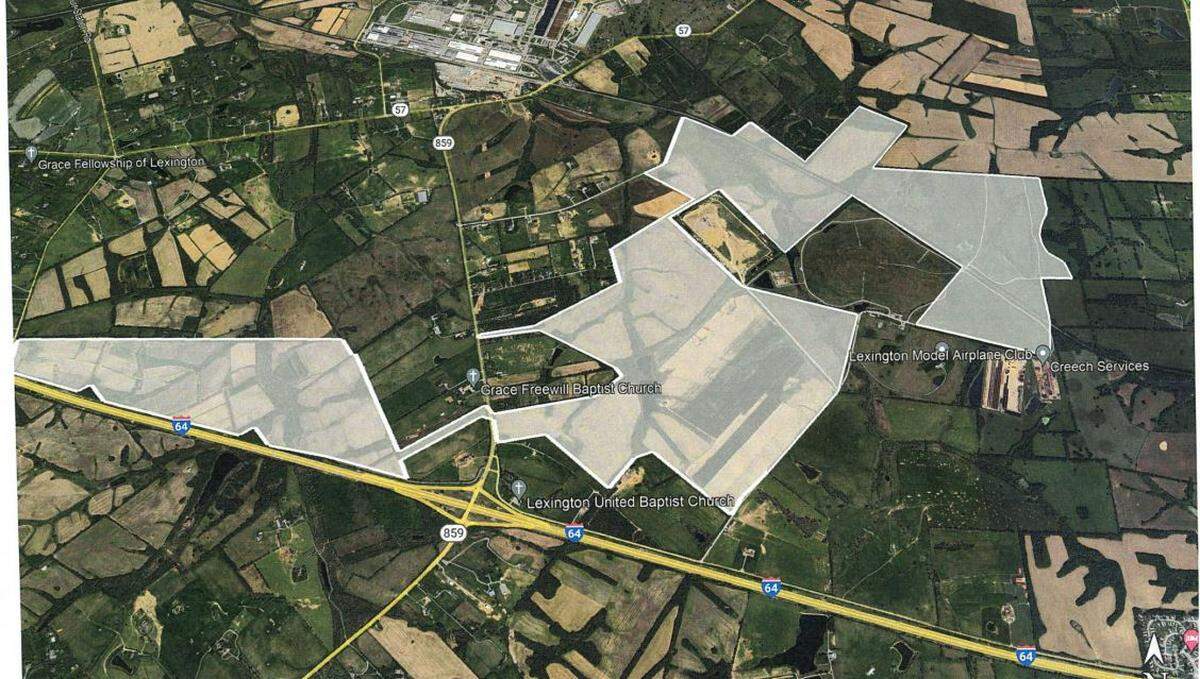
Silicon Ranch, a solar energy company based in Nashville, wants to build a 797-acre solar farm on the outskirts of town. The proposed construction site, in the Haley Road area, sits completely on Lexington’s farmland, which has historically been protected from development by zoning laws.
Silicon Ranch submitted a request to create a new section of Lexington’s zoning laws to regulate solar installations and allow for development in Fayette County’s rural areas.
That’s not sitting well with local preservationists — or Lexington’s Planning Commission.
“We’re putting our agricultural economy at risk and our identity at risk. We will begin to price out people from agriculture,” Brittany Roethemeier, Executive Director of Fayette Alliance, a local lobbying and civic education organization, told the Herald-Leader.
“When a solar company comes in and buys land, that also signals to other solar developers, ‘We can come here. We can get land for relatively cheap compared to the rest of the country,’ and it’s just a domino effect that I think is really dangerous.”
The Planning Commission recommended that the Lexington Fayette Urban County Council create an ordinance to regulate solar panel use in Fayette County, but prohibit ground-mounted solar in non-industrial zones.
Ground-mounted solar is free-standing panels anchored to the land — the type of panels used for solar farms. Other types of solar include rooftop panels and integrated panels, which are built into structures during construction.
The Planning Commission’s recommendation would stop all ground-mounted solar outside of the urban service boundary, which is the boundary between land that can be used for development and rural farmland.
Reaching net zero by 2050
Lexington aims to reach net-zero carbon emissions by 2050, but Councilmember Dave Sevigny said it’s not fair to put that burden on the city’s urban area alone.
Sevigny argued the city needs to open the rural area, which accounts for 70% of Lexington’s total land mass, to solar installations if they are serious about reaching carbon neutrality.
“How we handle this as an entire community makes a big difference in achieving this goal and as a body. If we choose to leave some options off the table, this goal will even become more difficult to achieve,” Sevigny said Tuesday at a General Government and Planning Committee meeting.
“I just refuse to allow the burden to fall on one group alone. We have to create and fund policies and guidelines to allow for investment to happen in a more organic and supportive way throughout the entire county.”
Even if the power generated from the solar energy systems isn’t distributed in Fayette County, the production will still offset Fayette’s carbon footprint, Sevigny said. More clean solar energy in Kentucky means there is less need for energy generation that relies on fossil fuels.
Sevigny and Councilmember Liz Sheehan co-sponsored amendments to the Planning Commission’s recommendations that would allow ground-mounted solar in the agricultural zones of Fayette County.
The amendments did not pass the committee. Sevigny and Sheehan can pursue amendments when the ordinance is presented at the council work session August 19.
Sevigny told the Herald-Leader he and Sheehan will still push for changes to the Planning Commission’s proposal, which passed at the committee Tuesday.
What governance does Lexington currently have for solar panels?
Local regulations are largely nonexistent on solar, Lexington Principal Planner Daniel Crum told the Herald-Leader. In zoning laws, which regulate what can go where in the city, there is “a single throwaway line” regulating the height of roof-mounted panels.
“That’s the only reference in the entire 300 or so pages of the zoning ordinance,” Crum said.
The Board of Adjustment, which handles zoning issues on a case-by-case basis, has permitted the installation of solar panels for industrial use in industrial zones.
But it has not approved free-standing solar panels on county farmland, as private companies want to pursue.
Regulating solar on farmland
The main difference between the Planning Commission’s recommended ordinance and the version Sevigny and Sheehan worked on lies within the agricultural zones.
The Planning Commission does not want to allow any kind of ground-mounted solar outside of the urban area, for now.
Crum said the commission did not feel comfortable putting forward regulations on the rural part of Lexington without proper time to study and better understand how the installations should be regulated.
By law, the commission had six months to respond to Silicon Ranch’s request for a zoning ordinance text amendment.
“I believe the planning commission made the correct decision on the ag-area, that it needs more study and certainly a more comprehensive look to see if it’s advisable in the agricultural area,” Keith Horn said, Commissioner of Planning and Preservation.
“If it is, are there particular areas of the county there may be less prime farmland? Areas that might lend itself better to that in the ag-area than just opening it up generally to any farm in the agricultural zone?”
Sevigny said it is important for the city to put pen to paper and have some guidelines for how solar can and can’t be implemented in the rural parts of the county.
That will at least set a precedent for regulations on public utility companies that want to put solar farms in Lexington. Public companies are not subject to local laws like private companies are.
Public utilities answer to the state’s Public Service Commission. While that commission doesn’t have to take into account local law, Sevigny said having an ordinance will at least give the council “legal leg to stand on” in case of future appeals.
Legislation passed by the council would regulate private companies, like Silicon Ranch, and private citizens.
Solar installations designated as conditional uses
The changes proposed by Sevigny and Sheehan would allow large-scale solar, defined in the amended ordinance as anything larger than 10 acres, in agricultural zones as conditional uses.
That means any project proposed larger than 10 acres would need to apply for a conditional use permit that has to be approved by the city Board of Adjustment, which handles zoning issues.
Crum said installations are designated as conditional uses when they may or may not be appropriate in a specific zone.
The application process gives the Board of Adjustment final say on what developments are approved.
The proposed changes would also allow intermediate scale, which is between 2,500 square feet and 10 acres, and small scale, less than 2,500 square feet, ground-mounted systems in the agricultural zones as accessory uses.
An accessory-use designation would mean ground-mounted solar installed in those zones would not require additional approval from the Board of Adjustment.
All ground installations in the agricultural zone would require a minimum 85% vegetative coverage underneath the solar panels. The amended ordinance would also cap solar farms at 2% of the rural land, meaning only around 2,600 acres could be used for solar installations.
That 2% limit would also include public utility solar farms.
They also proposed to allow intermediate-scale ground installations in medium and high-density residential zones, which are typically apartments or townhomes.
Councilmember Hil Boone, who represents Fayette County’s rural area, told the Herald-Leader he supported solar and it should be used to offset some of Lexington’s carbon footprint, but not on Lexington’s prime farmland.
He said it’s not passing his “smell test.”
“The farms we have around here are part of the agricultural economy that we have and what we stand for as a community. Whether it’s horse farms, cow farms, crop farms — all need a place and home to go to. So if you’re taking thousands of acres away from that, you’re kind of cutting into our identity,” he said.
“If it’s not helping housing or some sort of blatantly community problem that we have, I’m not sure it’s making much sense.”
He said solar farms are industrial projects that shouldn’t be designated as agriculture because they have grass or a few grazing livestock on property.
Who is Silicon Ranch?
Silicon Ranch has more than 180 energy projects in 15 states across the country. They own each of their projects, rather than leasing land.
They opened a 520-acre solar farm in Garrard County in 2023. That project has 151,296 solar panels and feeds around 700 sheep.
Rob Hamilton, director of corporate communications for Silicon Ranch, said their land management practices maintain the soil of the land they use.
“We develop these projects through our regenerative energy agribusiness. We develop them so that they’re built to last over a 40-year life cycle ... We track and measure the impacts to the soil and the benefits that regenerative grazing has on our solar projects,” he said in an interview.
The Fayette County Farm Bureau is not convinced.
In a press release, the organization said the risk of degradation heavily out weighs potential benefits.
“We farm in the Inner Bluegrass region of the state with some of the most fertile and productive soils in the country. The infrastructure needed to support the panel arrays will permanently alter and destroy the productive soils beneath them,” the statement said.
“Power transmission infrastructure is ubiquitous in the state, and there are many other sites with the requisite substation and no potential to damage important and productive soils.”
Hamilton said Silicon Ranch’s land management practices keep the land underneath the solar panels healthy enough for “other agricultural uses” if the site is decommissioned after the 40-year life cycle.
Silicon Ranch was founded in 2011, so their projects have not hit that threshold yet.
“At the end of 40 years, our projects will either be repowered with new solar equipment or decommissioned. If a project is decommissioned, all system components will be removed, and the ground will be stabilized. All costs associated with the decommissioning process will be the responsibility of Silicon Ranch, not the community or local government,” Hamilton said in an email.
This story was originally published July 2, 2025 at 1:48 PM.