
High prices, tight supply: KY’s cattle farmers navigate tricky beef market
Even if he wasn’t making any money, Andy Bishop would still be raising cattle.
“(When) most people think about cattle production, they think, ‘Oh, you’re just raising cows, selling calves and that’s about the end of it.’ But it’s a pretty intricate business, and there are a lot of variables that go into it,” he said.
“I say I work off the farm to support my farming habit. But for me, it’s a way of life.”
Bishop has run a 70-head cow-calf operation in unincorporated Coxs Creek, Kentucky, since 2007. There in Nelson County, he keeps a herd of cows to produce calves he then sells. He spends most days in Danville as an agriculture banker where he’s helping others navigate the volatile beef industry.
He’s one of many farmers across the commonwealth, the largest cattle-producing state east of the Mississippi River, who know well the ups and downs of beef production.
Kentucky is home to more than 38,000 beef farmers raising over 2 million cattle and calves, according to the Kentucky Beef Council. In 2024, gross receipts from cattle production totaled more than $1 billion, putting it among the state’s top five commodities, according to the Kentucky Department of Agriculture.
But the beef market is experiencing historically high prices as the result of strong demand and tight supply brought on by drought and other market conditions, said Kenny Burdine, an agriculture economics extension professor at the University of Kentucky.
Smaller herds are limiting how many cows at the end of their productive lives are being sold while a strong market of calves encourages farmers to keep cows for longer, which also is limiting supply, he said.
Those high prices are hurting consumers at the check-out lane and aren’t trickling down to the thousands of Kentucky farmers making sure product lands on shelves.
“Just because beef is expensive in the store doesn’t mean that that trickles down to the farmer himself,” Bishop said. “There are a lot of factors that go into that, but that money doesn’t always mean that the farmer is getting wealthy or making a lot of money.”
The market continues to be cost prohibitive for entry compared to just a few decades ago, especially for those who aren’t picking up where their fathers left off.
“But to me, the future of cattle in the state of Kentucky is bright,” Bishop said. “I think that you’re going to see maybe less cattle producers, but larger farming operations. So in other words, the people that are in the business and coming into the business would expand their operation while some of the smaller ones that are exiting don’t get replaced.”
Price of beef continues to increase for consumers
Beef in all cuts, grounds and types is more expensive in grocery stores for everyday consumers.
The national average of price per pound of lean ground beef was up almost 15% year-over-year at $7.95 in July, according to the Bureau of Labor Statistics. More quality cuts of beef, boneless sirloins and round steaks, have also increased in average price across the country.
The price of ground beef has been noticed by consumers, likely because it’s more versatile than other beef products, said University of Kentucky meat science professor Gregg Rentfrow.
Since President Donald Trump’s second inauguration in January, the Herald-Leader has kept track of prices of the same 26 items at the same three Lexington area grocery stores to see if he’s keeping his promise to lower grocery prices.
On our shopping list is the price per-pound of store-brand ground beef from Kroger, Meijer and Publix. At the start of the year, the average price per pound of ground beef was $5.24. In September, the average price had increased almost 50%, or by $2.61, to an average $7.85 per pound.
The average price per pound of a package of store-brand chicken breast has stayed relatively similar throughout the year at Lexington grocery stores after it went down to an average $4.62 per pound in September from January’s average of $6.34 per pound.
A 16-ounce package of Oscar Mayer bacon has also been in our shopping cart this year. In January, the average price was $7.94 across Lexington grocery stores, increased by $1 in the months of March, April and May and then decreased to an average price of $8.62 in September.
“Beef is not our No. 1 animal protein source that we eat in this country. Chicken is, but we’re still considered a beef-eating country,” Rentfrow said. “When we go out on a special occasion, it’s a steak dinner. When we go out to celebrate, it’s a steak dinner. When you get together as friends, it’s a steak dinner.”
Restaurants as part of supply chain not unaffected
Lexington’s Blue Door Smokehouse owner Jeff Newman said last summer the barbecue restaurant increased its prices but hasn’t since.
“I don’t think it’s going to come as a shock to anybody to see rising prices,” he said. “It definitely comes as a, maybe not a shock that prices are up, but a shock that now you have to pay those prices if you want to get the same products that you got in the past.”
He said demand for brisket sandwiches has remained about the same despite the $7.50 sandwich price tag and $15 plate.
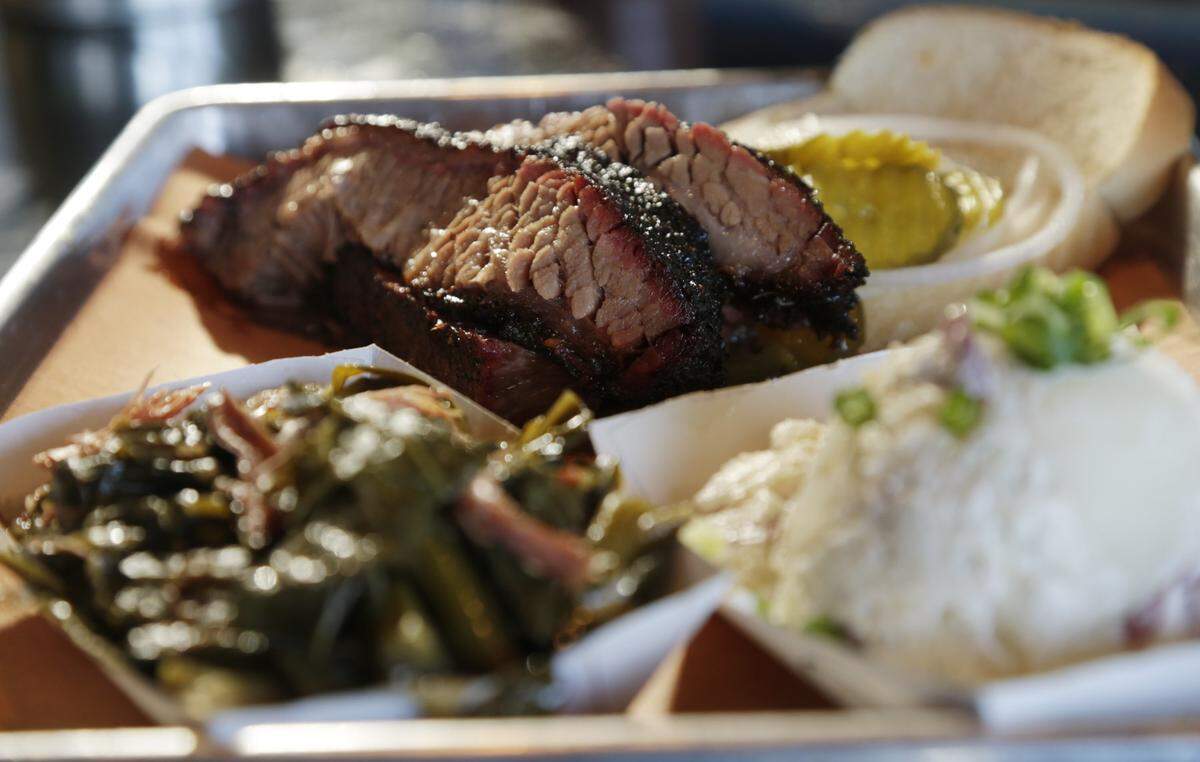
Newman said there’s a balance to pricing food at restaurants, a business he’s been in since before opening Blue Door in 2013. He wants to serve as many people as possible at low prices, and to make up for slim profit margins, he tries to increase the volume of sales.
For brisket, Newman’s most expensive purchase, he said he’s established rebate programs with his longtime suppliers.
If he can promise to make a purchase for a certain number of cases over a set number of weeks based on order history and sales from the previous year, Newman and the supplier agree on a price usually lower than what may have been originally advertised.
“Our supplier and their supplier both, they find value in giving us a little bit of a price decrease because we do purchase so much, and they know we’re consistently purchasing that much,” he said.
Direct-to-consumer interaction
That kind of direct-to-consumer participation in the supply chain is what another cattle farmer said is the only way he’s able to make money right now.
With his wife Danielle, Daniel Hayden operates his more than 40-year-old family farm in eastern Daviess and northern Ohio counties. He manages about 160 cow-calf pairs in addition to production bulls and some commercial poultry.
Hayden said to maintain his customer base, made up of local “small batch” buyers and those who buy freezer beef, a bulk purchase of a whole or half of a cow kept cold for later use, he would need to “increase my prices astronomically to mirror what the market prices have done.
“I will lose customers,” he said.
“But I want to keep my customer base for when the market’s coming down because historically, direct-to-consumer marketing just hand over fist strengthens your margins, because you’re cutting two to three sections out of the system.”
Rentfrow, the UK meat science professor, worked as a grocery store meat cutter before teaching.
He said the profit margins of grocery retailers are also quite slim because so many up and down the supply chain need to make money: the farmer, meat processor, trucking company, warehouse, grocery store and its employees.
Another complication to the market, especially right now after a year of drought conditions, is that it takes a long time for cows to mature compared to chickens and pigs. When there’s no water for grass to feed cows, it takes even longer.
“The guys that have cows, actual mama cows, on cow-calf operations are essentially in the driver’s seat,” Hayden said. “For you to buy a steak from me, it takes me three years to make that steak. Our turnover is very slow. It takes a lot of planning and establishment in order to get beef to the grocery stores.”
Hayden weans his calves off their mothers at around seven months. Then, they’ll graze on grass for another three to four months before being finished at a feed lot for another four to six months, where they reach 1,500 pounds.
Other complications in market
When prices of beef start to increase, people want to enter the business, said Darrh Bullock, a University of Kentucky professor and member of the school’s beef cattle extension team specializing in genetics.
Those entering the market will replenish or build a herd, increasing supply. But when there are more cows, the price of beef slides back down and people start getting out of the business.
It’s a cycle that happened in 2014 and a lesson farmers haven’t forgotten, Bishop said.
Young farmers bought replacement heifers, young female cows that haven’t had a calf, when prices were high and supply was tight. Prices fell, and the market became saturated and those who had invested in their herd, especially those who had borrowed money to finance their expansion were wiped out.
Since then, most farmers, Bishop said, are reluctant to start putting more cows into their herd.
“We’re in a little bit of a different situation now,” he said. “I mean, prices have gotten extremely high, so in order to replenish, a farmer basically has to keep back his heifers and not sell them.”
Hayden said he’s found himself looking at his cull cows, those that are older and not producing, as sources of immediate income when necessary. It’s made his herd smaller, but he’s made $3,000 every so often on a sale.
“It is important that we have the inventory available so that when we do need to sell some, we can,” Bishop said. “We usually sell about 10% of our operation, of our cows, annually as cull cows and then replace them with new heifers.”
Once those heifers are on the farm, “you’ve got to get three calves out of her before she breaks even,” Hayden said.
That kind of timeline on top of high-input costs bought at retail price, usually on a credit loan including for land, labor, fertilizer, feed and other supplies, is also keeping supply tight.
A farm operation line of credit is a kind of short-term loan. It’s usually revolving, meaning the person or business who takes out the line of credit has access to a set pool of money that can be drawn from as needed. Like a credit card and other loans, money used must be paid back with interest.
“It’s a great time to have cows, but it’s a terrible time to get into cows,” Hayden said.
“Agriculture is pretty complex. And it’s pretty sketchy, to be honest. But you won’t find a farmer out there that’ll admit that they like to gamble, but they do it every damn day.”
.JPG)