
Horse owner, wine maker Jess Jackson dies at 81
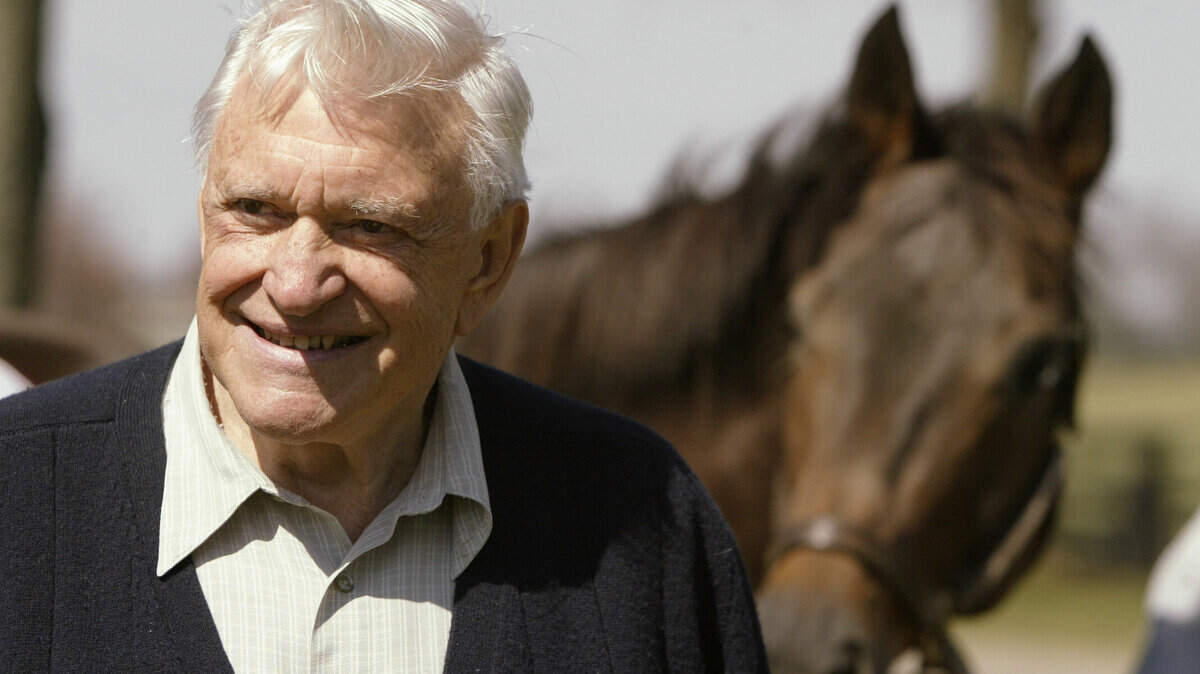
Jess Stonestreet Jackson, a titan in California wine who transferred that passion and success to Thoroughbred racing late in life, died Thursday at 81 at his home in Geyserville, Calif., after a long battle with cancer.
Mr. Jackson owned two of the biggest stars of recent racing history — Curlin, the two-time Horse of the Year who holds the North American record with more than $10.5 million in winnings, and Rachel Alexandra, the 2009 Horse of the Year who became the first filly to win the Preakness Stakes in 85 years.
Next January, Rachel Alexandra is expected to deliver a Curlin foal that could be the culmination of Mr. Jackson's success.
"I wish he could have lived to see that," said Richard A. Getty, Mr. Jackson's attorney and friend. "We all loved him and respected him. Sometimes those who seek big change are not fully appreciated when they do, but only afterward."
Getty remembered Mr. Jackson as "a great risk taker, and a good man," but said his contributions might best be measured by the fans.
"You don't realize, until you go to the races and look across the track and see the faces of the little girls waving signs for Rachel," Getty said. "It put a smile on his face. He liked to make other people happy."
A fitting epitaph for a wine maker as well as a horseman.
In five years, his Stone-street Stables, alone and with partners, won 144 races, including 32 graded stakes, more than $19 million and three Horse of the Year titles.
Founder of Kendall-Jackson Winery, Mr. Jackson was a billionaire and already well-known as the man who put California chardonnay on the wine map when he began to make a big splash in the Bluegrass.
In 2004, he began buying expensive horses at Keeneland and Fasig-Tipton sales, then bought 469-acre Buckram Oak Farm on Old Frankfort Pike for $17.4 million, renaming it Stonestreet Farms.
When Mr. Jackson dove in, he dove deep: that year alone, Jackson bought 95 horses for $21.7 million at the Keene-land November Breeding Stock Sale.
The next year, Mr. Jackson bought another 642-acre broodmare farm that was part of Frank Stronach's Adena Springs for $14.5 million for Mr. Jackson's burgeoning broodmare band. He extended his interest to active racehorses and stallions, including Ghostzapper and Awesome Again, who both stand at Adena Springs.
Stronach said simply Thursday of Mr. Jackson: "He was uncomplicated. He kept his word and he loved his horses."
That was echoed by racehorse owner George Bolton, who had a share in Curlin and co-owned with Mr. Jackson the homebred graded stakes winner Astrology.
"Behind all of the success and his famous life, he was still a lovely, fun, consistently good guy to his friends," Bolton said. "We had a great time. ... He was a crusader. He turned his business into one of the great wine businesses in the world and he took the same passion to racing. He was a force in the industry right off the bat like he was with everything else in his life."
Crusading didn't always make Mr. Jackson the toast of horse racing.
In 2005, after pouring millions into bloodstock and horse farms, Mr. Jackson became concerned about buying practices in the horse industry; he sued several who were involved in his purchases, accusing them of defrauding him by artificially inflating prices and taking kickbacks.
Bloodstock agent Emmanuel de Seroux eventually agreed to pay Mr. Jackson $3.5 million. The other suits were settled or dismissed but Mr. Jackson remained an outspoken critic of such dealings, pushing the horse business toward greater transparency.
As a result of Mr. Jackson's campaign, in 2006 Kentucky banned undisclosed "dual agency," preventing an agent from secretly working for both a horse buyer and seller.
"Jess Jackson left an indelible mark on Thoroughbred racing in a relatively short period of time. He was outspoken in his calls for a high degree of integrity in our sport and industry," said Alex Waldrop, National Thoroughbred Racing Association president and CEO.
Through it all, Mr. Jackson never lost his taste for horses, which he said stemmed from Depression-era trips to the track as a child in California.
He often told of sitting on an uncle's shoulders and watching the great racehorse Seabiscuit at Bay Meadows in 1938.
In 2007, Mr. Jackson bought into a colt, who the night before had won his first race at Gulfstream Park, and pointed him toward the Kentucky Derby. Curlin finished third at Churchill Downs but went on to win the Preakness, and came in second in the Belmont before winning the $5 million Breeders' Cup Classic.
Afterward, there was tremendous pressure on Mr. Jackson to retire Curlin to stand as a stallion.
But Mr. Jackson was adamant that the horse should keep running, that racing needed big stars like Seabiscuit again rather than one-year wonders, so he bought out his partners and pressed on.
"He put the good of the industry and the public first and economics second when he chose to run Curlin instead of putting him out to stud," family lawyer Getty said.
Curlin went on to a 4-year-old campaign that saw him win four more Grade I races, including the $6 million Dubai World Cup, before finishing fourth in the 2008 Breeders' Cup Classic in his final career start. In addition to his North American earnings record, Curlin became the first horse since Tiznow in 2000 and 2001 to repeat as Horse of the Year.
Waldrop hailed Mr. Jackson as "one of the most sporting owners of his generation (for) insisting on racing Curlin in 2008 at age 4 when there was little more to prove athletically and a financial temptation to retire him to stud," he said "What transpired was an inspiring 2008 campaign for Curlin — and yet another reminder of what Jess routinely achieved with his wonderful combination of wisdom and passion."
After the 2008 Kentucky Derby, which ended with the fatal breakdown of second-place finisher Eight Belles and the subsequent revelation that winner Big Brown raced legally on steroids, the racing industry came in for harsh public scrutiny.
Mr. Jackson and others testified before Congress about the need for uniform rules across states, including the elimination of steroids. While steroids were swiftly banned, racing is still grappling with uniformity. The day before Mr. Jackson's death, industry groups announced plans for a summit on ending the use of all race-day medication.
John Moynihan, the bloodstock agent who purchased both Curlin and Rachel Alexandra for Mr. Jackson, said that he was a visionary who saw what the sport needed to make it great again.
Mr. Jackson bought Rachel Alexandra after her record 201/4-length victory in the 2009 Kentucky Oaks and immediately made the decision to pit her against male horses. Rachel Alexandra followed up her historic Preakness Stakes win by also beating males in the Grade I Haskell Invitational and the Grade I Woodward Stakes, which ultimately secured her Horse of the Year title and helped win the sport new female fans.
"I don't think there's a lot of people who would have done that with her," Moynihan said. "When he had a good one, he had an intuitive feel for what they could do for the game in the national spotlight."
Racing peers Thursday praised Mr. Jackson for his outspokenness as well as his integrity.
"I admired his willingness to challenge the status quo. But most of all, I admired him as a person. Our sport is better because of his participation in it," said Nick Nicholson, president of Keeneland.
"When I think of Jess Jackson, I think of tenacity," said Walt Robertson, now Keeneland vice president of sales and former president of Fasig-Tipton. "He often told us as an industry not what we wanted to hear, but what we needed to hear. It takes a strong man to do that."
From Bob Evans, Churchill Downs chairman-elect and CEO: "Churchill Downs Incorporated employees across the country were deeply saddened by the news of Jess Jackson's passing. Mr. Jackson set a high standard for Thoroughbred horse ownership in the United States and abroad, and his competitive spirit made for some of horse racing's most memorable moments this century."
Before entering racing, Mr. Jackson had two successful careers — as a lawyer and then wine maker. He put himself through the University of California Berkeley's Boalt Hall law school, working as a longshoreman and as a police officer. But his heart was always elsewhere.
In 1974, he went into the wine business after buying an 80-acre pear and walnut orchard in Lakeport, Calif., that he converted to a vineyard. In 1982, he produced the first bottle under the Kendall-Jackson label. According to legend, the first 18,000 cases inadvertently ended up sweeter than most chardonnay. It turned out to be perfect for the American palette, winning the first of many medals for Kendall-Jackson.
Even in wine, Mr. Jackson was notoriously contrary, bucking the industry norm on everything from barrels to environmentally friendly production methods.
In 2009, he was inducted into the Vintner's Hall of Fame.
"Wine is a part of our cultural heritage," Mr. Jackson said at the time. "Wine celebrates friends, family, and love — all of the best things in life."
Of Kendall-Jackson, he wrote: "From day one we have been a family-owned and family-run business. It is a distinction that is rapidly becoming a rarity in our industry. Our family culture is built on the time-honored principles of hard work, integrity, and uncompromising desire for quality and the long-term stewardship of the land."
He is survived by his wife, Barbara Banke, five children: Jennifer Hartford, Laura Giron, Katie Jackson, Julia Jackson and Christopher Jackson and two grandchildren, Hailey Hartford and MacLean Hartford.
This story was originally published April 22, 2011 at 12:00 AM with the headline "Horse owner, wine maker Jess Jackson dies at 81."