
Lexington's famed Selectric typewriter turns 50
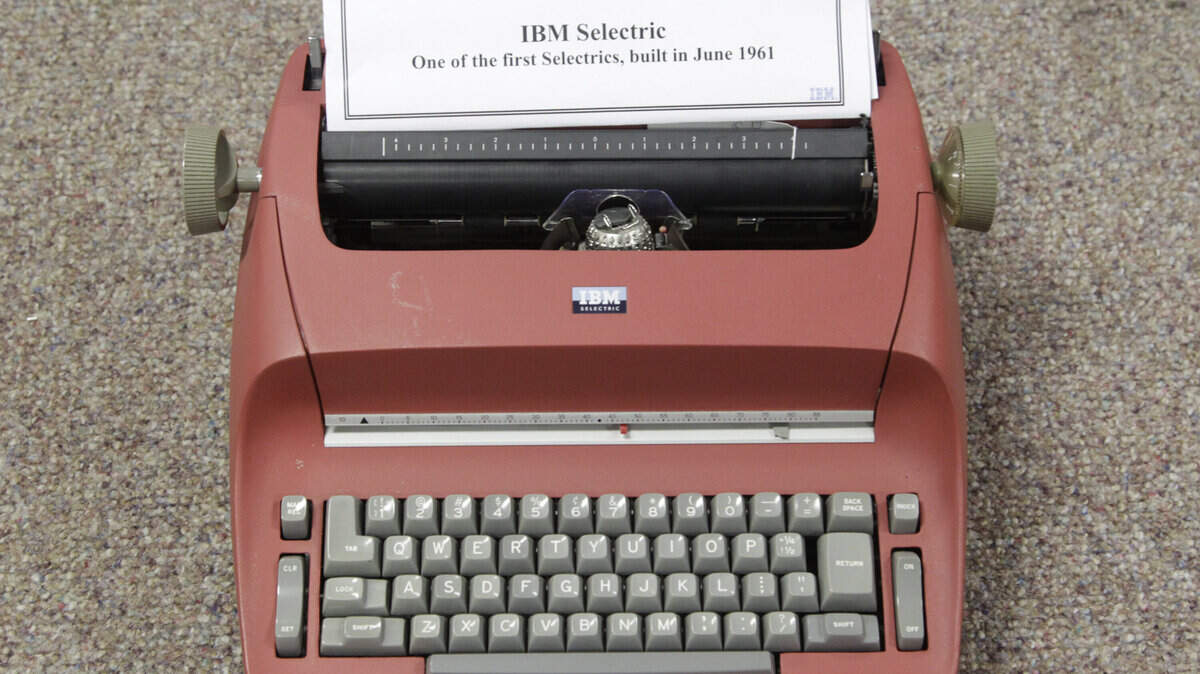
The IBM Selectric typewriter, arguably Lexington's most famous product, turns 50 on Sunday.
From what is now Lexmark International's headquarters along New Circle Road, thousands of IBM employees churned out millions of the iconic device, which became a love affair for office workers worldwide. The Selectric is considered so revolutionary that it is featured in the new "Pioneers of American Industrial Design" stamp series from the U.S. Postal Service.
"With what was going on inside that aluminum frame and all those parts, it was a small miracle it worked," said Robert Twist, who bills himself as the last typewriter salesman in the world because he oversaw the exit of IBM spinoff Lexmark from the typewriter business in 2002.
The Selectric's innovation that created such ardent fans was its ability to prevent jams. Its predecessors had characters on bars that each flipped up as the keys were struck. If you typed fast enough, you could jam the bars together.
"The Selectric just completely eliminated that issue," Twist said.
At its core was a golf ball-like sphere often called a typeball that contained all the characters, preventing the need for bars. When not in use, the ball would bob and wobble, but as the user typed — sometimes up to twice as fast as on an older-style typewriter — it spun, putting each character on the paper. Also, unlike older typewriters where a carriage moved the paper horizontally, the ball moved across the page and the paper remained still. The absence of the carriage allowed the typewriter to take up less space.
Credit for the Selectric went to Lexingtonian Horace Smart "Bud" Beattie, among others. Beattie invented the "mushroom printer," a single-element printing device that was the forerunner of the Selectric's golf ball-like device. Beattie, who lived in Lexington until his death in 1993, headed the engineering team that developed the Selectric. He was reportedly inspired to create the typeball's predecessor while changing a light bulb at his home.
In a 1986 story marking the 25th anniversary of the typewriter's debut, USA Today reported that Beattie "changed the office landscape forever." Coincidentally, 1986 was the same year the Selectric was retired; the final models came off the assembly line the next year.
Another lasting legacy of the Selectric is its keyboard, which featured keys that clicked when pressed. It essentially became a prototype for early personal computer keyboards. (Those remain so popular with some people that today, Lexington's Unicomp and its 25 or so employees on Henry Clay Boulevard create custom keyboards that mimic that clicking. The company bought the keyboard technology from Lexmark in the mid-1990s.)
"The reason it's popular is it's a much more accurate keyswitch," said President Neil Muyskens, a former IBM and Lexmark employee who was involved in the typewriter business. "You have less errors in typing."
So what kind of impact did the Selectric have? Consider this.
IBM had been in the typewriter business since the early 1930s. The company sold its 1 millionth typewriter in 1958, Twist said. In 1963, just two years after the Selectric's debut, IBM was celebrating the sale of its 2 millionth typewriter. By the time the Selectric was retired in 1986, IBM had sold 13 million of them, the company said.
The Selectric was "the Cadillac" of typewriters, Twist said, noting the price was slightly under $1,000 when he started with IBM in 1977. That made it expensive for offices to upgrade because "a thousand dollars back in 1975 was a huge amount of money."
But despite the price, "we often had a backlog because we couldn't build them fast enough. It could take three or four months to fill orders," he said.
People were willing to spend even more. Beyond the Selectric's traditional colors, which included topaz bronze and raven black, customers could pay $400 extra for a custom look.
"Every so often you would see a neon orange or neon pink typewriter going down the line," Twist recalled.
The Selectric was such an innovative product that it led to numerous competitors. Twist recalled visiting an office supply store in the early 1980s and seeing almost 30 competitive brands of typewriters. "Even Exxon got into the typewriter business for a short time," he said.
And while IBM also built typewriters in Brazil, Mexico and the Netherlands, Lexington was the hub of the industry. When the site opened in 1956, it was the first plant solely dedicated to the development and manufacturing of electric typewriters and related supplies.
When IBM spun off its information products subsidiary into Lexmark in 1991, the typewriter technology went with it.
And when Twist became the typewriter sales manager in 1998, the Selectric's legacy still loomed large. By that time, IBM had introduced a model called the Wheelwriter, which reduced the machine's parts from about 2,800 in the Selectric to just a couple of hundred.
"Our biggest competitor 12 years later was not another company but a used Selectric typewriter," said Twist, who is now Lexmark's director of business development for customer support services. "The customers would often be making the trade-off between buying a new Wheelwriter or an old rebuilt Selectric."
Today, models of the Selectric are on display at the Lexington History Museum, which has the entire IBM typewriter collection courtesy of a Lexmark donation more than a decade ago.
Museum president Jamie Millard said the Selectrics fascinate today's youth, who have grown up with computers.
"First, they're surprised you couldn't erase by backing up," he said. "And they find it incredulous that their parents and grandparents actually took a course in school about how to type.
"These kids learn to type almost before they talk."
This story was originally published July 30, 2011 at 12:00 AM with the headline "Lexington's famed Selectric typewriter turns 50."