
Tom Eblen: Lexington-Louisville economic initiative has a lot going for it
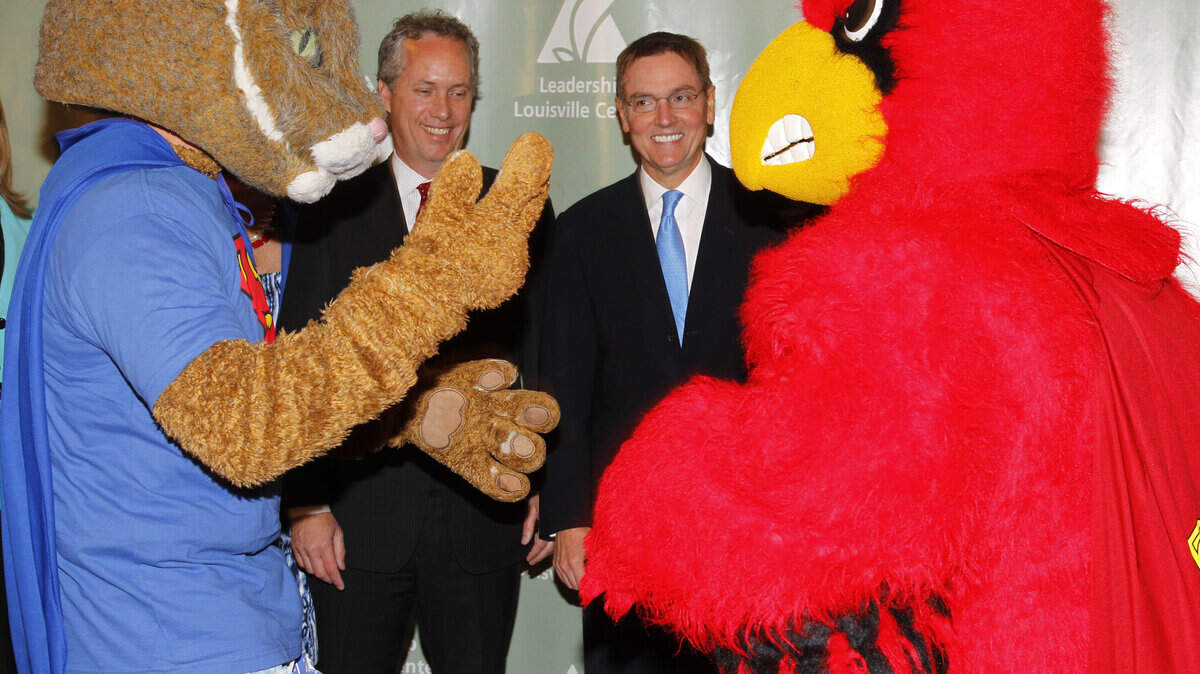
LOUISVILLE — The Bluegrass Economic Advancement Movement was announced Thursday with all the fanfare that two cities' business leaders could muster.
A furry University of Louisville cardinal mascot escorted Lexington Mayor Jim Gray to the stage of a Galt House ballroom as a furry University of Kentucky wildcat did the same for Louisville Mayor Greg Fischer. More than 1,000 people from both cities applauded, and a marching band played the Superman movie fanfare, symbolizing the goal of creating a super-region for advanced manufacturing.
The hype might have been goofy, but the ideas behind the effort and the process for achieving it could be an economic game- changer, not only for Louisville and Lexington, but for the entire state.
Brookings, the public- policy think tank, chose Lexington-Louisville as one of seven regions where it will work with business, government and educational leaders to develop a plan for regional economic development. The idea is to focus on business sectors that already are strong and have potential to become major players in international trade.
Brookings thinks regions, rather than individual cities, are the economic powerhouses of the future, especially as the world becomes more urbanized. More than half the world's population now lives in urban areas, up from 30 percent in 1950 and 2 percent in 1800. By 2030, it could be 60 percent.
Kentucky mirrors the trend. More than 55 percent of Kentuckians live in urban areas, which account for 72 percent of the gross state product of $50.5 billion a year. More than 2 million of Kentucky's 4.3 million people live in the 27 counties that make up the Louisville- Lexington region, which includes Elizabethtown. Metro Louisville accounts for 31 percent of gross state product; metro Lexington, 14.2 percent.
Fischer got the ball rolling with Brookings. A review of 11 previous economic studies quickly identified advanced manufacturing as an area for focus. Manufacturing employs 65,000 people, or 11 percent of the work force, in metro Louisville, and 30,000, or 8 percent of the work force, in metro Lexington.
The biggest manufacturing niche is the auto industry, with the Toyota assembly plant in Georgetown, two Ford assembly plants in Louisville and suppliers across the state.
Manufacturing jobs were key to creating the American middle class a century ago, and it is no coincidence that the middle class has declined as manufacturing has moved overseas. But some of that high-end manufacturing is moving back to the United States, and Kentucky has the potential to attract it, Fischer said.
"This is a can-do region with enormous assets," said Amy Liu of Brookings. "We think there's a real opportunity to succeed here."
So what could make this different from so many well-intentioned but marginally successful economic development efforts in Kentucky? Several things.
Brookings brings a level of expertise to which Kentucky has rarely had access. The institution is donating its services, valued at about $750,000. Kentuckians are providing about $250,000 in support services and expertise, which will be paid for with private donations.
Fischer and Gray — two new mayors with similar entrepreneurial backgrounds and political outlooks — are powering the initiative. Sports entrepreneur Jim Host will chair the effort. Host is one of Kentucky's most capable leaders — a drill sergeant with a strong record of getting things done in both cities. His most recent accomplishment: building the KFC Yum Center in downtown Louisville.
Host will lead a 15- to 20-member committee the mayors will appoint soon. And if the mayors are smart, two of those appointments will be the presidents of UK and U of L, which will be vital to this effort's success.
The committee will develop a specific business plan to be announced by the end of 2012. The key to execution will be forming partnerships among government, industry and education groups. The public may offer suggestions at Facebook.com/bluegrassmovement.
Beyond the goal, though, this cooperative effort could be a big deal for Kentucky. That is because Louisville and Lexington — cities only 70 miles apart but long separated by cultural differences and sports rivalries — will be working more closely than ever before.
The effort also will focus statewide attention on the economic importance of the Louisville and Lexington metro areas. After all, 40 cents of every tax dollar generated in Louisville goes to the rest of the state, as does 23 cents of every Lexington tax dollar, Host noted. When the cities succeed, the whole state benefits.
"The leverage potential this has, we don't even know," Gray said. For example, he noted, Jefferson County school board members invited Fayette County school board members to the announcement luncheon. What might a closer working relationship there lead to?
"Greg and I naturally see alliances as a big deal," he added. "And in this case, one-plus-one could add up to three, four or five. That's what all of this really represents."
This story was originally published August 15, 2011 at 12:00 AM.