
Study: Keeneland contributes almost $600 million a year to Lexington's economy
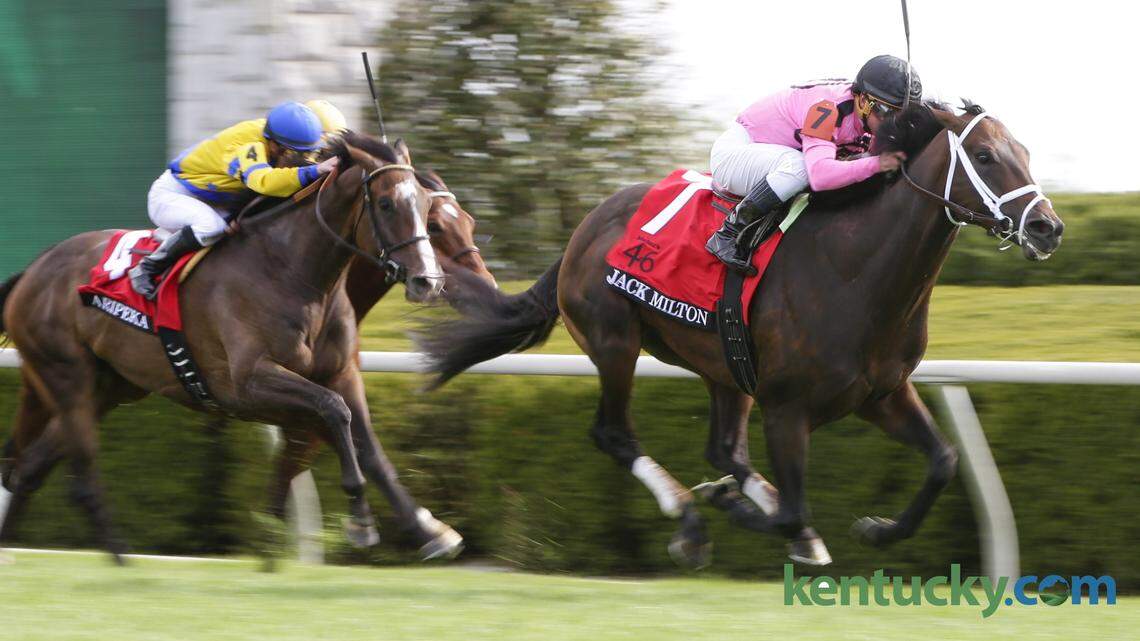
Between the boutique race meets in spring and fall and world-renowned horse sales, Keeneland has an economic impact of almost $600 million, according to a new study released Thursday.
The study, conducted by the University of Kentucky Center for Business and Economic Research, found that the racetrack brings in more than $266 million in outside spending to Fayette County in just three events: the fall race meeting and the epic September yearling and November breeding stock sales.
Coupled with the spring meet and two additional but smaller sales, the Lexington track and auction house has a projected impact of more than $590 million a year, according to study author and UK economist Chris Bollinger.
"Fayette County is a richly diverse economic climate, and Keeneland's quite unique," Bollinger said in an interview Thursday. "There's not a whole lot of other cities that have a venue like Keeneland."
Bill Thomason, president of Keeneland, said he hoped the study would illuminate the track's role in the local entertainment and business industry.
"There's a whole lot of people who count on Keeneland, for the production and breeding industry, and for what it means to Fayette County," Thomason said. "We commissioned the study to show the full balance of what Keeneland means to the community, our part in the economy. And this is only Fayette County, not even the metro area; this doesn't take into account sales of horses for surrounding counties. If you did that, it would add another couple hundred million dollars."
Thomason said he hoped the study would help people see Keeneland as "a part of the bigger economy."
The study doesn't take into account Breeders' Cup, the Thoroughbred racing championships that Keeneland will host for the first time in late October.
"Part of this is to make sure people understand the economics of what the Breeders' Cup will do for us," Thomason said. "Would we like to be in the rotation? Sure."
He said that the study wasnot aimed at a particular "ask" that the track plans to make of the city or state but that he hoped in future discussions about hotels, restaurants and other amenities for the city Keeneland would be part of the discussion.
In his study, Bollinger pointed out that, were Keeneland to vanish, it is hard to imagine what would take its place in the market, particularly because millions of dollars in horse sales are made to people outside of Fayette County, Kentucky or even the United States.
"Keeneland plays a role in facilitating the horse industry here that helps the industry tremendously," he said. "It provides (breeders) with an international market at relatively low cost. And that is crucial. Having a firm that facilitates this kind of international market access is very important, and for an agricultural product is very difficult to do."
Bollinger said he was surprised at the scope of the Thoroughbred sales and their contribution to the local economy. Because so many potential buyers are from out of state, the money they spend here with local breeders and at local businesses is what Bollinger tracked.
He found that at last year's yearling and breeding stock sale, more than $167 million in sales were of Fayette County horses to outside buyers.
Participants in the fall sales spend millions on food, beverages and hotel rooms, too, generating almost $5 million in taxes for the state and local governments.
"There's a lot of business dinners that go on here because of the sales events," Bollinger said.
Altogether, the four annual Keeneland horse auctions generate more than $228 million in direct spending and more than $390 million in total economic impact, according to Bollinger.
He said he also was surprised by how many people come to Fayette County primarily for the Keeneland racing meets. His team surveyed people every day at the fall meet — they interviewed 2,584 in all — to compile data on why they came and what they spent on wagering, hotels, food, drinks, souvenirs, gas and more.
The fall meet alone generated more than $59 million in direct economic impact and more than $99 million overall.
The spring meet, which is slightly bigger, adds $64 million more in direct impact and $102 million overall, for a combined economic impact from Keeneland racing of $123 million in direct spending and $200 million total impact.
The study didn't take into account the relatively small amount paid in sales taxes on horses. Only horses of racing age that are staying in Kentucky are taxed; young horses and breeding stock are exempt.
$390 million
in total impact from sales
$200 million
in total impact from racing
$99 million
in total impact from Fall Meet alone
$20 million
in commissions on horse sales
$9 million
on food and beverages
$6 million
on hotels for fall horse sales
$4.8 million
in local and state taxes generated by Fall Meet
$1 million
in hotel and sales taxes on food and beverages for fall sales
This story was originally published April 23, 2015 at 12:54 PM with the headline "Study: Keeneland contributes almost $600 million a year to Lexington's economy."