
Kroger CEO McMullen, a UK graduate, says success simple: Give customers what they want, cheaper
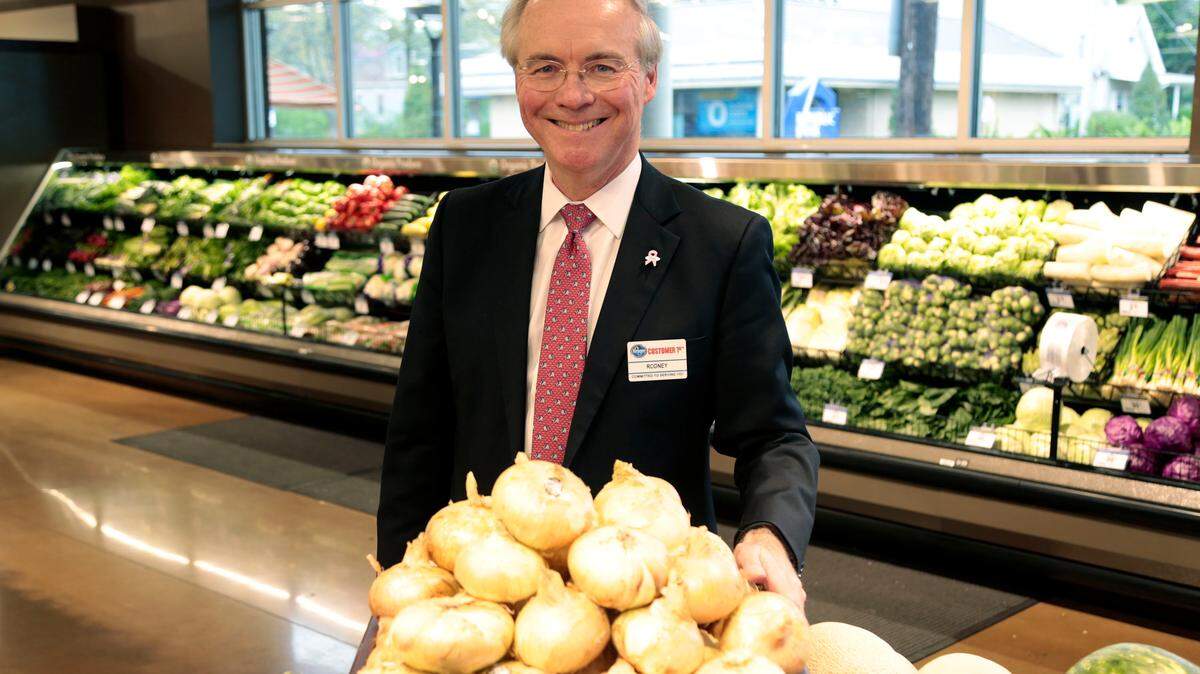
When Rodney McMullen began stocking shelves at the Eastland Shopping Center Kroger in college, he never dreamed he one day would run the company.
Today, that building houses a Sav-A-Lot, and McMullen has one of the last keys to the original store in his Cincinnati Kroger office as a reminder of those days, when he spent a lot of time working as vacation relief, covering all the jobs around the store.
The lessons from that time have stuck with him and helped him steer the $35 billion company to ever higher profits — 45 consecutive quarters — and $108 billion in sales.
McMullen, who became Kroger CEO in January 2014, was in Lexington in April to be inducted in the University of Kentucky Hall of Distinguished Alumni.
A native of Pineville, McMullen was the first person in his family to graduate from college. He identifies with the store personnel, he said.
"My personal story is so much like so many of the people at Kroger," he said. "You start out as a job, and it becomes a career. I always tell people if you like food and you like people, it's a wonderful place to be. Because you get to feed people, help them have a little bit better day. What more could you ask for?"
McMullen, 54, credits that attitude with Kroger's phenomenal rate of growth.
"Every day you have to earn customers' trust and serve their needs," he said "And the second we stop doing that, we won't like our results."
If employees deliver the shopping experience customers are looking for, they will buy more, go away happy and come back soon, he said.
McMullen considers people the most important part of the transaction equation. But another big part is price. Kroger has invested $3.5 billion in cutting prices over the past 10 years. Much of that has been done by shortening the supply chain, so fresh products like bread and milk get to your home faster.
"We went back to our manufacturing plants and figured out what changes we can make to have the product in the plant one less day," he said.
That strategy aims straight at Wal-Mart, which is the biggest retailer in the United States, with Kroger second and taking an increasing portion of the grocery pie.
Still, McMullen said he doesn't think Wal-Mart or Target sees Kroger as a threat.
"I doubt ... they are trying to develop a strategy against Kroger," he said. "I know for us, everything starts and ends with our customers and associates."
He admits his company scouts the competition, but rather than trying to imitate competitors, Kroger looks to figure out what customers want and deliver it, he said.
That helped the company come up with the new Euclid Avenue store, which is one of a kind for now but is likely to generate ideas to be incorporated in other Kroger stores.
"What we really strive to do is have each store match that trade area," McMullen said. Some aspects of Euclid Avenue's Kroger are unique, he said.
"Our folks did a wonderful job working with the local community in terms of tying in, like the murals. There's things in this store that Kroger hadn't ever done before. Look at the local food carts. The Greek restaurant and the crepes."
The Euclid Kroger has murals created by local artists on the inside and outside of the store, and cooking kiosks for Athenian Grill and Petite Creperie, both local restaurants.
"We had never, ever partnered with a local restaurant to put something in our stores. And that was something the Louisville division said, 'Let's try it,'" McMullen said. "We really like that, and I expect you'll see us do that in other places."
And the Euclid store has a large and attractive café seating area that encourages people to buy something to eat and stay to eat it there.
McMullen said he wants stores to be community gathering places and to contribute to the community. Part of that includes charitable partnerships and donations.
This year, nearly $800,000 in cash and donated goods were generated in a day for Shop and Share, first lady Jane Beshear's drive for domestic violence shelters.
Through Kroger's Community Rewards program, up to $3 million will be donated to Kentucky charities, part of $220 million in overall charitable donations of funding, food and products annually.
As well as the Euclid store is working out, McMullen said, there is always something new coming.
Next on Kroger's horizon: e-commerce, which is being tested in Cincinnati with a pilot that lets customers select and buy items online, then collect them at a store pickup window.
"Two years ago, we had zero e-commerce. Now we're rolling it out," he said. "The thing that helped us is we merged with Harris Teeter, which had a very strong click-and-collect operation, ... and we merged with a company called Vitacost — vitamins and natural foods — and that provided an infrastructure to do additional dot-com business off of, and a lot of talent."
With Kroger's emphasis on customer service and personal interaction, why move in the opposite direction?
"I think it will be one piece of the total puzzle. I don't think customers will only shop one way or the other," he said. "The customer will decide how they want to engage."
Comments from the pilot project are illuminating, McMullen said. Click and collect wins points with people who have no time to shop, such as those taking care of small children or sick parents.
"They were trying to make sure they had food in their parents' house, plus their own house," he said. "They really loved it, given what was going on in their lives."
Another winner has been organics. Sales of the company's Simple Truth line of natural foods topped $1.2 billion only 18 months after its launch.
An emphasis on local, with expanded offerings in all Kentucky stores of Kentucky Proud goods, has done well, too, McMullen said.
In the past year, Kroger scaled back or eliminated home goods merchandise, but the chain has no plans to move away from jewelry or clothing, which was introduced in Lexington last fall, he said.
"Clothing is actually a huge growth category for us," McMullen said. "It's doing very well — meaningfully better than what we expected."
As for jewelry: "My wife has jewelry from Kroger," McMullen said.
His first year running the company has not been all roses. Kroger has been the focus of a campaign by Mothers Demand Action, a group lobbying to ban the open carrying of guns inside stores. This month, the group released a new ad and renewed a call to pressure Kroger by shopping elsewhere and posting photos of receipts online. So far, the bottom line seems unaffected.
"I have not seen the new video," McMullen said. "As you know, we have customers that believe very strongly on both sides. We really don't feel we're the right person to take a position on it. We think politicians should make laws, not retailers."
But Kroger hasn't been shy about lobbying lawmakers in Kentucky and other states about laws it wants changed, including advocating for liquor and wine sales in the main grocery store rather than through a separate entrance.
That's because customers have said they want it, McMullen said.
Recently, as he roamed the Euclid Avenue store, greeting customers and associates, it was clear that he enjoyed just being there.
"It's feels like it's going back to what a grocery store was 50 years ago. When you knew your local butcher. You knew your local baker," McMullen said. "I would love for this store to be close to my house. My wife works, too. And we're always trying to figure out what's for dinner and all that. ... I would love for this store to be close to me."
This story was originally published May 3, 2015 at 4:55 PM with the headline "Kroger CEO McMullen, a UK graduate, says success simple: Give customers what they want, cheaper."