
‘They can’t let us all starve.’ These out-of-work Kentuckians can’t get unemployment.
Among the many Kentucky workers who have at least temporarily lost their jobs as a result of the new coronavirus, there are likely tens of thousands of independent contractors — hair stylists, barbers, yoga instructors, tattoo artists and personal trainers — who can’t get unemployment benefits under the current system.
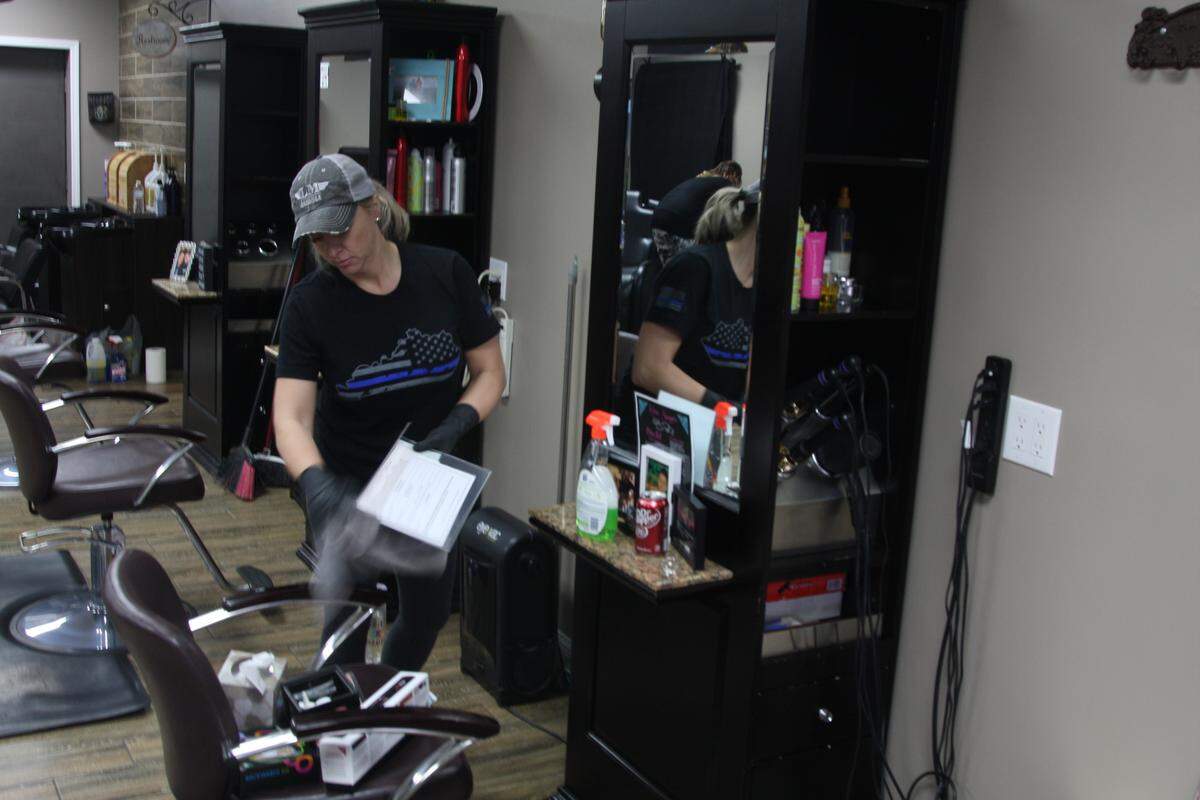
Alicia Hardwick is one of them. She and the other 11 stylists at Expressions Salon in Pikeville have been banned from working by Gov. Andy Beshear in an effort to slow the spread of COVID-19.
“Given the circumstances, I think people should be taken care of,” Hardwick said. “There’s just so many other people in the exact same boat. They can’t let us all starve.”
Beshear announced last week that he is pursuing changes to Kentucky’s unemployment insurance regulations in order to address this gap, but it remained unclear Tuesday how quickly those changes could be implemented and whether the federal government would support them.
“We are hoping that this week, maybe as early as (Tuesday), that we have better news on unemployment insurance as related to independent contractors and others,” Beshear said during a press conference Monday. “We continue to fight for this — it’s something that could be changed easily with the stroke of a pen by the president or an act of Congress , but we continue to work to find other ways to make sure that we can get there.”
Many self-employed workers and independent contractors are shut out from unemployment insurance, a system founded in the 1930s when the Great Depression left huge swaths of workers clamoring to survive amid mass layoffs.
Self-employed workers could benefit from the federal stimulus package that is being debated by the U.S. Senate, but that legislation does not currently include any provision that would allow independent contractors to receive unemployment benefits.
Kentucky is home to about 40,000 licensed cosmetologists — hair stylists, estheticians, nail technicians and others — and about 3,000 barbers, many of whom work as self-employed contractors in salons or shops where they pay rent for a station rather than work as employees.
Julie Campbell, board administrator for the Kentucky Board of Cosmetology, said upwards of 75 percent of licensed Kentucky cosmetologists work as independent contractors and would be unable to draw unemployment benefits as a result.
Along with the high percentage of independent contractors, cosmetologists are also more likely to be single mothers than workers in other fields, she said.
“Economic assistance is going to be the primary thing that these individuals need,” Campbell said.
Because hair stylists and barbers come in close contact with their customers, there is simply no way to perform their services while complying with federal and state guidelines to slow the spread of coronavirus, Campbell said.
As of Tuesday evening, the state had 163 confirmed cases of COVID-19, including four who have died.
Beshear has implemented strict orders to stop the spread of the virus, including a mandatory shutdown of all non-essential retail businesses, entertainment venues and many public-facing businesses, such as barbers, and nail and hair salons.
“We are entering what will be tougher and tougher times,” Beshear said Monday evening.
Kentucky has seen a dramatic surge in the number of unemployment insurance applicants since the outbreak of the coronavirus. On Sunday, Beshear said there have been 30 times as many applications this year as there were by this time in 2019.
Independent contractors urged to file for benefits anyway
Because many independent contractors are not technically employees of businesses that pay into the joint state-federal unemployment insurance program, they are often not eligible for benefits.
According to the U.S. Bureau of Labor Statistics, about 7 percent of the U.S. workforce were independent contractors in 2018.
In addition to independent contractors, Beshear said he hoped to make an announcement Tuesday on whether substitute teachers would be able to draw unemployment benefits.
“Everyone’s like, ‘Well, what do we do now? How do we weather the storm without any cash coming in?’” said Brian Stortzum, who owns Mid-Town Barbers in downtown Lexington. “You’re having to dip into your savings to help weather the storm, and ... the hole is just getting deeper and deeper.”
“I think you’re gonna find a lot of people that are gonna end up on the back side of this in a deeper state of poverty than they were going into it,” Stortzum said.
Some workers are misclassified by their employer as independent contractors, however, and could be eligible for benefits if a state board rules in their favor, said Brad Zoppoth, a supervising employment lawyer at The Zoppoth Law Firm in Louisville.
If a business is solely responsible for determining the worker’s hours and how the worker spends his or her time, the state board may rule that the person should be eligible for benefits, Zoppoth said.
“I would encourage everyone, even independent contractors who have been laid off, to apply, because it doesn’t cost anything to apply and the worst that they can say is ‘No,’” he said.
On Monday, Beshear announced the Team Kentucky Fund, to which people can make tax-deductible donations that will be used to help those who have been severely impacted by the COVID-19 outbreak.
‘We’re just as worthy.’
At Expressions Salon in Pikeville, four of the stylists put on gloves and began cleaning the entire shop Monday, from the walls and chairs to the teeth of every comb and brush in the store, in preparation for their extended closure.
Alicia Hardwick, who started working at Expressions about a year ago, said unemployment benefits would make a major difference in her and her fiance’s ability to make ends meet in the coming weeks.
Hardwick’s fiance works at a suboxone clinic, and is expected to keep his job during the mandatory closures of other businesses, but her loss of income will have a major impact on their security, she said.
For rural workers, Hardwick said finding a job in the businesses that remain open could be especially difficult. She’s trying to stay positive — a group message with her and some of her other coworkers helps — but Hardwick said she’s already thinking about the bills that are coming up, and they seem to come all at once.
The salon’s owner, Daph Johnson, said her husband also, at least temporarily, lost his job at CAM Mining, a coal company that issued a temporary mine closure to prevent the spread of the coronavirus.
Johnson said she was most worried for the hair stylists who are single mothers. One of the stylists who works at Expressions is a single mother of two, she said.
“People like her is the reason I really hope they open those benefits up for us,” she said. “I really hope they get that for us. We work every day, we’re just as worthy.”
This story was originally published March 24, 2020 at 11:32 AM.