Inmates at Kentucky prison with 34 COVID infections say it’s ‘like a death trap’
State inmates at the Green River Correctional Complex in Muhlenberg County say they’ve been forgotten as the novel coronavirus has ripped through their prison over the past three weeks, killing one inmate and sickening at least 19 others as well as 15 staff members.
Gov. Andy Beshear on Friday announced that a 49-year-old inmate from Green River has died after being admitted to a hospital and testing positive for the coronavirus. The man, from Jefferson County, had three years left to serve on a nine-year sentence for second-degree assault, Beshear said.
Many inmates and even some corrections officers continue to walk around the 982-bed prison without protective masks or gloves, although the virus was first detected there in late March after two employees tested positive, according to interviews with a Green River inmate and several friends and family of inmates who try to communicate daily with their loved ones.
Inmates also complain of inadequate cleaning of common areas; a reduction of meals to once a day, usually served late; failure to test people inside the complex for the coronavirus unless they are showing symptoms, such as a fever or cough; and an inability to properly segregate sick inmates from the rest of the population because of a lack of available space.
“It is absolutely heart breaking to hear a grown man cry over the phone because he is so afraid that they are just going to let them all die. Nobody in that prison has a death sentence,” said Kayleigh Watson, one of the inmates’ wives.
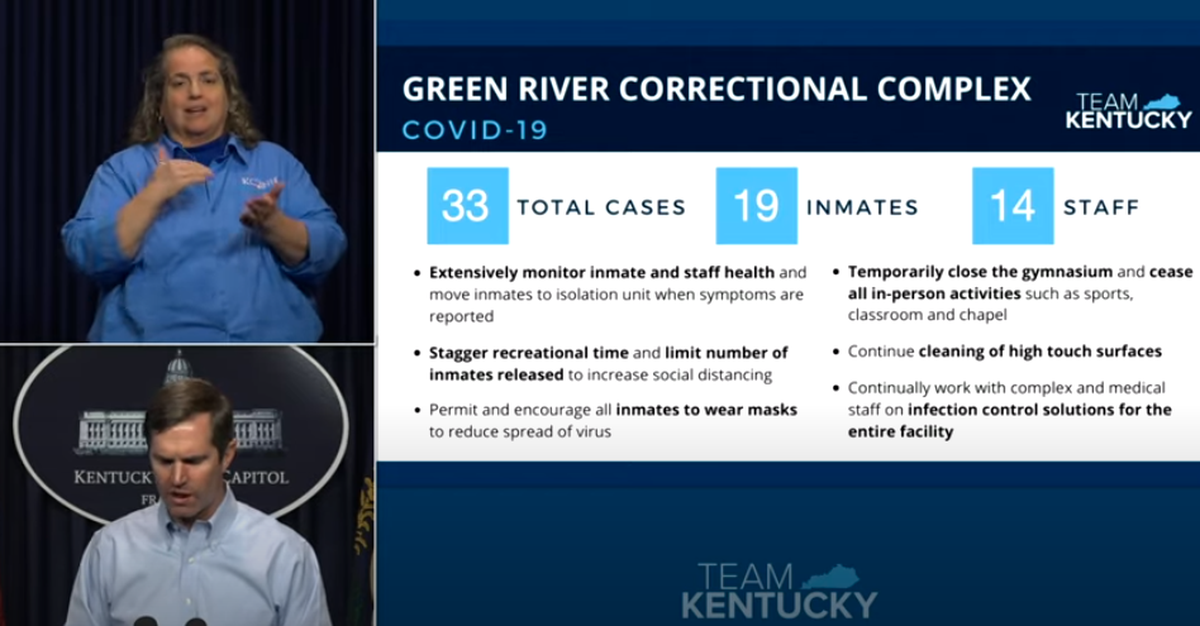
Relatives who keep in contact with inmates by phone say it’s unlikely that only 33 people in the prison have been infected, as the state reports, but the Kentucky Department of Corrections is not testing widely enough to get an accurate count.
“It’s like a death trap at this point. You have all of these men confined together in a space where the coronavirus is running rampant,” said Phoenix Shepherd, whose asthmatic husband is a Green River inmate. “People can be asymptomatic with this virus for a while, and we think some of the corrections officers are bringing it into the prison without even knowing it.”
Mekayla Breland’s fiancé is a Green River inmate. Breland said the prison initially used isolation cells to hold infected inmates apart from the general population. But as the number of infections grew — and the typical disciplinary problems that require segregation continued — the prison quickly ran out of these spaces.
At least one inmate dorm has healthy and sick men living together, she said.
“They just don’t know what to do,” Breland said. “I feel that Green River is trying their best, but they just can’t handle this.”
After this story was posted online, Gov. Andy Beshear briefly addressed the inmates’ concerns Thursday at his daily coronavirus briefing, even as he announced additional infections at the prison.
“I know the folks inside that institution are scared,” Beshear said. “This is a scary, scary virus. We’re going to do everything we can. And that’s masks, that’s sanitizer, that’s making sure we have different parts of the facility for those that are symptomatic or that we know have the virus.”
The Department of Corrections challenged parts of the inmates’ claims about the health conditions they’re facing.
▪ Cloth masks are currently being distributed to inmates and staff at all 13 state prisons, with Green River the first to receive them on April 3 and 4, said department spokeswoman Lisa Lamb. It is mandatory for staff to wear masks and “strongly encouraged” for inmates, Lamb said.
▪ Inmates still get three hot meals every day, although “meals have taken longer as we have adjusted the schedule ... Feeding is done by dormitory in small groups to allow for social distancing,” Lamb said.
▪ Infected inmates were segregated and kept apart at first, she said, but now “they are kept in their dormitory but in isolation with their cellmate if they test positive.”
▪ Testing for the coronavirus is limited, Lamb acknowledged. The Corrections Department does not automatically test for COVID-19 when an immate dies in custody, which has happened twice in the last week at the Luther Luckett Correctional Complex in La Grange. The first inmate, Gary Glass, died of a heart attack, while the second, Ronnie Lee Snow, died of “natural causes,” she said.
“To date, we have tested 44 inmates in our prisons, and we have 18 who have tested positive, all at Green River Correctional Complex. This is less than 2 percent of the prison’s total inmate population,” Lamb said. (Infection numbers within the prison continued to rise after Lamb made that statement on Wednesday.)
The state prisons have suspended inmate visitation, volunteer activities and outside programming to limit the number of people coming and going, Lamb said. Staff are screened for COVID-19 symptoms every day when they show up for work, she said.
Beshear has been slow to release state inmates during the COVID-19 pandemic even as court officials successfully shrank by one-third the local inmate population housed in jails in order to make it a smaller target for the highly infectious virus.
Beshear has signed two executive orders to free 883 state inmates convicted of low-level offenses, although it’s taking a few days to fully implement them, state prison officials say. However, Kentucky has more than 22,000 state inmates serving their felony time in the prisons and scores of local jails, many of them still packed well beyond their capacity.
“We have been calling for more sweeping action from the governor,” said Aaron Tucek, legal fellow at the ACLU of Kentucky.
“What we have seen in New York with Rikers Island and in Chicago with the Cook County jail is that any place people are incarcerated can turn into a serious hot spot for this disease,” Tucek said.
“You’ve got overcrowded rooms with little ability for people to maintain social distance or personal hygiene, no access at all to hand sanitizer because it has alcohol in it,” he said. “If we really haven’t seen an explosion in infections yet in the corrections institutions in Kentucky — and I’m skeptical about that — then we need to move right now to avoid it.”
This story was originally published April 15, 2020 at 6:38 PM.