
These KY counties rank among the worst for food insecurity. COVID-19 is hurting them.
Six Eastern Kentucky counties are among the 25 U.S. counties with the highest overall food insecurity rates, according to a new analysis by Feeding America, a national hunger relief program.
The COVID-19 pandemic is worsening an already bad situation in Bell, Harlan, Magoffin, Breathitt, Clay and Wolfe counties, where about one in four lack access to enough food for an active, healthy life for all household members. This can be a parent skipping a meal to ensure food is on the table for the family or watering down a soup to make it last longer, said Feeding Kentucky Executive Director Tamara Sandberg.
In Bell County, the Lighthouse Mission Center’s food pantry closed in April and May due to health concerns of volunteers, putting an additional burden on two others: Cooperative Christian Ministry and Henderson Settlement Kitchen. The food pantry reopened this week, but with changes to address volunteers’ concerns, according to operations director Carolyn Lawson.
Lawson said the first day of reopening was slow, but she expected business to be brisk Thursday.
“As word spreads, believe me, it’s going to pick up,” Lawson said.
The COVID-19 outbreak is making food insecurity worse across the state.
According to Feeding America’s COVID-19 impact analysis, the pandemic is projected to increase food insecurity by 35% and nearly 900,000 Kentuckians may experience food insecurity because of the economic impact of the coronavirus.
In Wolfe County, for example, the food insecurity rate is expected to jump from 24.4% in 2018 to 30.2% this year. Bell County’s rate of 24.7% is projected to climb to 30%.
Kentucky had reached its lowest levels of food insecurity in a decade in 2018, so it’s discouraging to see those rates rise again, Sandberg said.
“All this improvement is going to be wiped out because of this pandemic,” she said.
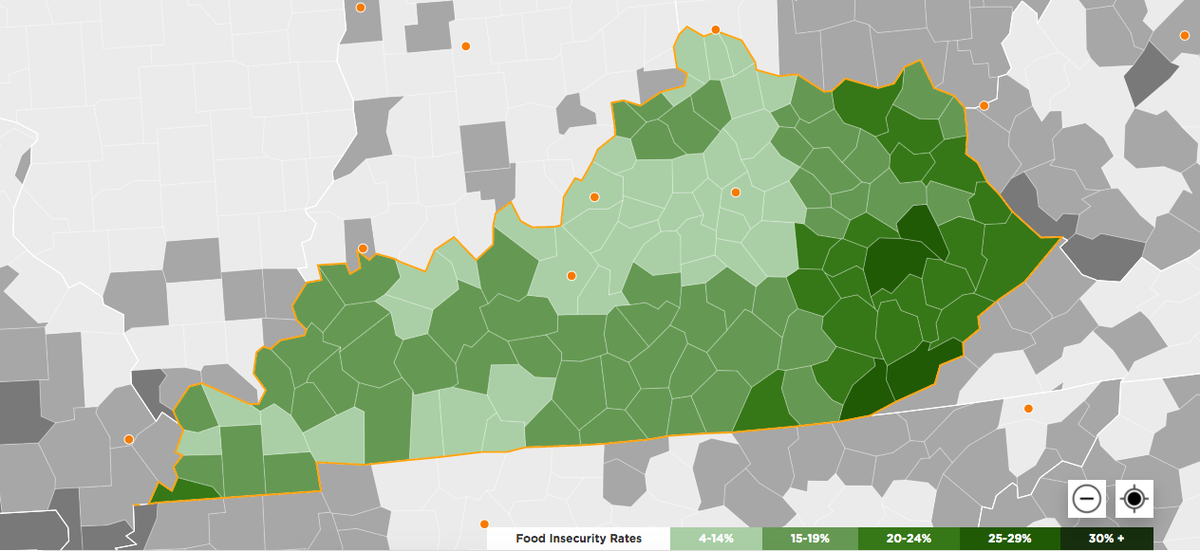
The hit is especially felt in Eastern Kentucky.
Michael Halligan, the chief executive officer with God’s Pantry Food Bank, said this region has never quite bounced back from the 2008 financial crisis, when the number of people nationally who were food insecure increased from 35.5 million to 50 million.
Food pantries that stayed open throughout the COVID-19 pandemic have adapted.
Red Bird Mission, based in Beverly, in Clay County, also serves Bell and Leslie counties.
Tracy Nolan, the mission’s community outreach director, said the mission has served the community this spring as it was hit by the pandemic, flooding and an extended power outage.
“The problem is just harder,” she said.
The mission has been close to closure, but a grant and some small donations have kept it open, Nolan said.
At Remnant Bread of Life, in Manchester, manager Sherri Day said there was a surge of people in need in March, which has been lessened by the federal stimulus check and increased food stamps.
The food pantry, though, lost its supply of workers — jail inmates on a work release program — when jails locked down to slow the spread of COVID-19. A church stepped in to help, Day said.
Day said as people return to work and get financial stability again, Remnant Bread of Life remains open to them.
“I would like them to come back and get something to eat,” Day said. “I wouldn’t want to rip the rug from under their feet.”
Halligan said God’s Pantry Food Bank, based in Lexington and serving food pantries in 50 counties in central and eastern Kentucky, has adapted “on the fly.”
The food bank aims to provide food in a dignified way by allowing people to “shop the pantry,” but this was not possible with social distancing guidelines.
The organization also saw a decrease in volunteers, many of whom are 65 and above and at a higher risk of complications from COVID-19. The National Guard stepped in and some people who were furloughed or laid off volunteered at the food bank, Halligan said.
Demand for food came fast. In the week of March 15, there was a 33% increase in God’s Pantry Food Bank service area. It has since leveled off at around 20% more than normal.
Halligan was fearful that food inventory would not keep up with demand, but the bank’s inventory is at a higher level now than at the beginning of March.
Halligan said the goal is to get that food out to the counties to “address hunger where hunger exists.”
This story was originally published June 4, 2020 at 3:40 PM.